

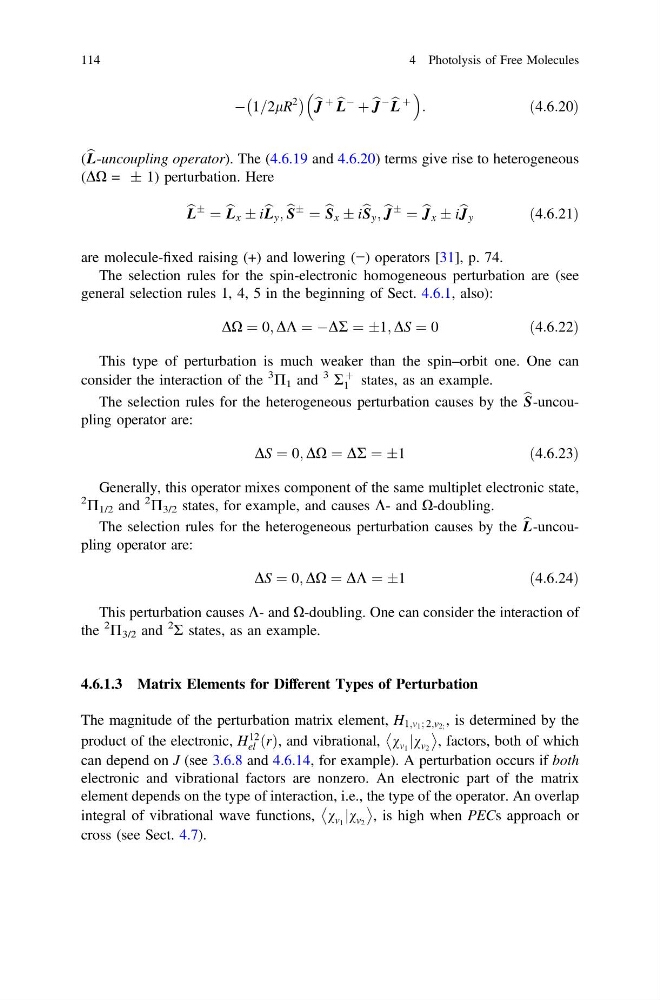
À 1=2lR
2
À
Á b J
þ b
L
À
þ b J
À b
L
þ
:
ð4:6:20Þ
( b
L-uncoupling operator). The (4.6.19 and 4.6.20) terms give rise to heterogeneous
(DX = ± 1) perturbation. Here
b
L
Æ
¼ b
L x Æ i b
L y ; b S
Æ
¼ b S x Æ i b S y ; b J
Æ
¼ b J x Æ i b J y
ð4:6:21Þ
are molecule-fixed raising (+) and lowering (−) operators [31], p. 74.
The selection rules for the spin-electronic homogeneous perturbation are (see
general selection rules 1, 4, 5 in the beginning of Sect. 4.6.1, also):
DX ¼ 0; DK ¼ ÀDR ¼ Æ1; DS ¼ 0
ð4:6:22Þ
This type of perturbation is much weaker than the spin–orbit one. One can
consider the interaction of the
3 P 1 and
3 R
þ
1 states, as an example.
The selection rules for the heterogeneous perturbation causes by the b S-uncoupling operator are:
DS ¼ 0; DX ¼ DR ¼ Æ1
ð4:6:23Þ
Generally, this operator mixes component of the same multiplet electronic state,
2 P 1/2 and
2 P 3/2 states, for example, and causes K- and X-doubling.
The selection rules for the heterogeneous perturbation causes by the b
L-uncoupling operator are:
DS ¼ 0; DX ¼ DK ¼ Æ1
ð4:6:24Þ
This perturbation causes K- and X-doubling. One can consider the interaction of
the
2 P 3/2 and
2 R states, as an example.
4.6.1.3 Matrix Elements for Different Types of Perturbation
The magnitude of the perturbation matrix element, H 1;v 1 ; 2;v 2; , is determined by the
product of the electronic, H
12
el ðrÞ, and vibrational, v v 1 jv v 2
, factors, both of which
can depend on J (see 3.6.8 and 4.6.14, for example). A perturbation occurs if both
electronic and vibrational factors are nonzero. An electronic part of the matrix
element depends on the type of interaction, i.e., the type of the operator. An overlap
integral of vibrational wave functions, v v 1 jv v 2
, is high when PECs approach or
cross (see Sect. 4.7).
114
4 Photolysis of Free Molecules
2
À
Á b J
þ b
L
À
þ b J
À b
L
þ
:
ð4:6:20Þ
( b
L-uncoupling operator). The (4.6.19 and 4.6.20) terms give rise to heterogeneous
(DX = ± 1) perturbation. Here
b
L
Æ
¼ b
L x Æ i b
L y ; b S
Æ
¼ b S x Æ i b S y ; b J
Æ
¼ b J x Æ i b J y
ð4:6:21Þ
are molecule-fixed raising (+) and lowering (−) operators [31], p. 74.
The selection rules for the spin-electronic homogeneous perturbation are (see
general selection rules 1, 4, 5 in the beginning of Sect. 4.6.1, also):
DX ¼ 0; DK ¼ ÀDR ¼ Æ1; DS ¼ 0
ð4:6:22Þ
This type of perturbation is much weaker than the spin–orbit one. One can
consider the interaction of the
3 P 1 and
3 R
þ
1 states, as an example.
The selection rules for the heterogeneous perturbation causes by the b S-uncoupling operator are:
DS ¼ 0; DX ¼ DR ¼ Æ1
ð4:6:23Þ
Generally, this operator mixes component of the same multiplet electronic state,
2 P 1/2 and
2 P 3/2 states, for example, and causes K- and X-doubling.
The selection rules for the heterogeneous perturbation causes by the b
L-uncoupling operator are:
DS ¼ 0; DX ¼ DK ¼ Æ1
ð4:6:24Þ
This perturbation causes K- and X-doubling. One can consider the interaction of
the
2 P 3/2 and
2 R states, as an example.
4.6.1.3 Matrix Elements for Different Types of Perturbation
The magnitude of the perturbation matrix element, H 1;v 1 ; 2;v 2; , is determined by the
product of the electronic, H
12
el ðrÞ, and vibrational, v v 1 jv v 2
, factors, both of which
can depend on J (see 3.6.8 and 4.6.14, for example). A perturbation occurs if both
electronic and vibrational factors are nonzero. An electronic part of the matrix
element depends on the type of interaction, i.e., the type of the operator. An overlap
integral of vibrational wave functions, v v 1 jv v 2
, is high when PECs approach or
cross (see Sect. 4.7).
114
4 Photolysis of Free Molecules