

The minimal energy gaps between adiabatic PECs occurs at the crossing point of
diabatic PECs and equal to 2H
el
12 ðrÞ. Similar results have been obtained in Sect. 3.6
(see 3.6.20).
4.6.1.2 Perturbations Between Electronic States of Different
Symmetry
The b
H SO and b
H OR operators cause the largest perturbation between the states of
different symmetry.
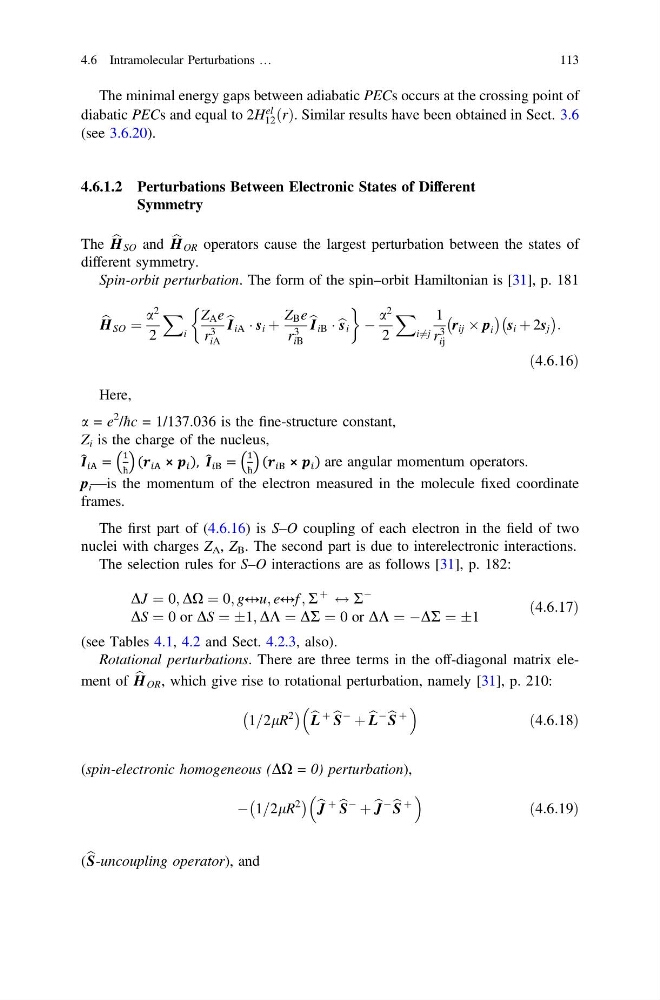
Spin-orbit perturbation. The form of the spin–orbit Hamiltonian is [31], p. 181
b
H SO ¼
a
2
2
X
i
Z A e
r
3
iA
b I iA Á s i þ
Z B e
r
3
iB
b I iB Á b s i
&
'
À
a
2
2
X
i6 ¼j
1
r
3
ij
r ij  p i
À
Á
s i þ 2s j
À
Á :
ð4:6:16Þ
Here,
a = e
2 /ħc = 1/137.036 is the fine-structure constant,
Z i is the charge of the nucleus,
are angular momentum operators.
p i —is the momentum of the electron measured in the molecule fixed coordinate
frames.
The first part of (4.6.16) is S–O coupling of each electron in the field of two
nuclei with charges Z A , Z B . The second part is due to interelectronic interactions.
The selection rules for S–O interactions are as follows [31], p. 182:
DJ ¼ 0; DX ¼ 0; g&u; e&f ; R
þ
$ R
À
DS ¼ 0 or DS ¼ Æ1; DK ¼ DR ¼ 0 or DK ¼ ÀDR ¼ Æ1
ð4:6:17Þ
(see Tables 4.1, 4.2 and Sect. 4.2.3, also).
Rotational perturbations. There are three terms in the off-diagonal matrix element of b
H OR , which give rise to rotational perturbation, namely [31], p. 210:
1=2lR
2
À
Á b
L
þ b S
À
þ b
L
À b S
þ
ð4:6:18Þ
(spin-electronic homogeneous (DX = 0) perturbation),
À 1=2lR
2
À
Á b J
þ b S
À
þ b J
À b S
þ
ð4:6:19Þ
( b S-uncoupling operator), and
4.6 Intramolecular Perturbations …
113
diabatic PECs and equal to 2H
el
12 ðrÞ. Similar results have been obtained in Sect. 3.6
(see 3.6.20).
4.6.1.2 Perturbations Between Electronic States of Different
Symmetry
The b
H SO and b
H OR operators cause the largest perturbation between the states of
different symmetry.
Spin-orbit perturbation. The form of the spin–orbit Hamiltonian is [31], p. 181
b
H SO ¼
a
2
2
X
i
Z A e
r
3
iA
b I iA Á s i þ
Z B e
r
3
iB
b I iB Á b s i
&
'
À
a
2
2
X
i6 ¼j
1
r
3
ij
r ij  p i
À
Á
s i þ 2s j
À
Á :
ð4:6:16Þ
Here,
a = e
2 /ħc = 1/137.036 is the fine-structure constant,
Z i is the charge of the nucleus,
are angular momentum operators.
p i —is the momentum of the electron measured in the molecule fixed coordinate
frames.
The first part of (4.6.16) is S–O coupling of each electron in the field of two
nuclei with charges Z A , Z B . The second part is due to interelectronic interactions.
The selection rules for S–O interactions are as follows [31], p. 182:
DJ ¼ 0; DX ¼ 0; g&u; e&f ; R
þ
$ R
À
DS ¼ 0 or DS ¼ Æ1; DK ¼ DR ¼ 0 or DK ¼ ÀDR ¼ Æ1
ð4:6:17Þ
(see Tables 4.1, 4.2 and Sect. 4.2.3, also).
Rotational perturbations. There are three terms in the off-diagonal matrix element of b
H OR , which give rise to rotational perturbation, namely [31], p. 210:
1=2lR
2
À
Á b
L
þ b S
À
þ b
L
À b S
þ
ð4:6:18Þ
(spin-electronic homogeneous (DX = 0) perturbation),
À 1=2lR
2
À
Á b J
þ b S
À
þ b J
À b S
þ
ð4:6:19Þ
( b S-uncoupling operator), and
4.6 Intramolecular Perturbations …
113