

and
U
ad
1
b
T N
U
ad
2
D
E
r
6 ¼ 0;
ð4:6:12Þ
are valid.
The vibronic interaction between the level v 1 of the diabatic PEC V
d
1 ðRÞ and the
level v 2 of the diabatic PEC V
d
2 ðRÞ is determined by the matrix element
H 1;v 1 ; 2;v 2; ¼ U
d
1 v
d
v 1
b
H el
U
d
2 v
d
v 2
D
E
ð4:6:13Þ
(v
d
v i
is vibrational wave function of the i = 1, 2 states). After integration over the
electronic coordinates, one obtains.
H 1;v 1 ; 2;v 2; ¼ H
12
el ðrÞ v
d
v 1
jv
d
v 2
D
E
;
ð4:6:14Þ
(see 4.6.10), where v
d
v 1
jv
d
v 2
D
E
is the overlap integral (see 3.6.8). The H
el
12 ðrÞ value
depends on R weakly and can be described using R-centroid approximation see
[31], p. 163).
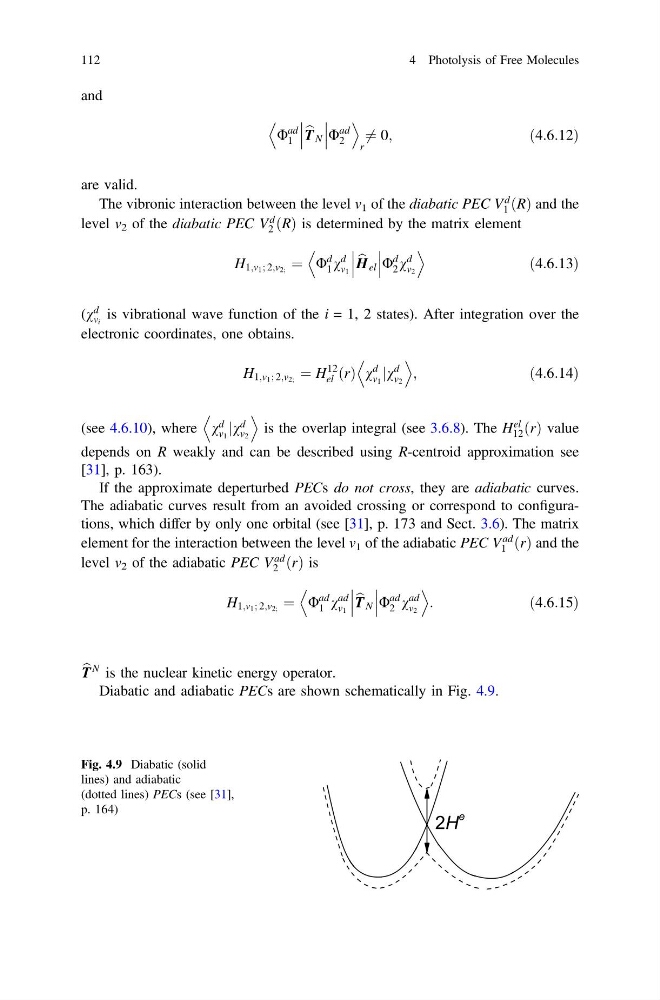
If the approximate deperturbed PECs do not cross, they are adiabatic curves.
The adiabatic curves result from an avoided crossing or correspond to configurations, which differ by only one orbital (see [31], p. 173 and Sect. 3.6). The matrix
element for the interaction between the level v 1 of the adiabatic PEC V
ad
1 ðrÞ and the
level v 2 of the adiabatic PEC V
ad
2 ðrÞ is
H 1;v 1 ; 2;v 2; ¼ U
ad
1 v
ad
v 1
b
T N
U
ad
2 v
ad
v 2
D
E
:
ð4:6:15Þ
b
T
N is the nuclear kinetic energy operator.
Diabatic and adiabatic PECs are shown schematically in Fig. 4.9.
Fig. 4.9 Diabatic (solid
lines) and adiabatic
(dotted lines) PECs (see [31],
p. 164)
112
4 Photolysis of Free Molecules
U
ad
1
b
T N
U
ad
2
D
E
r
6 ¼ 0;
ð4:6:12Þ
are valid.
The vibronic interaction between the level v 1 of the diabatic PEC V
d
1 ðRÞ and the
level v 2 of the diabatic PEC V
d
2 ðRÞ is determined by the matrix element
H 1;v 1 ; 2;v 2; ¼ U
d
1 v
d
v 1
b
H el
U
d
2 v
d
v 2
D
E
ð4:6:13Þ
(v
d
v i
is vibrational wave function of the i = 1, 2 states). After integration over the
electronic coordinates, one obtains.
H 1;v 1 ; 2;v 2; ¼ H
12
el ðrÞ v
d
v 1
jv
d
v 2
D
E
;
ð4:6:14Þ
(see 4.6.10), where v
d
v 1
jv
d
v 2
D
E
is the overlap integral (see 3.6.8). The H
el
12 ðrÞ value
depends on R weakly and can be described using R-centroid approximation see
[31], p. 163).
If the approximate deperturbed PECs do not cross, they are adiabatic curves.
The adiabatic curves result from an avoided crossing or correspond to configurations, which differ by only one orbital (see [31], p. 173 and Sect. 3.6). The matrix
element for the interaction between the level v 1 of the adiabatic PEC V
ad
1 ðrÞ and the
level v 2 of the adiabatic PEC V
ad
2 ðrÞ is
H 1;v 1 ; 2;v 2; ¼ U
ad
1 v
ad
v 1
b
T N
U
ad
2 v
ad
v 2
D
E
:
ð4:6:15Þ
b
T
N is the nuclear kinetic energy operator.
Diabatic and adiabatic PECs are shown schematically in Fig. 4.9.
Fig. 4.9 Diabatic (solid
lines) and adiabatic
(dotted lines) PECs (see [31],
p. 164)
112
4 Photolysis of Free Molecules