

4.6.1.1 Perturbations Between States of the Same Symmetry
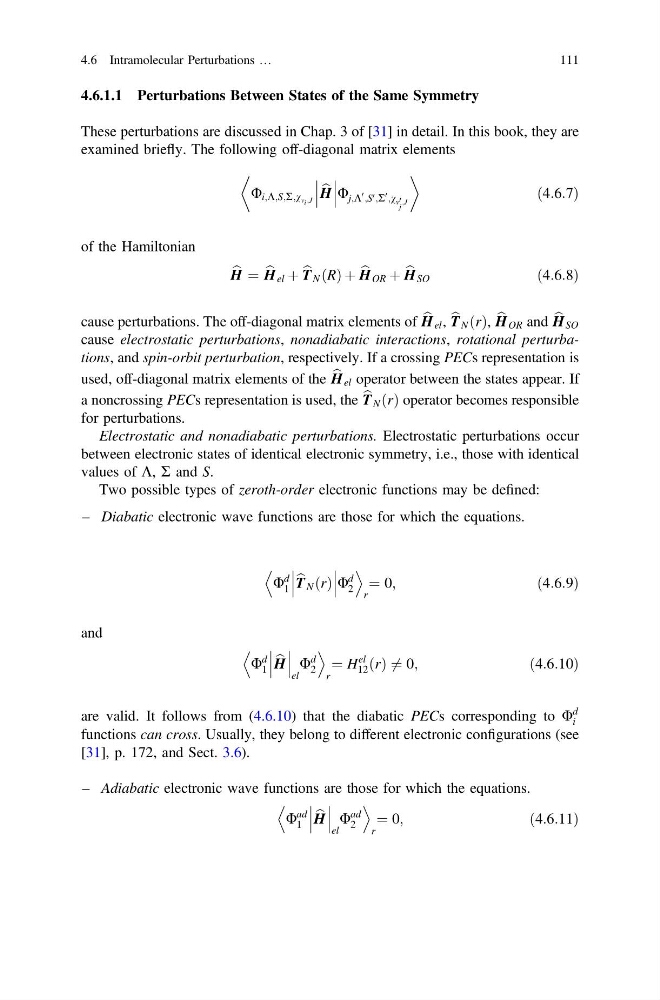
These perturbations are discussed in Chap. 3 of [31] in detail. In this book, they are
examined briefly. The following off-diagonal matrix elements
U i;K;S;R;v v i ;J
b
H
U j;K
0 ;S 0 ;R
0 ;v v 0
j
;J
(
)
ð4:6:7Þ
of the Hamiltonian
b
H ¼ b
H el þ b
T N ðRÞ þ b
H OR þ b
H SO
ð4:6:8Þ
cause perturbations. The off-diagonal matrix elements of b
H el , b
T N ðrÞ, b
H OR and b
H SO
cause electrostatic perturbations, nonadiabatic interactions, rotational perturbations, and spin-orbit perturbation, respectively. If a crossing PECs representation is
used, off-diagonal matrix elements of the b
H el operator between the states appear. If
a noncrossing PECs representation is used, the b
T N ðrÞ operator becomes responsible
for perturbations.
Electrostatic and nonadiabatic perturbations. Electrostatic perturbations occur
between electronic states of identical electronic symmetry, i.e., those with identical
values of K, R and S.
Two possible types of zeroth-order electronic functions may be defined:
– Diabatic electronic wave functions are those for which the equations.
U
d
1
b
T N ðrÞ
U
d
2
D
E
r
¼ 0;
ð4:6:9Þ
and
U
d
1
b
H
el
U
d
2
D
E
r
¼ H
el
12 ðrÞ 6 ¼ 0;
ð4:6:10Þ
are valid. It follows from (4.6.10) that the diabatic PECs corresponding to U
d
i
functions can cross. Usually, they belong to different electronic configurations (see
[31], p. 172, and Sect. 3.6).
– Adiabatic electronic wave functions are those for which the equations.
U
ad
1
b
H
el
U
ad
2
D
E
r
¼ 0;
ð4:6:11Þ
4.6 Intramolecular Perturbations …
111
These perturbations are discussed in Chap. 3 of [31] in detail. In this book, they are
examined briefly. The following off-diagonal matrix elements
U i;K;S;R;v v i ;J
b
H
U j;K
0 ;S 0 ;R
0 ;v v 0
j
;J
(
)
ð4:6:7Þ
of the Hamiltonian
b
H ¼ b
H el þ b
T N ðRÞ þ b
H OR þ b
H SO
ð4:6:8Þ
cause perturbations. The off-diagonal matrix elements of b
H el , b
T N ðrÞ, b
H OR and b
H SO
cause electrostatic perturbations, nonadiabatic interactions, rotational perturbations, and spin-orbit perturbation, respectively. If a crossing PECs representation is
used, off-diagonal matrix elements of the b
H el operator between the states appear. If
a noncrossing PECs representation is used, the b
T N ðrÞ operator becomes responsible
for perturbations.
Electrostatic and nonadiabatic perturbations. Electrostatic perturbations occur
between electronic states of identical electronic symmetry, i.e., those with identical
values of K, R and S.
Two possible types of zeroth-order electronic functions may be defined:
– Diabatic electronic wave functions are those for which the equations.
U
d
1
b
T N ðrÞ
U
d
2
D
E
r
¼ 0;
ð4:6:9Þ
and
U
d
1
b
H
el
U
d
2
D
E
r
¼ H
el
12 ðrÞ 6 ¼ 0;
ð4:6:10Þ
are valid. It follows from (4.6.10) that the diabatic PECs corresponding to U
d
i
functions can cross. Usually, they belong to different electronic configurations (see
[31], p. 172, and Sect. 3.6).
– Adiabatic electronic wave functions are those for which the equations.
U
ad
1
b
H
el
U
ad
2
D
E
r
¼ 0;
ð4:6:11Þ
4.6 Intramolecular Perturbations …
111