

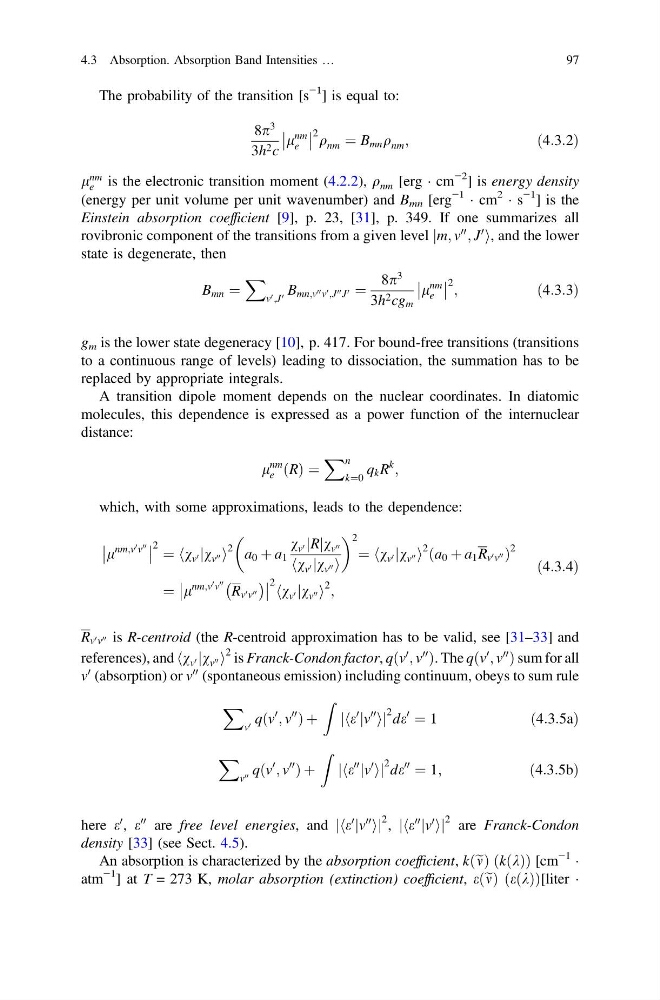
The probability of the transition [s
−1 ] is equal to:
8p
3
3h 2 c
l
nm
e
2 q nm ¼ B mn q nm ;
ð4:3:2Þ
l
nm
e is the electronic transition moment (4.2.2), q nm [erg Á cm
−2 ] is energy density
(energy per unit volume per unit wavenumber) and B mn [erg
−1
Á cm
2
Á s
−1 ] is the
Einstein absorption coefficient [9], p. 23, [31], p. 349. If one summarizes all
rovibronic component of the transitions from a given level m; v
00
; J
0
j
i , and the lower
state is degenerate, then
B mn ¼
X
v 0 ;J 0 B mn;v 00 v 0 ;J 00 J 0 ¼
8p
3
3h 2 cg m
l
nm
e
2 ;
ð4:3:3Þ
g m is the lower state degeneracy [10], p. 417. For bound-free transitions (transitions
to a continuous range of levels) leading to dissociation, the summation has to be
replaced by appropriate integrals.
A transition dipole moment depends on the nuclear coordinates. In diatomic
molecules, this dependence is expressed as a power function of the internuclear
distance:
l
nm
e ðRÞ ¼
X n
k¼0
q k R
k
;
which, with some approximations, leads to the dependence:
l
nm;v
0 v
00
2 ¼ v v 0 jv v 00
h
i
2 a 0 þ a 1
v v 0 R
j jv v 00
v v 0 jv v 00
h
i
2
¼ v v 0 jv v 00
h
i
2 ða 0 þ a 1 R v 0 v 00 Þ
2
¼ l
nm;v
0 v
00 R v 0 v 00
À
Á
2 v v 0 jv v 00
h
i
2 ;
ð4:3:4Þ
R v 0 v 00 is R-centroid (the R-centroid approximation has to be valid, see [31–33] and
references), and v v 0 jv v 00
h
i
2 is Franck-Condon factor, q v
0
; v
00
ð
Þ. The q v
0
; v
00
ð
Þsum for all
v
0 (absorption) or v
00 (spontaneous emission) including continuum, obeys to sum rule
X
v 0 q v
0
; v
00
ð
Þþ
Z
e
0
jv
00
h
i
j
j
2 de
0
¼ 1
ð4:3:5aÞ
X
v 00 q v
0
; v
00
ð
Þþ
Z
e
00
jv
0
h
i
j
j
2 de
00
¼ 1;
ð4:3:5bÞ
here e
0 , e
00 are free level energies, and e
0
jv
00
h
i
j
j
2 , e
00
jv
0
h
i
j
j
2 are Franck-Condon
density [33] (see Sect. 4.5).
An absorption is characterized by the absorption coefficient, k e m
ð Þ ðkðkÞÞ [cm
−1 Á
atm
−1 ] at T = 273 K, molar absorption (extinction) coefficient, e e m
ð Þ ðeðkÞÞ[liter Á
4.3 Absorption. Absorption Band Intensities …
97
−1 ] is equal to:
8p
3
3h 2 c
l
nm
e
2 q nm ¼ B mn q nm ;
ð4:3:2Þ
l
nm
e is the electronic transition moment (4.2.2), q nm [erg Á cm
−2 ] is energy density
(energy per unit volume per unit wavenumber) and B mn [erg
−1
Á cm
2
Á s
−1 ] is the
Einstein absorption coefficient [9], p. 23, [31], p. 349. If one summarizes all
rovibronic component of the transitions from a given level m; v
00
; J
0
j
i , and the lower
state is degenerate, then
B mn ¼
X
v 0 ;J 0 B mn;v 00 v 0 ;J 00 J 0 ¼
8p
3
3h 2 cg m
l
nm
e
2 ;
ð4:3:3Þ
g m is the lower state degeneracy [10], p. 417. For bound-free transitions (transitions
to a continuous range of levels) leading to dissociation, the summation has to be
replaced by appropriate integrals.
A transition dipole moment depends on the nuclear coordinates. In diatomic
molecules, this dependence is expressed as a power function of the internuclear
distance:
l
nm
e ðRÞ ¼
X n
k¼0
q k R
k
;
which, with some approximations, leads to the dependence:
l
nm;v
0 v
00
2 ¼ v v 0 jv v 00
h
i
2 a 0 þ a 1
v v 0 R
j jv v 00
v v 0 jv v 00
h
i
2
¼ v v 0 jv v 00
h
i
2 ða 0 þ a 1 R v 0 v 00 Þ
2
¼ l
nm;v
0 v
00 R v 0 v 00
À
Á
2 v v 0 jv v 00
h
i
2 ;
ð4:3:4Þ
R v 0 v 00 is R-centroid (the R-centroid approximation has to be valid, see [31–33] and
references), and v v 0 jv v 00
h
i
2 is Franck-Condon factor, q v
0
; v
00
ð
Þ. The q v
0
; v
00
ð
Þsum for all
v
0 (absorption) or v
00 (spontaneous emission) including continuum, obeys to sum rule
X
v 0 q v
0
; v
00
ð
Þþ
Z
e
0
jv
00
h
i
j
j
2 de
0
¼ 1
ð4:3:5aÞ
X
v 00 q v
0
; v
00
ð
Þþ
Z
e
00
jv
0
h
i
j
j
2 de
00
¼ 1;
ð4:3:5bÞ
here e
0 , e
00 are free level energies, and e
0
jv
00
h
i
j
j
2 , e
00
jv
0
h
i
j
j
2 are Franck-Condon
density [33] (see Sect. 4.5).
An absorption is characterized by the absorption coefficient, k e m
ð Þ ðkðkÞÞ [cm
−1 Á
atm
−1 ] at T = 273 K, molar absorption (extinction) coefficient, e e m
ð Þ ðeðkÞÞ[liter Á
4.3 Absorption. Absorption Band Intensities …
97