

this effect is also due to the contribution of the ‘singlet’ 1441 0
þ
u ion-pair state to
the 2431 B0
þ
u state via 1342 0
þ
u one, i.e., the 1441 0
þ
u ‘singlet’ state mixes with
the 1342 0
þ
u one, and this ‘new’ state mixes with the 2431 B0
þ
u state. This
coupling is the (c), type II one since the 2431 B0
þ
u and 1441 0
þ
u states are formed
from different configurations of iodine atoms: the 1342 0
þ
u and 1441 0
þ
u states
correlate with the I
+ + I
− ions, p
4
Á p
6 configuration (see [29, 30] and references,
also).
4.3 Absorption. Absorption Band Intensities. Einstein
Absorption and Stimulated Emission Coefficients.
Beer-Lambert Law. Oscillator Strength
The number of photons with the energy hm, equal to the energy gap between lower,
m, and upper, n, state absorbed per unit time per unit volume (the absorbed
radiation density n
a
hm ðkÞ, see 4.1.18) in the transition is proportional to the population of the m state, N m , [cm
−3 ] and the number of photons per unit volume, q
hm
nm
[cm
−3 ]:
n
a
hm ðkÞ $ N m q
hm
nm :
ð4:3:1Þ
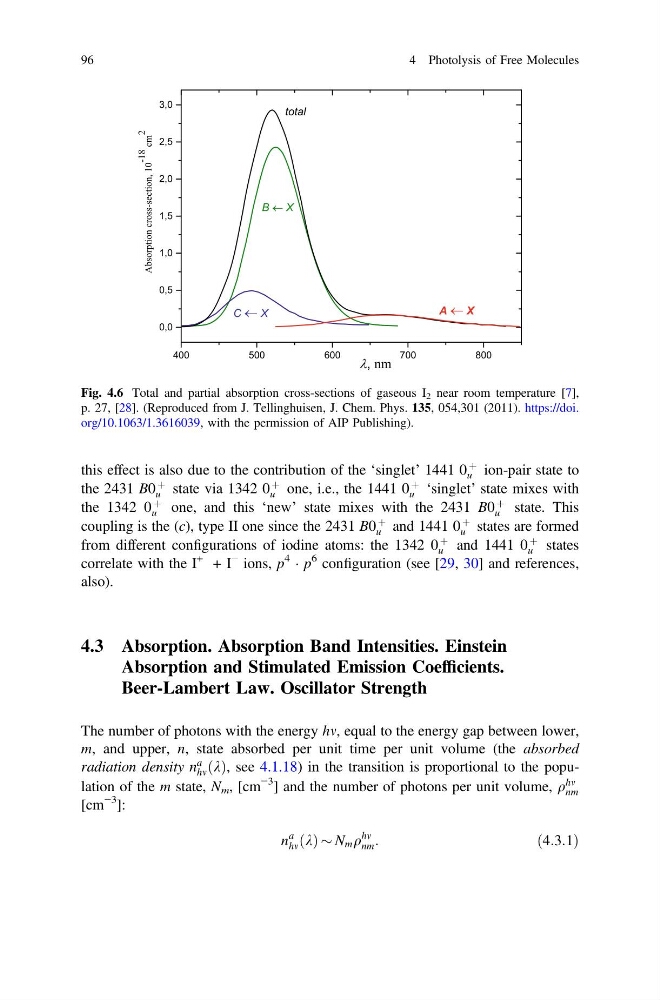
Fig. 4.6 Total and partial absorption cross-sections of gaseous I 2 near room temperature [7],
p. 27, [28]. (Reproduced from J. Tellinghuisen, J. Chem. Phys. 135, 054,301 (2011). https://doi.
org/10.1063/1.3616039, with the permission of AIP Publishing).
96
4 Photolysis of Free Molecules
þ
u ion-pair state to
the 2431 B0
þ
u state via 1342 0
þ
u one, i.e., the 1441 0
þ
u ‘singlet’ state mixes with
the 1342 0
þ
u one, and this ‘new’ state mixes with the 2431 B0
þ
u state. This
coupling is the (c), type II one since the 2431 B0
þ
u and 1441 0
þ
u states are formed
from different configurations of iodine atoms: the 1342 0
þ
u and 1441 0
þ
u states
correlate with the I
+ + I
− ions, p
4
Á p
6 configuration (see [29, 30] and references,
also).
4.3 Absorption. Absorption Band Intensities. Einstein
Absorption and Stimulated Emission Coefficients.
Beer-Lambert Law. Oscillator Strength
The number of photons with the energy hm, equal to the energy gap between lower,
m, and upper, n, state absorbed per unit time per unit volume (the absorbed
radiation density n
a
hm ðkÞ, see 4.1.18) in the transition is proportional to the population of the m state, N m , [cm
−3 ] and the number of photons per unit volume, q
hm
nm
[cm
−3 ]:
n
a
hm ðkÞ $ N m q
hm
nm :
ð4:3:1Þ
Fig. 4.6 Total and partial absorption cross-sections of gaseous I 2 near room temperature [7],
p. 27, [28]. (Reproduced from J. Tellinghuisen, J. Chem. Phys. 135, 054,301 (2011). https://doi.
org/10.1063/1.3616039, with the permission of AIP Publishing).
96
4 Photolysis of Free Molecules