

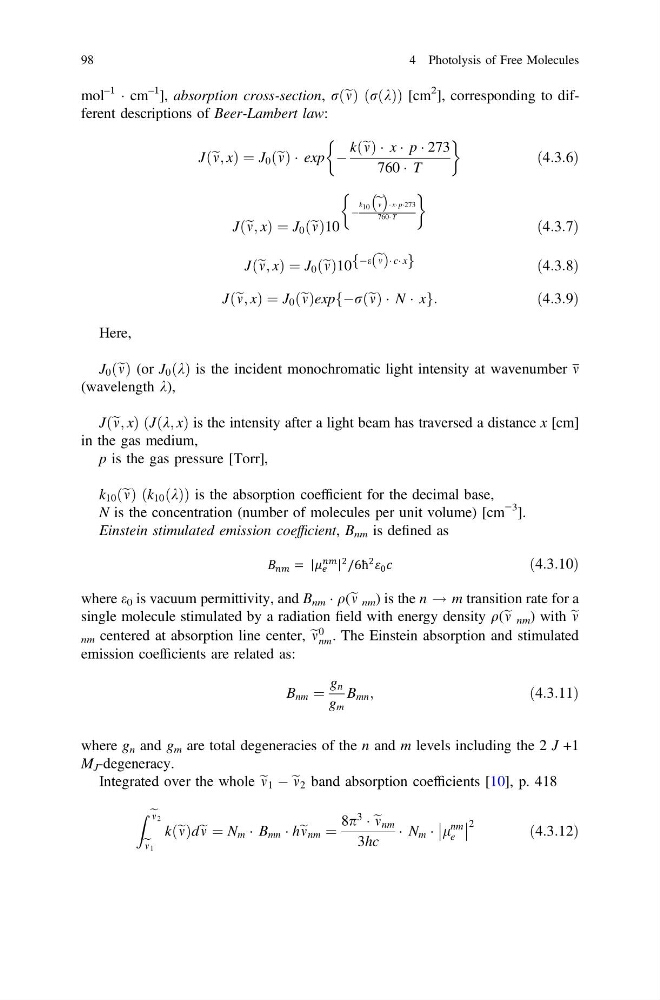
mol
–1
Á cm
–1 ], absorption cross-section, r e m
ð Þ ðrðkÞÞ [cm
2 ], corresponding to different descriptions of Beer-Lambert law:
J e m; x
ð Þ ¼ J 0 e m
ð Þ Á exp À
k e m
ð Þ Á x Á p Á 273
760 Á T
&
'
ð4:3:6Þ
J e m; x
ð Þ ¼ J 0 e m
ð Þ10
À
k 10 e m
À Á
Á xÁ pÁ273
760Á T
&
'
ð4:3:7Þ
J e m; x
ð Þ ¼ J 0 e m
ð Þ10
Àe e m
ð ÞÁ cÁ x
f
g
ð4:3:8Þ
J e m; x
ð Þ ¼ J 0 e m
ð Þexp Àr e m
ð Þ Á N Á x
f
g :
ð4:3:9Þ
Here,
J 0 e m
ð Þ (or J 0 ðkÞ is the incident monochromatic light intensity at wavenumber m
(wavelength k),
J e m; x
ð Þ ðJðk; xÞ is the intensity after a light beam has traversed a distance x [cm]
in the gas medium,
p is the gas pressure [Torr],
k 10 e m
ð Þ ðk 10 ðkÞÞ is the absorption coefficient for the decimal base,
N is the concentration (number of molecules per unit volume) [cm
−3 ].
Einstein stimulated emission coefficient, B nm is defined as
ð4:3:10Þ
where e 0 is vacuum permittivity, and B nm Á q(e m nm ) is the n ! m transition rate for a
single molecule stimulated by a radiation field with energy density q(e m nm ) with e m
nm centered at absorption line center, e m
0
nm . The Einstein absorption and stimulated
emission coefficients are related as:
B nm ¼
g n
g m
B mn ;
ð4:3:11Þ
where g n and g m are total degeneracies of the n and m levels including the 2 J +1
M J -degeneracy.
Integrated over the whole e m 1 À e m 2 band absorption coefficients [10], p. 418
Z e m 2
e m 1
k e m
ð Þde m ¼ N m Á B mn Á he m nm ¼
8p
3
Á e m nm
3hc
Á N m Á l
nm
e
2
ð4:3:12Þ
98
4 Photolysis of Free Molecules
–1
Á cm
–1 ], absorption cross-section, r e m
ð Þ ðrðkÞÞ [cm
2 ], corresponding to different descriptions of Beer-Lambert law:
J e m; x
ð Þ ¼ J 0 e m
ð Þ Á exp À
k e m
ð Þ Á x Á p Á 273
760 Á T
&
'
ð4:3:6Þ
J e m; x
ð Þ ¼ J 0 e m
ð Þ10
À
k 10 e m
À Á
Á xÁ pÁ273
760Á T
&
'
ð4:3:7Þ
J e m; x
ð Þ ¼ J 0 e m
ð Þ10
Àe e m
ð ÞÁ cÁ x
f
g
ð4:3:8Þ
J e m; x
ð Þ ¼ J 0 e m
ð Þexp Àr e m
ð Þ Á N Á x
f
g :
ð4:3:9Þ
Here,
J 0 e m
ð Þ (or J 0 ðkÞ is the incident monochromatic light intensity at wavenumber m
(wavelength k),
J e m; x
ð Þ ðJðk; xÞ is the intensity after a light beam has traversed a distance x [cm]
in the gas medium,
p is the gas pressure [Torr],
k 10 e m
ð Þ ðk 10 ðkÞÞ is the absorption coefficient for the decimal base,
N is the concentration (number of molecules per unit volume) [cm
−3 ].
Einstein stimulated emission coefficient, B nm is defined as
ð4:3:10Þ
where e 0 is vacuum permittivity, and B nm Á q(e m nm ) is the n ! m transition rate for a
single molecule stimulated by a radiation field with energy density q(e m nm ) with e m
nm centered at absorption line center, e m
0
nm . The Einstein absorption and stimulated
emission coefficients are related as:
B nm ¼
g n
g m
B mn ;
ð4:3:11Þ
where g n and g m are total degeneracies of the n and m levels including the 2 J +1
M J -degeneracy.
Integrated over the whole e m 1 À e m 2 band absorption coefficients [10], p. 418
Z e m 2
e m 1
k e m
ð Þde m ¼ N m Á B mn Á he m nm ¼
8p
3
Á e m nm
3hc
Á N m Á l
nm
e
2
ð4:3:12Þ
98
4 Photolysis of Free Molecules