

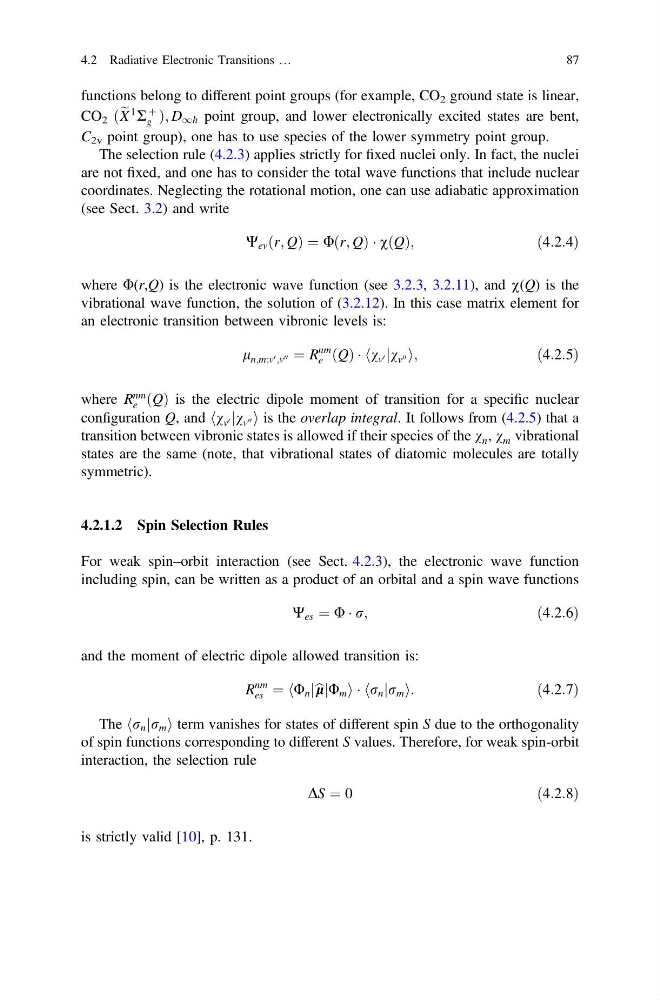
functions belong to different point groups (for example, CO 2 ground state is linear,
CO 2 ð e
X
1 R
þ
g Þ; D 1h point group, and lower electronically excited states are bent,
C 2v point group), one has to use species of the lower symmetry point group.
The selection rule (4.2.3) applies strictly for fixed nuclei only. In fact, the nuclei
are not fixed, and one has to consider the total wave functions that include nuclear
coordinates. Neglecting the rotational motion, one can use adiabatic approximation
(see Sect. 3.2) and write
W ev r; Q
ð
Þ ¼ U r; Q
ð
ÞÁvðQÞ;
ð4:2:4Þ
where U(r,Q) is the electronic wave function (see 3.2.3, 3.2.11), and v(Q) is the
vibrational wave function, the solution of (3.2.12). In this case matrix element for
an electronic transition between vibronic levels is:
l n;m;v 0 ;v 00 ¼ R
nm
e ðQÞ Á v v 0 jv v 00
h
i;
ð4:2:5Þ
where R
nm
e Q
ð Þ is the electric dipole moment of transition for a specific nuclear
configuration Q, and v v 0 jv v 00
h
iis the overlap integral. It follows from (4.2.5) that a
transition between vibronic states is allowed if their species of the v n , v m vibrational
states are the same (note, that vibrational states of diatomic molecules are totally
symmetric).
4.2.1.2 Spin Selection Rules
For weak spin–orbit interaction (see Sect. 4.2.3), the electronic wave function
including spin, can be written as a product of an orbital and a spin wave functions
W es ¼ U Á r;
ð4:2:6Þ
and the moment of electric dipole allowed transition is:
R
nm
es ¼ U n b l
j jU m
h
iÁ r n jr m
h
i:
ð4:2:7Þ
The r n jr m
h
iterm vanishes for states of different spin S due to the orthogonality
of spin functions corresponding to different S values. Therefore, for weak spin-orbit
interaction, the selection rule
DS ¼ 0
ð4:2:8Þ
is strictly valid [10], p. 131.
4.2 Radiative Electronic Transitions …
87
CO 2 ð e
X
1 R
þ
g Þ; D 1h point group, and lower electronically excited states are bent,
C 2v point group), one has to use species of the lower symmetry point group.
The selection rule (4.2.3) applies strictly for fixed nuclei only. In fact, the nuclei
are not fixed, and one has to consider the total wave functions that include nuclear
coordinates. Neglecting the rotational motion, one can use adiabatic approximation
(see Sect. 3.2) and write
W ev r; Q
ð
Þ ¼ U r; Q
ð
ÞÁvðQÞ;
ð4:2:4Þ
where U(r,Q) is the electronic wave function (see 3.2.3, 3.2.11), and v(Q) is the
vibrational wave function, the solution of (3.2.12). In this case matrix element for
an electronic transition between vibronic levels is:
l n;m;v 0 ;v 00 ¼ R
nm
e ðQÞ Á v v 0 jv v 00
h
i;
ð4:2:5Þ
where R
nm
e Q
ð Þ is the electric dipole moment of transition for a specific nuclear
configuration Q, and v v 0 jv v 00
h
iis the overlap integral. It follows from (4.2.5) that a
transition between vibronic states is allowed if their species of the v n , v m vibrational
states are the same (note, that vibrational states of diatomic molecules are totally
symmetric).
4.2.1.2 Spin Selection Rules
For weak spin–orbit interaction (see Sect. 4.2.3), the electronic wave function
including spin, can be written as a product of an orbital and a spin wave functions
W es ¼ U Á r;
ð4:2:6Þ
and the moment of electric dipole allowed transition is:
R
nm
es ¼ U n b l
j jU m
h
iÁ r n jr m
h
i:
ð4:2:7Þ
The r n jr m
h
iterm vanishes for states of different spin S due to the orthogonality
of spin functions corresponding to different S values. Therefore, for weak spin-orbit
interaction, the selection rule
DS ¼ 0
ð4:2:8Þ
is strictly valid [10], p. 131.
4.2 Radiative Electronic Transitions …
87