

4.2.2 Forbidden Electronic Transitions
Transitions which do not comply selection rules discussed in Sect. 4.2.1 are called
electric dipole forbidden. However, some of these transitions can have appreciable
intensities due to perturbations.
4.2.2.1 Transitions in Polyatomic Molecules Allowed Due to Vibronic
Interactions
A transition in polyatomic molecules forbidden due to the symmetry of electronic
wave functions may be allowed when vibronic interactions are taken into account
(see 4.2.4). In this case
C W ev
ð Þ ¼ C U
ð Þ Â C v Q
À Á
;
ð4:2:9Þ
(see 3.2.15 and Sect. 3.2). A transition is allowed if direct products of the C b l
ð Þ and
C W ev
ð Þ species for both, lower and upper states, have a totally symmetric component (see Sect. 4.6.2.1).
There are pairs of electronic states in many point groups that cannot be combined in electronic transitions, even when vibronic interaction is taken into account
due to vibrational deficiency. Vibrationally deficient molecules are defined as
molecules that species for the normal vibrational modes of a molecule fail to span
all the corresponding point group the irreducible representations. An important
consequence of vibrational deficiency is electronic transitions, which are forbidden
even if one takes into account a vibronic interaction (first-order vibronic prohibition [13]).
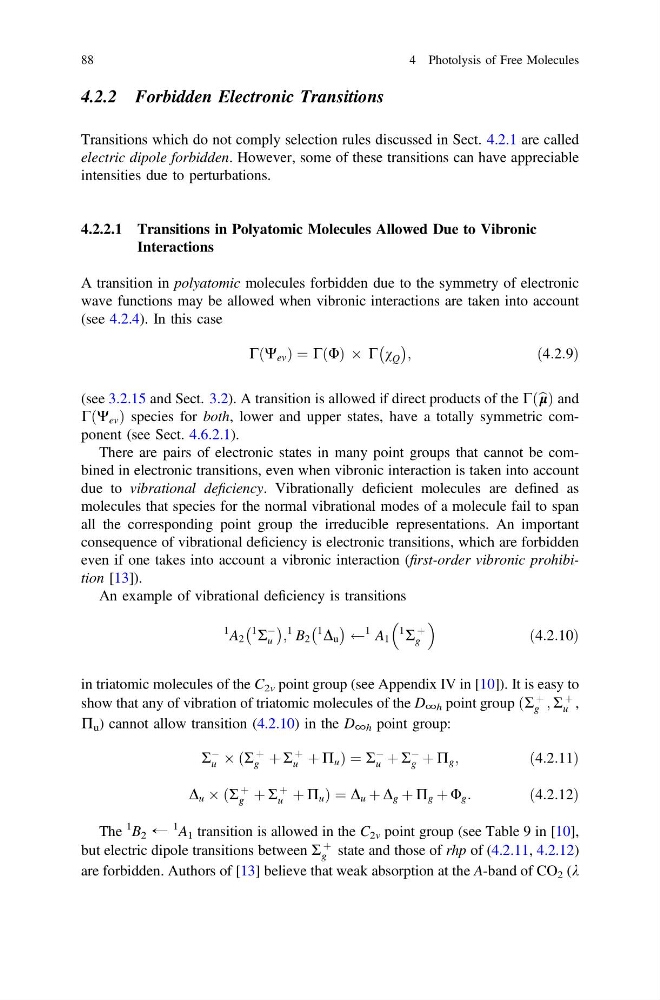
An example of vibrational deficiency is transitions
1
A 2
1 R
À
u
À
Á ;
1
B 2
1 D u
À Á 1 A 1
1 R
þ
g
ð4:2:10Þ
in triatomic molecules of the C 2v point group (see Appendix IV in [10]). It is easy to
show that any of vibration of triatomic molecules of the D ∞h point group ðR
þ
g ; R
þ
u ,
P u ) cannot allow transition (4.2.10) in the D ∞h point group:
R
À
u  ðR
þ
g þ R
þ
u þ P u Þ ¼ R
À
u þ R
À
g þ P g ;
ð4:2:11Þ
D u  ðR
þ
g þ R
þ
u þ P u Þ ¼ D u þ D g þ P g þ U g :
ð4:2:12Þ
The
1
B 2 ←
1
A 1 transition is allowed in the C 2v point group (see Table 9 in [10],
but electric dipole transitions between R
þ
g state and those of rhp of (4.2.11, 4.2.12)
are forbidden. Authors of [13] believe that weak absorption at the A-band of CO 2 (k
88
4 Photolysis of Free Molecules
Transitions which do not comply selection rules discussed in Sect. 4.2.1 are called
electric dipole forbidden. However, some of these transitions can have appreciable
intensities due to perturbations.
4.2.2.1 Transitions in Polyatomic Molecules Allowed Due to Vibronic
Interactions
A transition in polyatomic molecules forbidden due to the symmetry of electronic
wave functions may be allowed when vibronic interactions are taken into account
(see 4.2.4). In this case
C W ev
ð Þ ¼ C U
ð Þ Â C v Q
À Á
;
ð4:2:9Þ
(see 3.2.15 and Sect. 3.2). A transition is allowed if direct products of the C b l
ð Þ and
C W ev
ð Þ species for both, lower and upper states, have a totally symmetric component (see Sect. 4.6.2.1).
There are pairs of electronic states in many point groups that cannot be combined in electronic transitions, even when vibronic interaction is taken into account
due to vibrational deficiency. Vibrationally deficient molecules are defined as
molecules that species for the normal vibrational modes of a molecule fail to span
all the corresponding point group the irreducible representations. An important
consequence of vibrational deficiency is electronic transitions, which are forbidden
even if one takes into account a vibronic interaction (first-order vibronic prohibition [13]).
An example of vibrational deficiency is transitions
1
A 2
1 R
À
u
À
Á ;
1
B 2
1 D u
À Á 1 A 1
1 R
þ
g
ð4:2:10Þ
in triatomic molecules of the C 2v point group (see Appendix IV in [10]). It is easy to
show that any of vibration of triatomic molecules of the D ∞h point group ðR
þ
g ; R
þ
u ,
P u ) cannot allow transition (4.2.10) in the D ∞h point group:
R
À
u  ðR
þ
g þ R
þ
u þ P u Þ ¼ R
À
u þ R
À
g þ P g ;
ð4:2:11Þ
D u  ðR
þ
g þ R
þ
u þ P u Þ ¼ D u þ D g þ P g þ U g :
ð4:2:12Þ
The
1
B 2 ←
1
A 1 transition is allowed in the C 2v point group (see Table 9 in [10],
but electric dipole transitions between R
þ
g state and those of rhp of (4.2.11, 4.2.12)
are forbidden. Authors of [13] believe that weak absorption at the A-band of CO 2 (k
88
4 Photolysis of Free Molecules