

4.2 Radiative Electronic Transitions. Selection Rules
for Radiative Electronic Transitions. Spin–Orbit
Coupling and Spin-Forbidden Radiative Electronic
Transitions
Radiative transitions between rovibronic levels of different molecular electronic
states are discussed briefly in this section. Allowed and forbidden transitions are
distinguished.
4.2.1 Allowed Radiative Electronic Transitions
Radiative electronic transition (transition in the following) is considered as allowed
if it occurs as an electric dipole one without taking into account spin–orbit, vibronic
and rotational-electronic interactions [10].
4.2.1.1 General Selection Rules for Electric Dipole Transitions
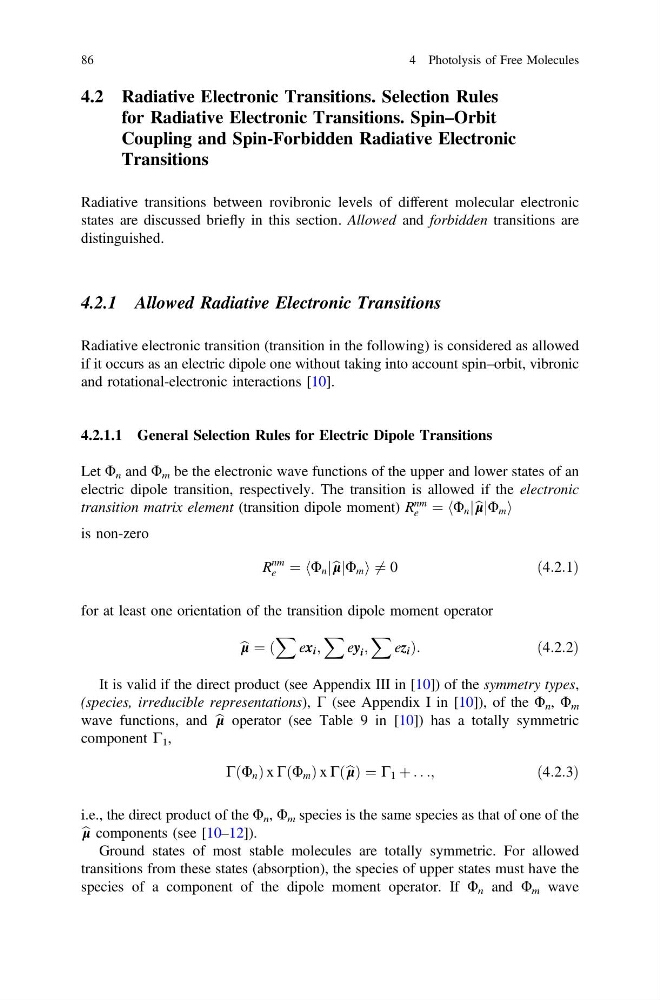
Let U n and U m be the electronic wave functions of the upper and lower states of an
electric dipole transition, respectively. The transition is allowed if the electronic
transition matrix element (transition dipole moment) R
nm
e ¼ U n b l
j jU m
h
i
is non-zero
R
nm
e ¼ U n b l
j jU m
h
i6 ¼ 0
ð4:2:1Þ
for at least one orientation of the transition dipole moment operator
b l ¼ ð
X
ex i ;
X
ey i ;
X
ez i Þ:
ð4:2:2Þ
It is valid if the direct product (see Appendix III in [10]) of the symmetry types,
(species, irreducible representations), C (see Appendix I in [10]), of the U n , U m
wave functions, and b l operator (see Table 9 in [10]) has a totally symmetric
component C 1 ,
C U n
ð Þx C U m
ð Þx C b l
ð Þ ¼ C 1 þ . . .;
ð4:2:3Þ
i.e., the direct product of the U n , U m species is the same species as that of one of the
b l components (see [10–12]).
Ground states of most stable molecules are totally symmetric. For allowed
transitions from these states (absorption), the species of upper states must have the
species of a component of the dipole moment operator. If U n and U m wave
86
4 Photolysis of Free Molecules
for Radiative Electronic Transitions. Spin–Orbit
Coupling and Spin-Forbidden Radiative Electronic
Transitions
Radiative transitions between rovibronic levels of different molecular electronic
states are discussed briefly in this section. Allowed and forbidden transitions are
distinguished.
4.2.1 Allowed Radiative Electronic Transitions
Radiative electronic transition (transition in the following) is considered as allowed
if it occurs as an electric dipole one without taking into account spin–orbit, vibronic
and rotational-electronic interactions [10].
4.2.1.1 General Selection Rules for Electric Dipole Transitions
Let U n and U m be the electronic wave functions of the upper and lower states of an
electric dipole transition, respectively. The transition is allowed if the electronic
transition matrix element (transition dipole moment) R
nm
e ¼ U n b l
j jU m
h
i
is non-zero
R
nm
e ¼ U n b l
j jU m
h
i6 ¼ 0
ð4:2:1Þ
for at least one orientation of the transition dipole moment operator
b l ¼ ð
X
ex i ;
X
ey i ;
X
ez i Þ:
ð4:2:2Þ
It is valid if the direct product (see Appendix III in [10]) of the symmetry types,
(species, irreducible representations), C (see Appendix I in [10]), of the U n , U m
wave functions, and b l operator (see Table 9 in [10]) has a totally symmetric
component C 1 ,
C U n
ð Þx C U m
ð Þx C b l
ð Þ ¼ C 1 þ . . .;
ð4:2:3Þ
i.e., the direct product of the U n , U m species is the same species as that of one of the
b l components (see [10–12]).
Ground states of most stable molecules are totally symmetric. For allowed
transitions from these states (absorption), the species of upper states must have the
species of a component of the dipole moment operator. If U n and U m wave
86
4 Photolysis of Free Molecules