

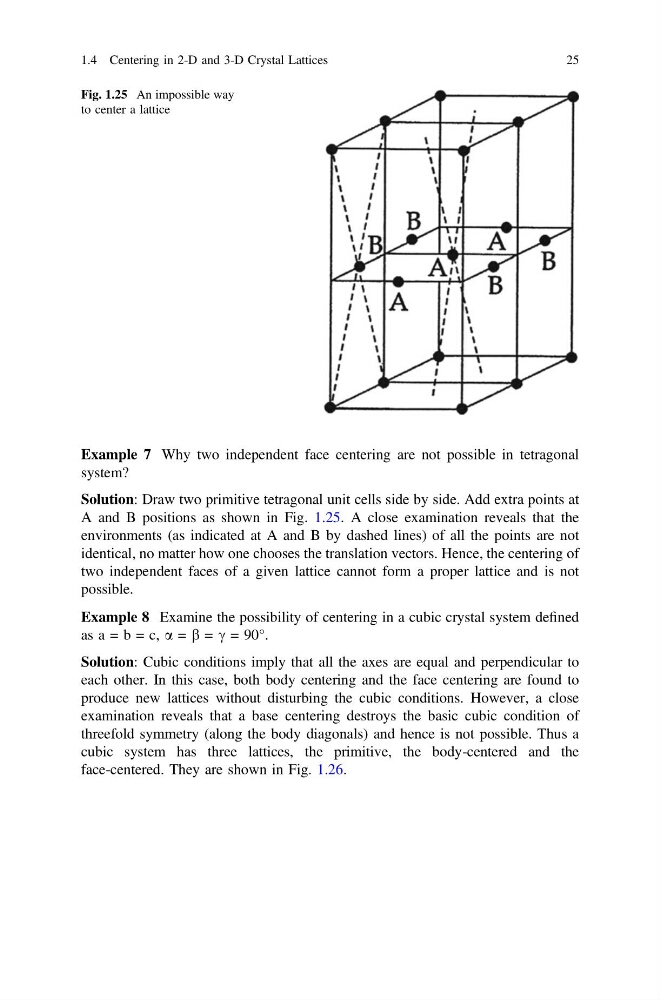
Example 7 Why two independent face centering are not possible in tetragonal
system?
Solution: Draw two primitive tetragonal unit cells side by side. Add extra points at
A and B positions as shown in Fig. 1.25. A close examination reveals that the
environments (as indicated at A and B by dashed lines) of all the points are not
identical, no matter how one chooses the translation vectors. Hence, the centering of
two independent faces of a given lattice cannot form a proper lattice and is not
possible.
Example 8 Examine the possibility of centering in a cubic crystal system defined
as a = b = c, a = b = c = 90°.
Solution: Cubic conditions imply that all the axes are equal and perpendicular to
each other. In this case, both body centering and the face centering are found to
produce new lattices without disturbing the cubic conditions. However, a close
examination reveals that a base centering destroys the basic cubic condition of
threefold symmetry (along the body diagonals) and hence is not possible. Thus a
cubic system has three lattices, the primitive, the body-centered and the
face-centered. They are shown in Fig. 1.26.
Fig. 1.25 An impossible way
to center a lattice
1.4 Centering in 2-D and 3-D Crystal Lattices
25
system?
Solution: Draw two primitive tetragonal unit cells side by side. Add extra points at
A and B positions as shown in Fig. 1.25. A close examination reveals that the
environments (as indicated at A and B by dashed lines) of all the points are not
identical, no matter how one chooses the translation vectors. Hence, the centering of
two independent faces of a given lattice cannot form a proper lattice and is not
possible.
Example 8 Examine the possibility of centering in a cubic crystal system defined
as a = b = c, a = b = c = 90°.
Solution: Cubic conditions imply that all the axes are equal and perpendicular to
each other. In this case, both body centering and the face centering are found to
produce new lattices without disturbing the cubic conditions. However, a close
examination reveals that a base centering destroys the basic cubic condition of
threefold symmetry (along the body diagonals) and hence is not possible. Thus a
cubic system has three lattices, the primitive, the body-centered and the
face-centered. They are shown in Fig. 1.26.
Fig. 1.25 An impossible way
to center a lattice
1.4 Centering in 2-D and 3-D Crystal Lattices
25