

According to monoclinic condition, a = b = 90° 6 ¼ c, b-c and c-a faces are
perpendicular to each other and the corresponding A- and B- centering give rise to a
new centered lattice. Applying this criterion to the orthorhombic system (where all
faces are perpendicular to each other), all A-, B- and C- centering will give rise to a
new centered lattice. However, they can be described in terms of any one simply by
interchanging the orthogonal axes. Normally, the C-centering is conventionally
preferred over others.
On a similar ground, one can verify that all the face-centering (F-centering) and
body centering (I-centering) will give rise to distinct possible centered lattices in
orthorhombic crystal system. Hence, all the four lattices, that is, P, C, I and F are
possible in this crystal system.
Example 6 Examine the possibility of centering in a tetragonal crystal system
defined as a = b 6 ¼ c, a = b = c = 90°.
Solution: Tetragonal conditions imply that there exists one fourfold symmetry axis
and all the axes are perpendicular to each other.
Body centering in tetragonal system provides a new and still complies with the
tetrahedral condition. Therefore, an I-lattice is a new lattice in tetragonal system. On
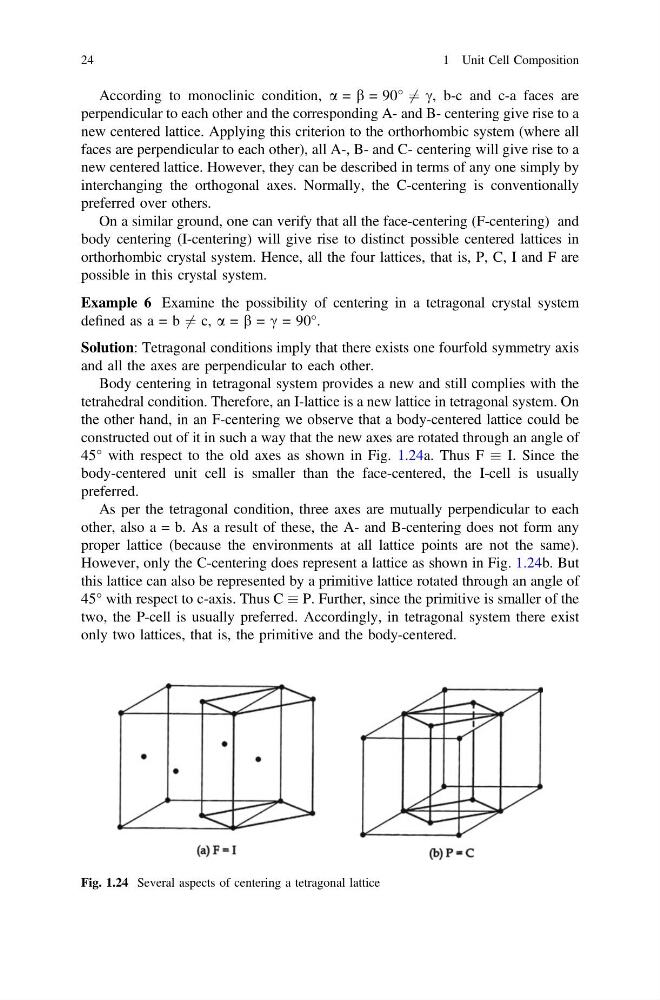
the other hand, in an F-centering we observe that a body-centered lattice could be
constructed out of it in such a way that the new axes are rotated through an angle of
45° with respect to the old axes as shown in Fig. 1.24a. Thus F I. Since the
body-centered unit cell is smaller than the face-centered, the I-cell is usually
preferred.
As per the tetragonal condition, three axes are mutually perpendicular to each
other, also a = b. As a result of these, the A- and B-centering does not form any
proper lattice (because the environments at all lattice points are not the same).
However, only the C-centering does represent a lattice as shown in Fig. 1.24b. But
this lattice can also be represented by a primitive lattice rotated through an angle of
45° with respect to c-axis. Thus C P. Further, since the primitive is smaller of the
two, the P-cell is usually preferred. Accordingly, in tetragonal system there exist
only two lattices, that is, the primitive and the body-centered.
Fig. 1.24 Several aspects of centering a tetragonal lattice
24
1 Unit Cell Composition
perpendicular to each other and the corresponding A- and B- centering give rise to a
new centered lattice. Applying this criterion to the orthorhombic system (where all
faces are perpendicular to each other), all A-, B- and C- centering will give rise to a
new centered lattice. However, they can be described in terms of any one simply by
interchanging the orthogonal axes. Normally, the C-centering is conventionally
preferred over others.
On a similar ground, one can verify that all the face-centering (F-centering) and
body centering (I-centering) will give rise to distinct possible centered lattices in
orthorhombic crystal system. Hence, all the four lattices, that is, P, C, I and F are
possible in this crystal system.
Example 6 Examine the possibility of centering in a tetragonal crystal system
defined as a = b 6 ¼ c, a = b = c = 90°.
Solution: Tetragonal conditions imply that there exists one fourfold symmetry axis
and all the axes are perpendicular to each other.
Body centering in tetragonal system provides a new and still complies with the
tetrahedral condition. Therefore, an I-lattice is a new lattice in tetragonal system. On
the other hand, in an F-centering we observe that a body-centered lattice could be
constructed out of it in such a way that the new axes are rotated through an angle of
45° with respect to the old axes as shown in Fig. 1.24a. Thus F I. Since the
body-centered unit cell is smaller than the face-centered, the I-cell is usually
preferred.
As per the tetragonal condition, three axes are mutually perpendicular to each
other, also a = b. As a result of these, the A- and B-centering does not form any
proper lattice (because the environments at all lattice points are not the same).
However, only the C-centering does represent a lattice as shown in Fig. 1.24b. But
this lattice can also be represented by a primitive lattice rotated through an angle of
45° with respect to c-axis. Thus C P. Further, since the primitive is smaller of the
two, the P-cell is usually preferred. Accordingly, in tetragonal system there exist
only two lattices, that is, the primitive and the body-centered.
Fig. 1.24 Several aspects of centering a tetragonal lattice
24
1 Unit Cell Composition