

(b) A-, B- and C-face centering
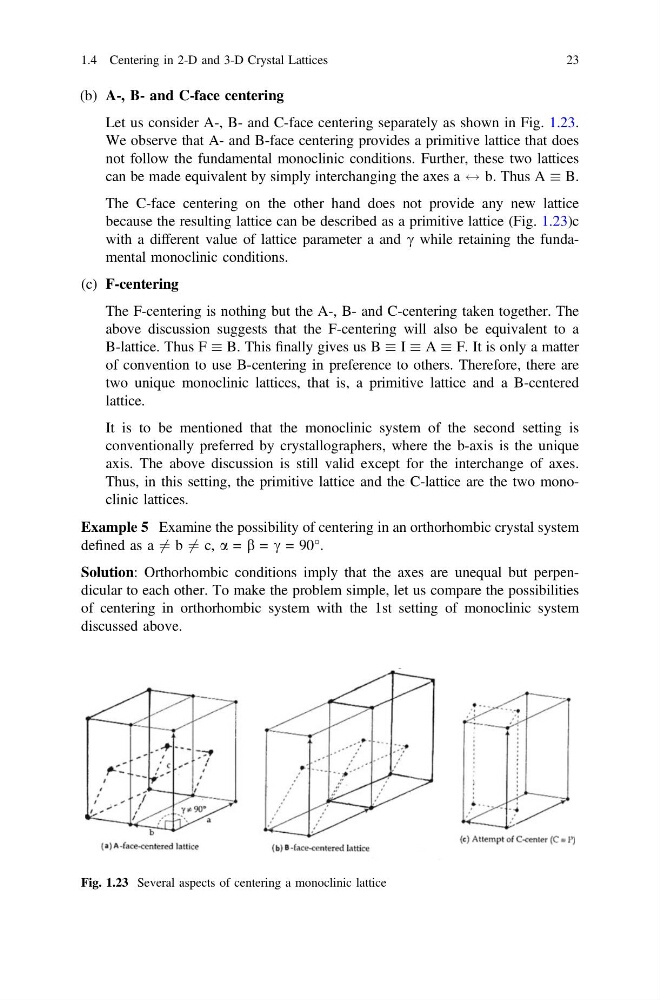
Let us consider A-, B- and C-face centering separately as shown in Fig. 1.23.
We observe that A- and B-face centering provides a primitive lattice that does
not follow the fundamental monoclinic conditions. Further, these two lattices
can be made equivalent by simply interchanging the axes a $ b. Thus A B.
The C-face centering on the other hand does not provide any new lattice
because the resulting lattice can be described as a primitive lattice (Fig. 1.23)c
with a different value of lattice parameter a and c while retaining the fundamental monoclinic conditions.
(c) F-centering
The F-centering is nothing but the A-, B- and C-centering taken together. The
above discussion suggests that the F-centering will also be equivalent to a
B-lattice. Thus F B. This finally gives us B I A F. It is only a matter
of convention to use B-centering in preference to others. Therefore, there are
two unique monoclinic lattices, that is, a primitive lattice and a B-centered
lattice.
It is to be mentioned that the monoclinic system of the second setting is
conventionally preferred by crystallographers, where the b-axis is the unique
axis. The above discussion is still valid except for the interchange of axes.
Thus, in this setting, the primitive lattice and the C-lattice are the two monoclinic lattices.
Example 5 Examine the possibility of centering in an orthorhombic crystal system
defined as a 6 ¼ b 6 ¼ c, a = b = c = 90°.
Solution: Orthorhombic conditions imply that the axes are unequal but perpendicular to each other. To make the problem simple, let us compare the possibilities
of centering in orthorhombic system with the 1st setting of monoclinic system
discussed above.
Fig. 1.23 Several aspects of centering a monoclinic lattice
1.4 Centering in 2-D and 3-D Crystal Lattices
23
Let us consider A-, B- and C-face centering separately as shown in Fig. 1.23.
We observe that A- and B-face centering provides a primitive lattice that does
not follow the fundamental monoclinic conditions. Further, these two lattices
can be made equivalent by simply interchanging the axes a $ b. Thus A B.
The C-face centering on the other hand does not provide any new lattice
because the resulting lattice can be described as a primitive lattice (Fig. 1.23)c
with a different value of lattice parameter a and c while retaining the fundamental monoclinic conditions.
(c) F-centering
The F-centering is nothing but the A-, B- and C-centering taken together. The
above discussion suggests that the F-centering will also be equivalent to a
B-lattice. Thus F B. This finally gives us B I A F. It is only a matter
of convention to use B-centering in preference to others. Therefore, there are
two unique monoclinic lattices, that is, a primitive lattice and a B-centered
lattice.
It is to be mentioned that the monoclinic system of the second setting is
conventionally preferred by crystallographers, where the b-axis is the unique
axis. The above discussion is still valid except for the interchange of axes.
Thus, in this setting, the primitive lattice and the C-lattice are the two monoclinic lattices.
Example 5 Examine the possibility of centering in an orthorhombic crystal system
defined as a 6 ¼ b 6 ¼ c, a = b = c = 90°.
Solution: Orthorhombic conditions imply that the axes are unequal but perpendicular to each other. To make the problem simple, let us compare the possibilities
of centering in orthorhombic system with the 1st setting of monoclinic system
discussed above.
Fig. 1.23 Several aspects of centering a monoclinic lattice
1.4 Centering in 2-D and 3-D Crystal Lattices
23