

1.5 Close Packing of Identical Atoms (Spheres)
When identical atoms (spheres) are packed in a plane such that they touch each
other, they automatically acquire a close-packed hexagonally coordinated
arrangement as shown in Fig. 1.27. This is the only way of packing identical atoms
(spheres) in most efficient way in 2-D. Coordination in such an arrangement is 6
and its maximum symmetry is 6mm. Let us call this as A-layer. This contains two
types of voids, one with the apex of the triangle up (Δ) and labelled B, and the other
with apex down (∇) and labelled C (Fig. 1.27).
In a 3-D packing, the hexagonally close-packed layer can occupy either B or C
position, but not both at the same time. Similarly, above a B-layer, it can be either C
or A and above a C-layer, it can be either A or B and so on without violating the
rule of close packing (where no two adjacent layers can be in the same orientation).
Coordination number in such a 3-D arrangement of atoms or spheres is 12, where 6
spheres are in the reference layer and 3 each in the layer just above and just below it
as shown in Fig. 1.28 for two different packing arrangements AB/A and ABC/A,
respectively.
Addition of each layer perpendicular to the principal axis [0001] will form a new
structure, NH or 3NR depending upon the nature of the resulting ABC……
sequence (where N is the number of layer/layers in the hexagonal unit cell). NH and
3NR, respectively, represent the hexagonal close-packed (HCP) and rhombohedral
close-packed (RCP) structures, they have been discovered as two new and independent lattices by Wahab and Wahab (2015) and called Wahab lattices. The
number of possible structures increases rapidly with the size of the unit cell. Many
elements (such as Si, Ge, etc.) and compounds (such as SiC, ZnS, CdI 2 , PbI 2 , etc.)
are found to exhibit such structures known as polytypes.
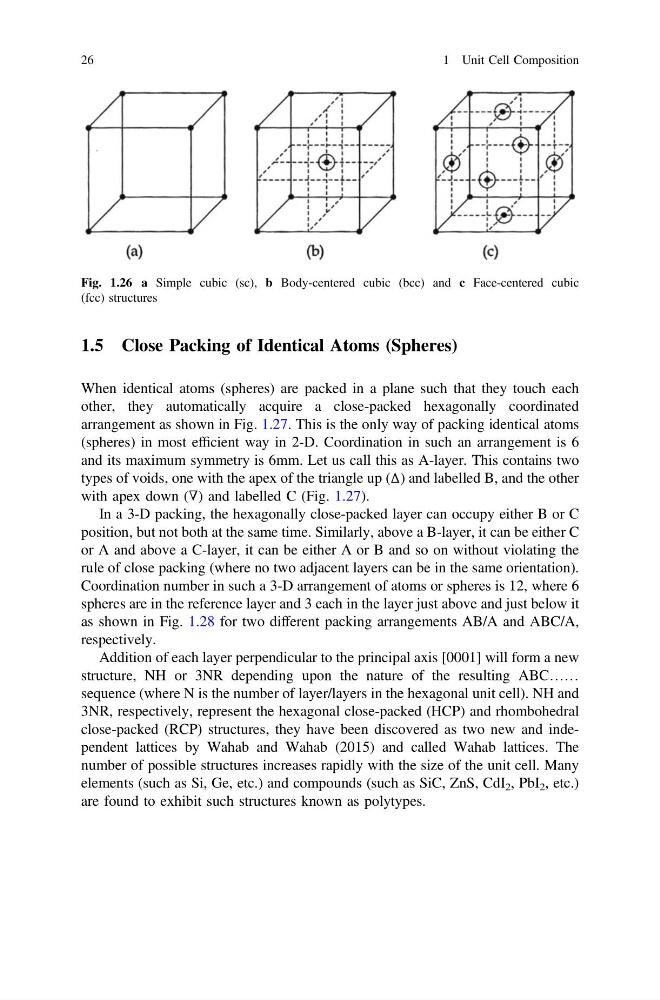
Fig. 1.26 a Simple cubic (sc), b Body-centered cubic (bcc) and c Face-centered cubic
(fcc) structures
26
1 Unit Cell Composition
When identical atoms (spheres) are packed in a plane such that they touch each
other, they automatically acquire a close-packed hexagonally coordinated
arrangement as shown in Fig. 1.27. This is the only way of packing identical atoms
(spheres) in most efficient way in 2-D. Coordination in such an arrangement is 6
and its maximum symmetry is 6mm. Let us call this as A-layer. This contains two
types of voids, one with the apex of the triangle up (Δ) and labelled B, and the other
with apex down (∇) and labelled C (Fig. 1.27).
In a 3-D packing, the hexagonally close-packed layer can occupy either B or C
position, but not both at the same time. Similarly, above a B-layer, it can be either C
or A and above a C-layer, it can be either A or B and so on without violating the
rule of close packing (where no two adjacent layers can be in the same orientation).
Coordination number in such a 3-D arrangement of atoms or spheres is 12, where 6
spheres are in the reference layer and 3 each in the layer just above and just below it
as shown in Fig. 1.28 for two different packing arrangements AB/A and ABC/A,
respectively.
Addition of each layer perpendicular to the principal axis [0001] will form a new
structure, NH or 3NR depending upon the nature of the resulting ABC……
sequence (where N is the number of layer/layers in the hexagonal unit cell). NH and
3NR, respectively, represent the hexagonal close-packed (HCP) and rhombohedral
close-packed (RCP) structures, they have been discovered as two new and independent lattices by Wahab and Wahab (2015) and called Wahab lattices. The
number of possible structures increases rapidly with the size of the unit cell. Many
elements (such as Si, Ge, etc.) and compounds (such as SiC, ZnS, CdI 2 , PbI 2 , etc.)
are found to exhibit such structures known as polytypes.
Fig. 1.26 a Simple cubic (sc), b Body-centered cubic (bcc) and c Face-centered cubic
(fcc) structures
26
1 Unit Cell Composition