

e
/i
¼ cos/ þ i sin /
The structure factor of each atom or ion has two components for each hkl value:
1. Phase angle contains the information only about the position of atom (or ion) in
the unit cell; that is, x, y, z, and
2. Amplitude contains information about the scattering of the particular kind of
atom (or ion) in the unit cell; for example, a carbon atom.
Phase angle
Phase angle can be determined if the location of the atom in the unit cell is known,
while the position of an atom in the unit cell is located by its fractional coordinates
x, y, z. For an atom j, the position vector ~ r j is given by
~ r j ¼ x j ~ a þ y j ~ b þ z j ~ c
where ~ a, ~ b, and ~ c are the basis vectors of the direct lattice. On the other hand, the
position of the hkl reflection in the reciprocal lattice is given by
HðhklÞ ¼ h a
Ã
þ k b
Ã
þ l c
Ã
where a
Ã
; b
Ã
; and c
à are the basis vectors in the reciprocal lattice. The phase angle of
the wave scattered from the atom j in the unit cell is given by the dot product in
radians as
/ ¼ 2p H hkl
ð Þ:r j ¼ hx j þ k y j þ l z j
ð8:3Þ
Amplitude
In X-ray diffraction, the amplitude of the scattered wave contains information about
the scattering of the particular kind of atom (or ion) in the unit cell; for example, a
carbon atom, a potassium atom, etc. When an isolated atom scatters, the atomic
scattering factor is a continuous function of sin θ/λ, where λ is the wavelength and θ
is any angle between 0 and 90°. The variable sin θ/λ is conveniently chosen to take
the advantage of the situation that the crystal scatters only at the Bragg angle, h hkl .
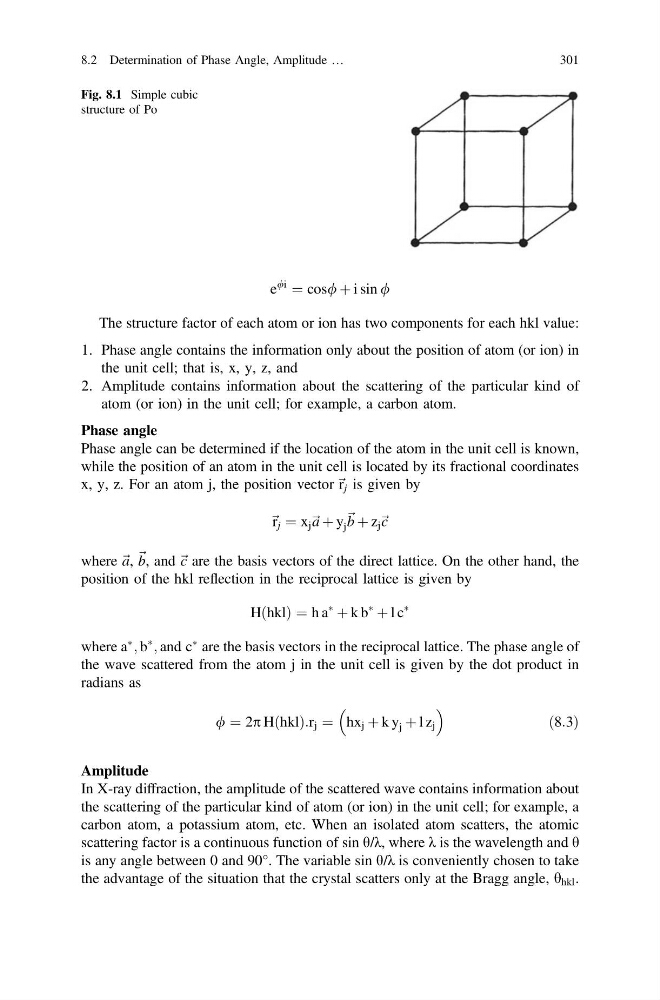
Fig. 8.1 Simple cubic
structure of Po
8.2 Determination of Phase Angle, Amplitude …
301
/i
¼ cos/ þ i sin /
The structure factor of each atom or ion has two components for each hkl value:
1. Phase angle contains the information only about the position of atom (or ion) in
the unit cell; that is, x, y, z, and
2. Amplitude contains information about the scattering of the particular kind of
atom (or ion) in the unit cell; for example, a carbon atom.
Phase angle
Phase angle can be determined if the location of the atom in the unit cell is known,
while the position of an atom in the unit cell is located by its fractional coordinates
x, y, z. For an atom j, the position vector ~ r j is given by
~ r j ¼ x j ~ a þ y j ~ b þ z j ~ c
where ~ a, ~ b, and ~ c are the basis vectors of the direct lattice. On the other hand, the
position of the hkl reflection in the reciprocal lattice is given by
HðhklÞ ¼ h a
Ã
þ k b
Ã
þ l c
Ã
where a
Ã
; b
Ã
; and c
à are the basis vectors in the reciprocal lattice. The phase angle of
the wave scattered from the atom j in the unit cell is given by the dot product in
radians as
/ ¼ 2p H hkl
ð Þ:r j ¼ hx j þ k y j þ l z j
ð8:3Þ
Amplitude
In X-ray diffraction, the amplitude of the scattered wave contains information about
the scattering of the particular kind of atom (or ion) in the unit cell; for example, a
carbon atom, a potassium atom, etc. When an isolated atom scatters, the atomic
scattering factor is a continuous function of sin θ/λ, where λ is the wavelength and θ
is any angle between 0 and 90°. The variable sin θ/λ is conveniently chosen to take
the advantage of the situation that the crystal scatters only at the Bragg angle, h hkl .
Fig. 8.1 Simple cubic
structure of Po
8.2 Determination of Phase Angle, Amplitude …
301