

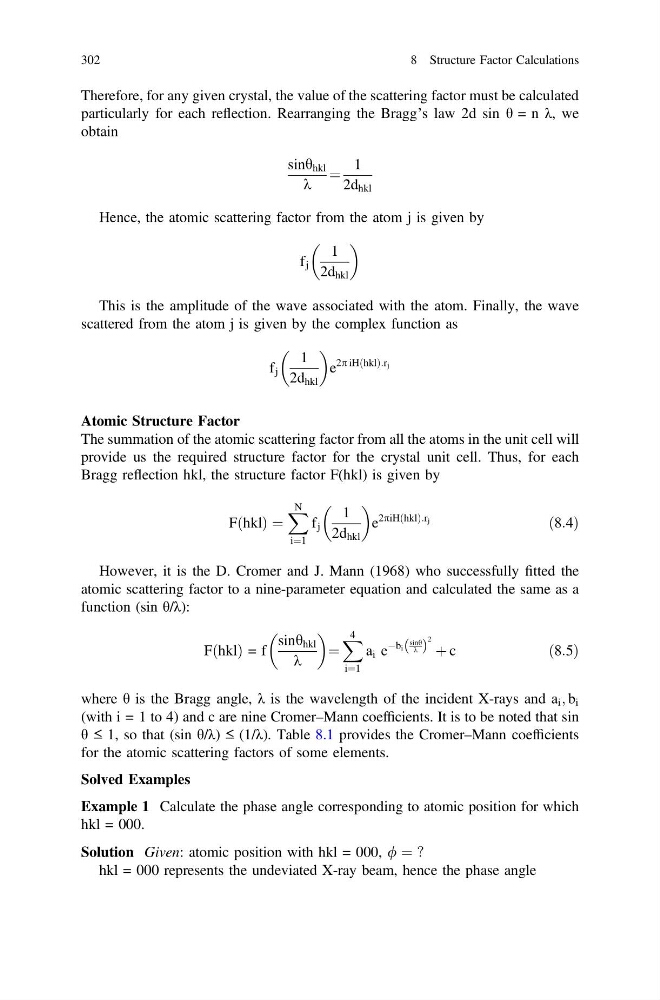
Therefore, for any given crystal, the value of the scattering factor must be calculated
particularly for each reflection. Rearranging the Bragg’s law 2d sin θ = n λ, we
obtain
sinh hkl
k
¼
1
2d hkl
Hence, the atomic scattering factor from the atom j is given by
f j
1
2d hkl
This is the amplitude of the wave associated with the atom. Finally, the wave
scattered from the atom j is given by the complex function as
f j
1
2d hkl
e
2p iH hkl
ð Þ:r j
Atomic Structure Factor
The summation of the atomic scattering factor from all the atoms in the unit cell will
provide us the required structure factor for the crystal unit cell. Thus, for each
Bragg reflection hkl, the structure factor F(hkl) is given by
F hkl
ð Þ ¼
X N
i¼1
f j
1
2d hkl
e
2piH hkl
ð Þ:r j
ð8:4Þ
However, it is the D. Cromer and J. Mann (1968) who successfully fitted the
atomic scattering factor to a nine-parameter equation and calculated the same as a
function (sin θ/λ):
F hkl
ð Þ = f
sinh hkl
k
¼
X 4
i¼1
a i e
Àb i
sinh
k
ð Þ
2 þ c
ð8:5Þ
where θ is the Bragg angle, λ is the wavelength of the incident X-rays and a i ; b i
(with i = 1 to 4) and c are nine Cromer–Mann coefficients. It is to be noted that sin
θ ≤ 1, so that (sin θ/λ) ≤ (1/λ). Table 8.1 provides the Cromer–Mann coefficients
for the atomic scattering factors of some elements.
Solved Examples
Example 1 Calculate the phase angle corresponding to atomic position for which
hkl = 000.
Solution Given: atomic position with hkl = 000, / ¼ ?
hkl = 000 represents the undeviated X-ray beam, hence the phase angle
302
8 Structure Factor Calculations
particularly for each reflection. Rearranging the Bragg’s law 2d sin θ = n λ, we
obtain
sinh hkl
k
¼
1
2d hkl
Hence, the atomic scattering factor from the atom j is given by
f j
1
2d hkl
This is the amplitude of the wave associated with the atom. Finally, the wave
scattered from the atom j is given by the complex function as
f j
1
2d hkl
e
2p iH hkl
ð Þ:r j
Atomic Structure Factor
The summation of the atomic scattering factor from all the atoms in the unit cell will
provide us the required structure factor for the crystal unit cell. Thus, for each
Bragg reflection hkl, the structure factor F(hkl) is given by
F hkl
ð Þ ¼
X N
i¼1
f j
1
2d hkl
e
2piH hkl
ð Þ:r j
ð8:4Þ
However, it is the D. Cromer and J. Mann (1968) who successfully fitted the
atomic scattering factor to a nine-parameter equation and calculated the same as a
function (sin θ/λ):
F hkl
ð Þ = f
sinh hkl
k
¼
X 4
i¼1
a i e
Àb i
sinh
k
ð Þ
2 þ c
ð8:5Þ
where θ is the Bragg angle, λ is the wavelength of the incident X-rays and a i ; b i
(with i = 1 to 4) and c are nine Cromer–Mann coefficients. It is to be noted that sin
θ ≤ 1, so that (sin θ/λ) ≤ (1/λ). Table 8.1 provides the Cromer–Mann coefficients
for the atomic scattering factors of some elements.
Solved Examples
Example 1 Calculate the phase angle corresponding to atomic position for which
hkl = 000.
Solution Given: atomic position with hkl = 000, / ¼ ?
hkl = 000 represents the undeviated X-ray beam, hence the phase angle
302
8 Structure Factor Calculations