

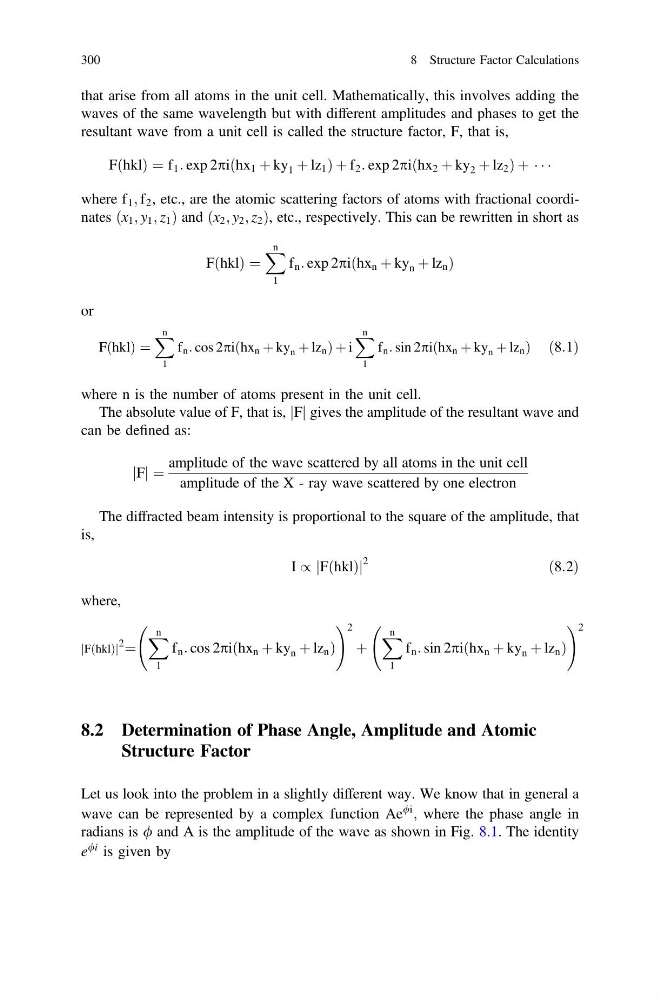
that arise from all atoms in the unit cell. Mathematically, this involves adding the
waves of the same wavelength but with different amplitudes and phases to get the
resultant wave from a unit cell is called the structure factor, F, that is,
FðhklÞ ¼ f 1 : exp 2pi hx 1 þ ky 1 þ lz 1
ð
Þ þ f 2 : exp 2pi hx 2 þ ky 2 þ lz 2
ð
Þ þ Á Á Á
where f 1 ; f 2 , etc., are the atomic scattering factors of atoms with fractional coordinates x 1 ; y 1 ; z 1
ð
Þand x 2 ; y 2 ; z 2
ð
Þ , etc., respectively. This can be rewritten in short as
F hkl
ð Þ ¼
X n
1
f n : exp 2pi hx n þ ky n þ lz n
ð
Þ
or
F hkl
ð Þ ¼
X n
1
f n : cos 2pi hx n þ ky n þ lz n
ð
Þ þ i
X n
1
f n : sin 2pi hx n þ ky n þ lz n
ð
Þ ð8:1Þ
where n is the number of atoms present in the unit cell.
The absolute value of F, that is, F
j j gives the amplitude of the resultant wave and
can be defined as:
F
j j ¼
amplitude of the wave scattered by all atoms in the unit cell
amplitude of the X - ray wave scattered by one electron
The diffracted beam intensity is proportional to the square of the amplitude, that
is,
I / FðhklÞ
j
j
2
ð8:2Þ
where,
FðhklÞ
j
j
2
¼
X n
1
f n : cos 2pi hx n þ ky n þ lz n
ð
Þ
! 2
þ
X n
1
f n : sin 2pi hx n þ ky n þ lz n
ð
Þ
! 2
8.2 Determination of Phase Angle, Amplitude and Atomic
Structure Factor
Let us look into the problem in a slightly different way. We know that in general a
wave can be represented by a complex function Ae
/i
; where the phase angle in
radians is / and A is the amplitude of the wave as shown in Fig. 8.1. The identity
e
/i is given by
300
8 Structure Factor Calculations
waves of the same wavelength but with different amplitudes and phases to get the
resultant wave from a unit cell is called the structure factor, F, that is,
FðhklÞ ¼ f 1 : exp 2pi hx 1 þ ky 1 þ lz 1
ð
Þ þ f 2 : exp 2pi hx 2 þ ky 2 þ lz 2
ð
Þ þ Á Á Á
where f 1 ; f 2 , etc., are the atomic scattering factors of atoms with fractional coordinates x 1 ; y 1 ; z 1
ð
Þand x 2 ; y 2 ; z 2
ð
Þ , etc., respectively. This can be rewritten in short as
F hkl
ð Þ ¼
X n
1
f n : exp 2pi hx n þ ky n þ lz n
ð
Þ
or
F hkl
ð Þ ¼
X n
1
f n : cos 2pi hx n þ ky n þ lz n
ð
Þ þ i
X n
1
f n : sin 2pi hx n þ ky n þ lz n
ð
Þ ð8:1Þ
where n is the number of atoms present in the unit cell.
The absolute value of F, that is, F
j j gives the amplitude of the resultant wave and
can be defined as:
F
j j ¼
amplitude of the wave scattered by all atoms in the unit cell
amplitude of the X - ray wave scattered by one electron
The diffracted beam intensity is proportional to the square of the amplitude, that
is,
I / FðhklÞ
j
j
2
ð8:2Þ
where,
FðhklÞ
j
j
2
¼
X n
1
f n : cos 2pi hx n þ ky n þ lz n
ð
Þ
! 2
þ
X n
1
f n : sin 2pi hx n þ ky n þ lz n
ð
Þ
! 2
8.2 Determination of Phase Angle, Amplitude and Atomic
Structure Factor
Let us look into the problem in a slightly different way. We know that in general a
wave can be represented by a complex function Ae
/i
; where the phase angle in
radians is / and A is the amplitude of the wave as shown in Fig. 8.1. The identity
e
/i is given by
300
8 Structure Factor Calculations