

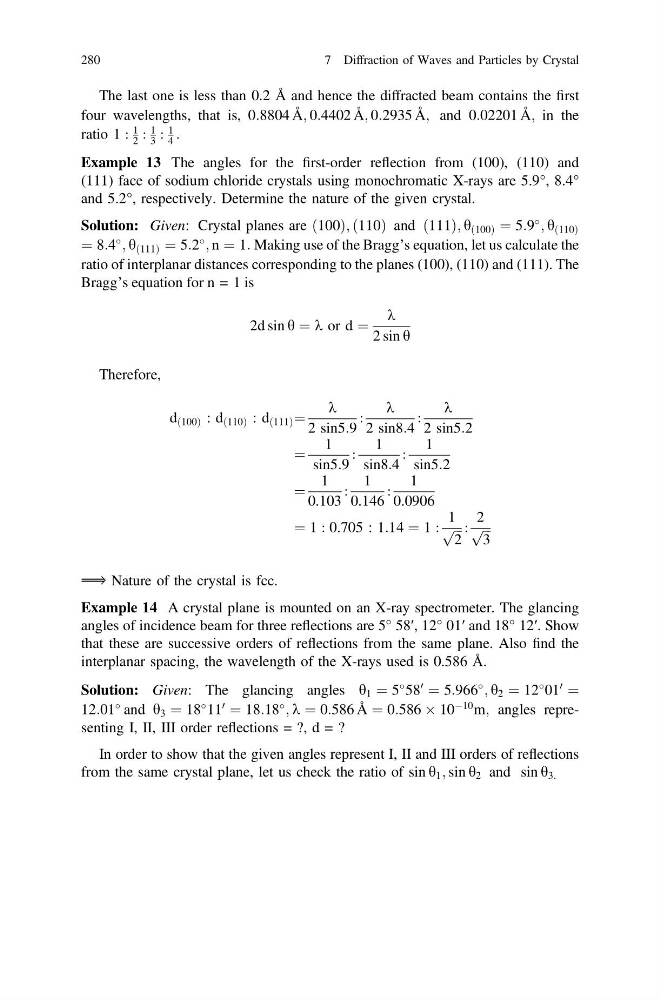
The last one is less than 0.2 Å and hence the diffracted beam contains the first
four wavelengths, that is, 0:8804 ˚
A; 0:4402 ˚
A; 0:2935 ˚
A; and 0:02201 ˚
A; in the
ratio 1 :
1
2 :
1
3 :
1
4 :
Example 13 The angles for the first-order reflection from (100), (110) and
(111) face of sodium chloride crystals using monochromatic X-rays are 5.9°, 8.4°
and 5.2°, respectively. Determine the nature of the given crystal.
Solution: Given: Crystal planes are 100
ð
Þ; 110
ð
Þ and 111
ð
Þ; h ð100Þ ¼ 5:9
; h ð110Þ
¼ 8:4
; h ð111Þ ¼ 5:2
; n ¼ 1: Making use of the Bragg’s equation, let us calculate the
ratio of interplanar distances corresponding to the planes (100), (110) and (111). The
Bragg’s equation for n = 1 is
2d sin h ¼ k or d ¼
k
2 sin h
Therefore,
d ð100Þ : d ð110Þ : d ð111Þ ¼
k
2 sin5:9
:
k
2 sin8:4
:
k
2 sin5:2
¼
1
sin5:9
:
1
sin8:4
:
1
sin5:2
¼
1
0.103
:
1
0.146
:
1
0.0906
¼ 1 : 0.705 : 1:14 ¼ 1 :
1
ffiffi ffi
2
p :
2
ffiffi ffi
3
p
⟹ Nature of the crystal is fcc.
Example 14 A crystal plane is mounted on an X-ray spectrometer. The glancing
angles of incidence beam for three reflections are 5° 58′, 12° 01′ and 18° 12′. Show
that these are successive orders of reflections from the same plane. Also find the
interplanar spacing, the wavelength of the X-rays used is 0.586 Å.
Solution: Given: The glancing angles h 1 ¼ 5
58
0
¼ 5:966
; h 2 ¼ 12
01
0
¼
12:01
and h 3 ¼ 18
11
0
¼ 18:18
; k ¼ 0:586 ˚
A ¼ 0:586 Â 10
À10 m; angles representing I, II, III order reflections = ?, d = ?
In order to show that the given angles represent I, II and III orders of reflections
from the same crystal plane, let us check the ratio of sin h 1 ; sin h 2 and sin h 3:
280
7 Diffraction of Waves and Particles by Crystal
four wavelengths, that is, 0:8804 ˚
A; 0:4402 ˚
A; 0:2935 ˚
A; and 0:02201 ˚
A; in the
ratio 1 :
1
2 :
1
3 :
1
4 :
Example 13 The angles for the first-order reflection from (100), (110) and
(111) face of sodium chloride crystals using monochromatic X-rays are 5.9°, 8.4°
and 5.2°, respectively. Determine the nature of the given crystal.
Solution: Given: Crystal planes are 100
ð
Þ; 110
ð
Þ and 111
ð
Þ; h ð100Þ ¼ 5:9
; h ð110Þ
¼ 8:4
; h ð111Þ ¼ 5:2
; n ¼ 1: Making use of the Bragg’s equation, let us calculate the
ratio of interplanar distances corresponding to the planes (100), (110) and (111). The
Bragg’s equation for n = 1 is
2d sin h ¼ k or d ¼
k
2 sin h
Therefore,
d ð100Þ : d ð110Þ : d ð111Þ ¼
k
2 sin5:9
:
k
2 sin8:4
:
k
2 sin5:2
¼
1
sin5:9
:
1
sin8:4
:
1
sin5:2
¼
1
0.103
:
1
0.146
:
1
0.0906
¼ 1 : 0.705 : 1:14 ¼ 1 :
1
ffiffi ffi
2
p :
2
ffiffi ffi
3
p
⟹ Nature of the crystal is fcc.
Example 14 A crystal plane is mounted on an X-ray spectrometer. The glancing
angles of incidence beam for three reflections are 5° 58′, 12° 01′ and 18° 12′. Show
that these are successive orders of reflections from the same plane. Also find the
interplanar spacing, the wavelength of the X-rays used is 0.586 Å.
Solution: Given: The glancing angles h 1 ¼ 5
58
0
¼ 5:966
; h 2 ¼ 12
01
0
¼
12:01
and h 3 ¼ 18
11
0
¼ 18:18
; k ¼ 0:586 ˚
A ¼ 0:586 Â 10
À10 m; angles representing I, II, III order reflections = ?, d = ?
In order to show that the given angles represent I, II and III orders of reflections
from the same crystal plane, let us check the ratio of sin h 1 ; sin h 2 and sin h 3:
280
7 Diffraction of Waves and Particles by Crystal