

sin h 1 : sin h 2 : sin h 3 ¼ sin 5:966 : sin 12:01 : sin 18:18 ¼ 0:1040 : 0:2080
: 0:3120 ¼ 1 : 2 : 3
⟹ These angles of incidence correspond to I, II and III orders of reflections,
respectively.
Now, from Bragg’s equation 2d sin h ¼ nk; we obtain
For I order; d ¼
1k
2 sin h 1
¼
0:586 Â 10
À10
2 Â 0:1040
¼ 2:817 Â 10
À10 m
For II order; d ¼
2k
2 sin h 2
¼
2 Â 0:586 Â 10
À10
2 Â 0:2080
¼ 2:817 Â 10
À10 m
For III order; d ¼
3k
2 sin h 3
¼
3 Â 0:586 Â 10
À10
2 Â 0:3120
¼ 2:817 Â 10
À10 m
Hence the mean value of the interplanar spacing, d ¼ 2:817 Â 10
À10 m:
7.3 Absorption of X-Rays
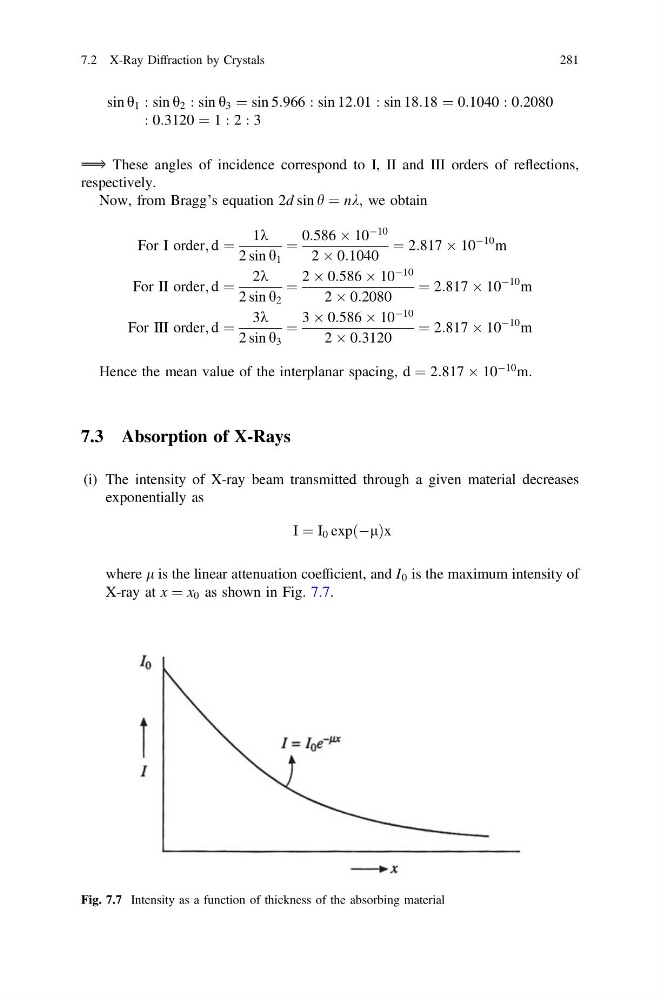
(i) The intensity of X-ray beam transmitted through a given material decreases
exponentially as
I ¼ I 0 exp Àl
ð Þx
where l is the linear attenuation coefficient, and I 0 is the maximum intensity of
X-ray at x ¼ x 0 as shown in Fig. 7.7.
Fig. 7.7 Intensity as a function of thickness of the absorbing material
7.2 X-Ray Diffraction by Crystals
281
: 0:3120 ¼ 1 : 2 : 3
⟹ These angles of incidence correspond to I, II and III orders of reflections,
respectively.
Now, from Bragg’s equation 2d sin h ¼ nk; we obtain
For I order; d ¼
1k
2 sin h 1
¼
0:586 Â 10
À10
2 Â 0:1040
¼ 2:817 Â 10
À10 m
For II order; d ¼
2k
2 sin h 2
¼
2 Â 0:586 Â 10
À10
2 Â 0:2080
¼ 2:817 Â 10
À10 m
For III order; d ¼
3k
2 sin h 3
¼
3 Â 0:586 Â 10
À10
2 Â 0:3120
¼ 2:817 Â 10
À10 m
Hence the mean value of the interplanar spacing, d ¼ 2:817 Â 10
À10 m:
7.3 Absorption of X-Rays
(i) The intensity of X-ray beam transmitted through a given material decreases
exponentially as
I ¼ I 0 exp Àl
ð Þx
where l is the linear attenuation coefficient, and I 0 is the maximum intensity of
X-ray at x ¼ x 0 as shown in Fig. 7.7.
Fig. 7.7 Intensity as a function of thickness of the absorbing material
7.2 X-Ray Diffraction by Crystals
281