

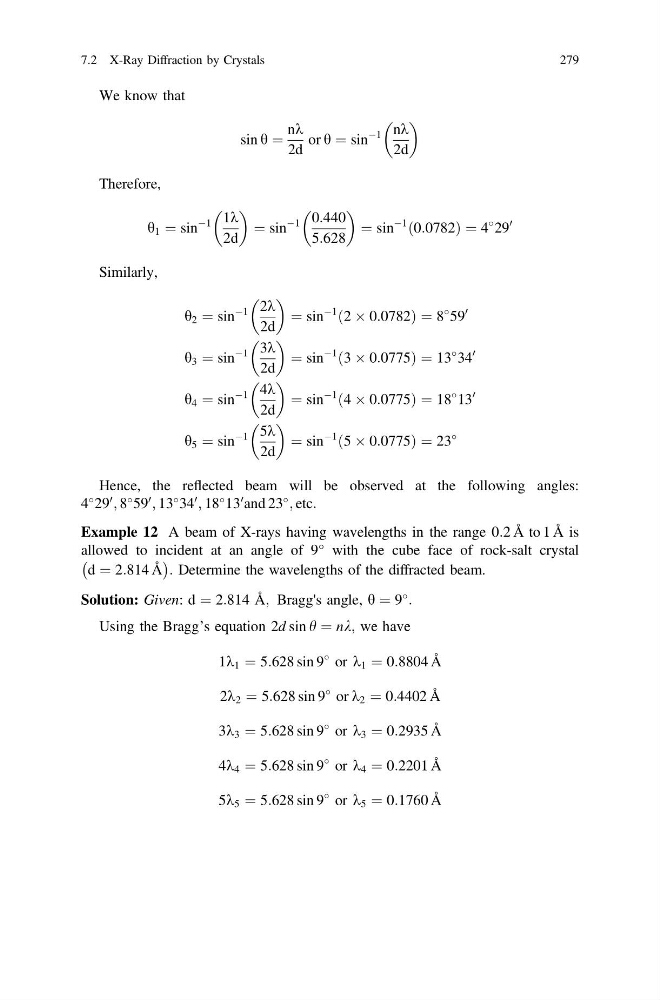
We know that
sin h ¼
nk
2d
or h ¼ sin
À1 nk
2d
Therefore,
h 1 ¼ sin
À1 1k
2d
¼ sin
À1 0:440
5:628
¼ sin
À1 0:0782
ð
Þ¼4
29
0
Similarly,
h 2 ¼ sin
À1 2k
2d
¼ sin
À1 2 Â 0:0782
ð
Þ¼8
59
0
h 3 ¼ sin
À1 3k
2d
¼ sin
À1 3 Â 0:0775
ð
Þ¼13
34
0
h 4 ¼ sin
À1 4k
2d
¼ sin
À1 4 Â 0:0775
ð
Þ¼18
13
0
h 5 ¼ sin
À1 5k
2d
¼ sin
À1 5 Â 0:0775
ð
Þ¼23
Hence, the reflected beam will be observed at the following angles:
4
29
0
; 8
59
0
; 13
34
0
; 18
13
0 and 23
; etc:
Example 12 A beam of X-rays having wavelengths in the range 0:2 ˚
A to 1 ˚
A is
allowed to incident at an angle of 9° with the cube face of rock-salt crystal
d ¼ 2:814 ˚
A
À
Á : Determine the wavelengths of the diffracted beam.
Solution: Given: d ¼ 2:814 ˚
A; Bragg's angle, h ¼ 9
:
Using the Bragg’s equation 2d sin h ¼ nk; we have
1k 1 ¼ 5:628 sin 9
or k 1 ¼ 0:8804 ˚
A
2k 2 ¼ 5:628 sin 9
or k 2 ¼ 0:4402 ˚
A
3k 3 ¼ 5:628 sin 9
or k 3 ¼ 0:2935 ˚
A
4k 4 ¼ 5:628 sin 9
or k 4 ¼ 0:2201 ˚
A
5k 5 ¼ 5:628 sin 9
or k 5 ¼ 0:1760 ˚
A
7.2 X-Ray Diffraction by Crystals
279
sin h ¼
nk
2d
or h ¼ sin
À1 nk
2d
Therefore,
h 1 ¼ sin
À1 1k
2d
¼ sin
À1 0:440
5:628
¼ sin
À1 0:0782
ð
Þ¼4
29
0
Similarly,
h 2 ¼ sin
À1 2k
2d
¼ sin
À1 2 Â 0:0782
ð
Þ¼8
59
0
h 3 ¼ sin
À1 3k
2d
¼ sin
À1 3 Â 0:0775
ð
Þ¼13
34
0
h 4 ¼ sin
À1 4k
2d
¼ sin
À1 4 Â 0:0775
ð
Þ¼18
13
0
h 5 ¼ sin
À1 5k
2d
¼ sin
À1 5 Â 0:0775
ð
Þ¼23
Hence, the reflected beam will be observed at the following angles:
4
29
0
; 8
59
0
; 13
34
0
; 18
13
0 and 23
; etc:
Example 12 A beam of X-rays having wavelengths in the range 0:2 ˚
A to 1 ˚
A is
allowed to incident at an angle of 9° with the cube face of rock-salt crystal
d ¼ 2:814 ˚
A
À
Á : Determine the wavelengths of the diffracted beam.
Solution: Given: d ¼ 2:814 ˚
A; Bragg's angle, h ¼ 9
:
Using the Bragg’s equation 2d sin h ¼ nk; we have
1k 1 ¼ 5:628 sin 9
or k 1 ¼ 0:8804 ˚
A
2k 2 ¼ 5:628 sin 9
or k 2 ¼ 0:4402 ˚
A
3k 3 ¼ 5:628 sin 9
or k 3 ¼ 0:2935 ˚
A
4k 4 ¼ 5:628 sin 9
or k 4 ¼ 0:2201 ˚
A
5k 5 ¼ 5:628 sin 9
or k 5 ¼ 0:1760 ˚
A
7.2 X-Ray Diffraction by Crystals
279