

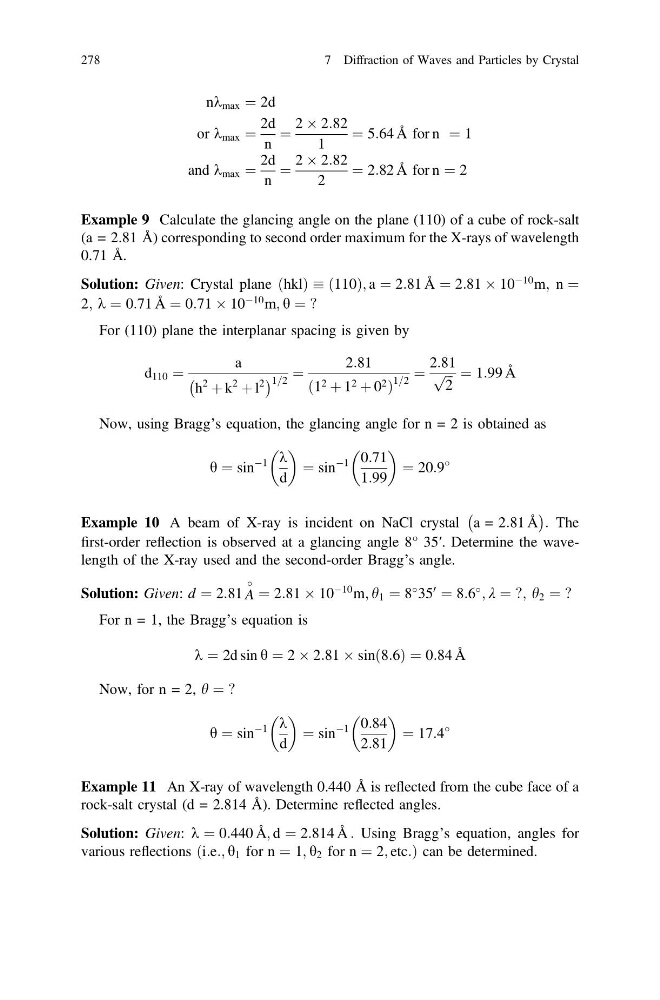
nk max ¼ 2d
or k max ¼
2d
n
¼
2 Â 2:82
1
¼ 5:64 ˚
A for n ¼ 1
and k max ¼
2d
n
¼
2 Â 2:82
2
¼ 2:82 ˚
A for n ¼ 2
Example 9 Calculate the glancing angle on the plane (110) of a cube of rock-salt
(a = 2.81 Å) corresponding to second order maximum for the X-rays of wavelength
0.71 Å.
Solution: Given: Crystal plane hkl
ð Þ 110
ð
Þ; a ¼ 2:81 ˚
A ¼ 2:81 Â 10
À10 m; n ¼
2; k ¼ 0:71 ˚
A ¼ 0:71 Â 10
À10 m; h ¼ ?
For (110) plane the interplanar spacing is given by
d 110 ¼
a
h
2
þ k
2
þ l
2
À
Á 1=2 ¼
2:81
1 2 þ 1 2 þ 0 2
ð
Þ
1=2
¼
2:81
ffiffi ffi
2
p ¼ 1:99 ˚
A
Now, using Bragg’s equation, the glancing angle for n = 2 is obtained as
h ¼ sin
À1 k
d
¼ sin
À1 0:71
1:99
¼ 20:9
Example 10 A beam of X-ray is incident on NaCl crystal a = 2:81 ˚
A
À
Á : The
first-order reflection is observed at a glancing angle 8° 35′. Determine the wavelength of the X-ray used and the second-order Bragg’s angle.
Solution: Given: d ¼ 2:81 A
¼ 2:81 Â 10
À10 m; h 1 ¼ 8
35
0
¼ 8:6
; k ¼ ?; h 2 ¼ ?
For n = 1, the Bragg’s equation is
k ¼ 2d sin h ¼ 2 Â 2:81 Â sin 8:6
ð Þ ¼ 0:84 ˚
A
Now, for n = 2, h ¼ ?
h ¼ sin
À1 k
d
¼ sin
À1 0:84
2:81
¼ 17:4
Example 11 An X-ray of wavelength 0.440 Å is reflected from the cube face of a
rock-salt crystal (d = 2.814 Å). Determine reflected angles.
Solution: Given: k ¼ 0:440 ˚
A; d ¼ 2:814 ˚
A : Using Bragg’s equation, angles for
various reflections ði:e:; h 1 for n ¼ 1; h 2 for n ¼ 2; etc:Þ can be determined.
278
7 Diffraction of Waves and Particles by Crystal
or k max ¼
2d
n
¼
2 Â 2:82
1
¼ 5:64 ˚
A for n ¼ 1
and k max ¼
2d
n
¼
2 Â 2:82
2
¼ 2:82 ˚
A for n ¼ 2
Example 9 Calculate the glancing angle on the plane (110) of a cube of rock-salt
(a = 2.81 Å) corresponding to second order maximum for the X-rays of wavelength
0.71 Å.
Solution: Given: Crystal plane hkl
ð Þ 110
ð
Þ; a ¼ 2:81 ˚
A ¼ 2:81 Â 10
À10 m; n ¼
2; k ¼ 0:71 ˚
A ¼ 0:71 Â 10
À10 m; h ¼ ?
For (110) plane the interplanar spacing is given by
d 110 ¼
a
h
2
þ k
2
þ l
2
À
Á 1=2 ¼
2:81
1 2 þ 1 2 þ 0 2
ð
Þ
1=2
¼
2:81
ffiffi ffi
2
p ¼ 1:99 ˚
A
Now, using Bragg’s equation, the glancing angle for n = 2 is obtained as
h ¼ sin
À1 k
d
¼ sin
À1 0:71
1:99
¼ 20:9
Example 10 A beam of X-ray is incident on NaCl crystal a = 2:81 ˚
A
À
Á : The
first-order reflection is observed at a glancing angle 8° 35′. Determine the wavelength of the X-ray used and the second-order Bragg’s angle.
Solution: Given: d ¼ 2:81 A
¼ 2:81 Â 10
À10 m; h 1 ¼ 8
35
0
¼ 8:6
; k ¼ ?; h 2 ¼ ?
For n = 1, the Bragg’s equation is
k ¼ 2d sin h ¼ 2 Â 2:81 Â sin 8:6
ð Þ ¼ 0:84 ˚
A
Now, for n = 2, h ¼ ?
h ¼ sin
À1 k
d
¼ sin
À1 0:84
2:81
¼ 17:4
Example 11 An X-ray of wavelength 0.440 Å is reflected from the cube face of a
rock-salt crystal (d = 2.814 Å). Determine reflected angles.
Solution: Given: k ¼ 0:440 ˚
A; d ¼ 2:814 ˚
A : Using Bragg’s equation, angles for
various reflections ði:e:; h 1 for n ¼ 1; h 2 for n ¼ 2; etc:Þ can be determined.
278
7 Diffraction of Waves and Particles by Crystal