

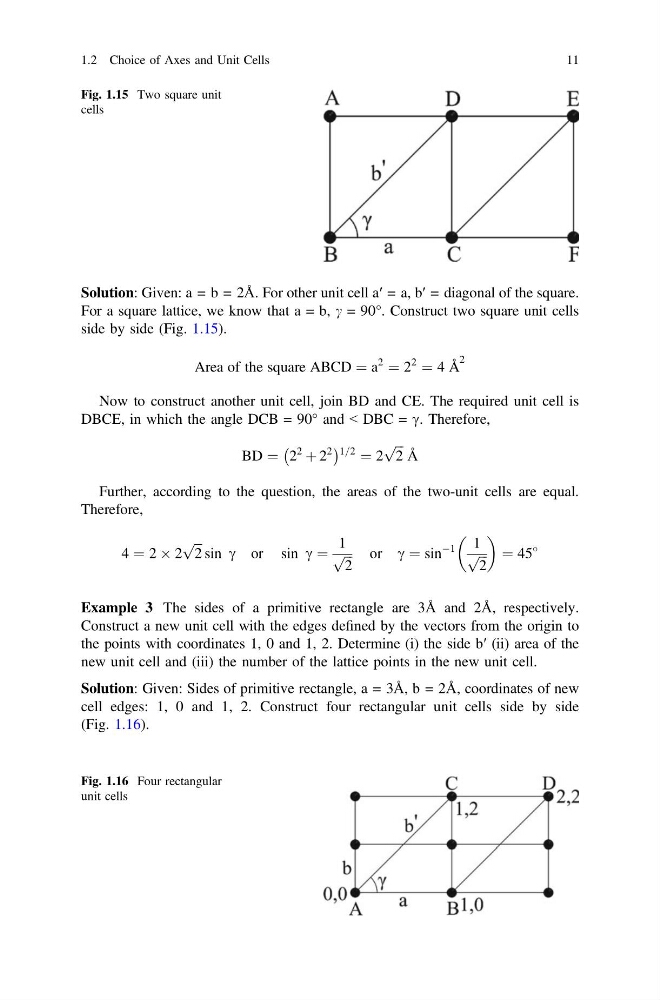
Solution: Given: a = b = 2Å. For other unit cell a′ = a, b′ = diagonal of the square.
For a square lattice, we know that a = b, c = 90°. Construct two square unit cells
side by side (Fig. 1.15).
Area of the square ABCD ¼ a
2
¼ 2
2
¼ 4 ˚
A
2
Now to construct another unit cell, join BD and CE. The required unit cell is
DBCE, in which the angle DCB = 90° and ˂ DBC = c. Therefore,
BD ¼ 2
2
þ 2
2
À
Á 1=2 ¼ 2
ffiffi ffi
2
p ˚
A
Further, according to the question, the areas of the two-unit cells are equal.
Therefore,
4 ¼ 2 Â 2
ffiffi ffi
2
p
sin c or sin c ¼
1
ffiffi ffi
2
p
or c ¼ sin
À1
1
ffiffi ffi
2
p
¼ 45
Example 3 The sides of a primitive rectangle are 3Å and 2Å, respectively.
Construct a new unit cell with the edges defined by the vectors from the origin to
the points with coordinates 1, 0 and 1, 2. Determine (i) the side b′ (ii) area of the
new unit cell and (iii) the number of the lattice points in the new unit cell.
Solution: Given: Sides of primitive rectangle, a = 3Å, b = 2Å, coordinates of new
cell edges: 1, 0 and 1, 2. Construct four rectangular unit cells side by side
(Fig. 1.16).
Fig. 1.15 Two square unit
cells
Fig. 1.16 Four rectangular
unit cells
1.2 Choice of Axes and Unit Cells
11
For a square lattice, we know that a = b, c = 90°. Construct two square unit cells
side by side (Fig. 1.15).
Area of the square ABCD ¼ a
2
¼ 2
2
¼ 4 ˚
A
2
Now to construct another unit cell, join BD and CE. The required unit cell is
DBCE, in which the angle DCB = 90° and ˂ DBC = c. Therefore,
BD ¼ 2
2
þ 2
2
À
Á 1=2 ¼ 2
ffiffi ffi
2
p ˚
A
Further, according to the question, the areas of the two-unit cells are equal.
Therefore,
4 ¼ 2 Â 2
ffiffi ffi
2
p
sin c or sin c ¼
1
ffiffi ffi
2
p
or c ¼ sin
À1
1
ffiffi ffi
2
p
¼ 45
Example 3 The sides of a primitive rectangle are 3Å and 2Å, respectively.
Construct a new unit cell with the edges defined by the vectors from the origin to
the points with coordinates 1, 0 and 1, 2. Determine (i) the side b′ (ii) area of the
new unit cell and (iii) the number of the lattice points in the new unit cell.
Solution: Given: Sides of primitive rectangle, a = 3Å, b = 2Å, coordinates of new
cell edges: 1, 0 and 1, 2. Construct four rectangular unit cells side by side
(Fig. 1.16).
Fig. 1.15 Two square unit
cells
Fig. 1.16 Four rectangular
unit cells
1.2 Choice of Axes and Unit Cells
11