

V cell ¼ ~ a Á ~ b Â~ c
¼ abc 1 À cos
2
a À cos
2
b À cos
2
c þ 2 cos a cos b cos c
À
Á 1=2 Triclinic
ð
Þ
¼ abc sin b Monoclinic
ð
Þ
¼ abc sin c ¼ a
2 c sin 120
¼
ffiffi ffi
3
p
2
a
2 c Hexagonal
ð
Þ
¼ abc Orthogonal Cells
ð
Þ
¼ a
3
ðCubicÞ
ð1:5Þ
Solved Examples
Example 1 Determine the area of a primitive rectangle whose sides are 4Å and
3Å, respectively. Construct another primitive cell of equal area whose sides are 4Å
and 5Å. Determine the angle between them.
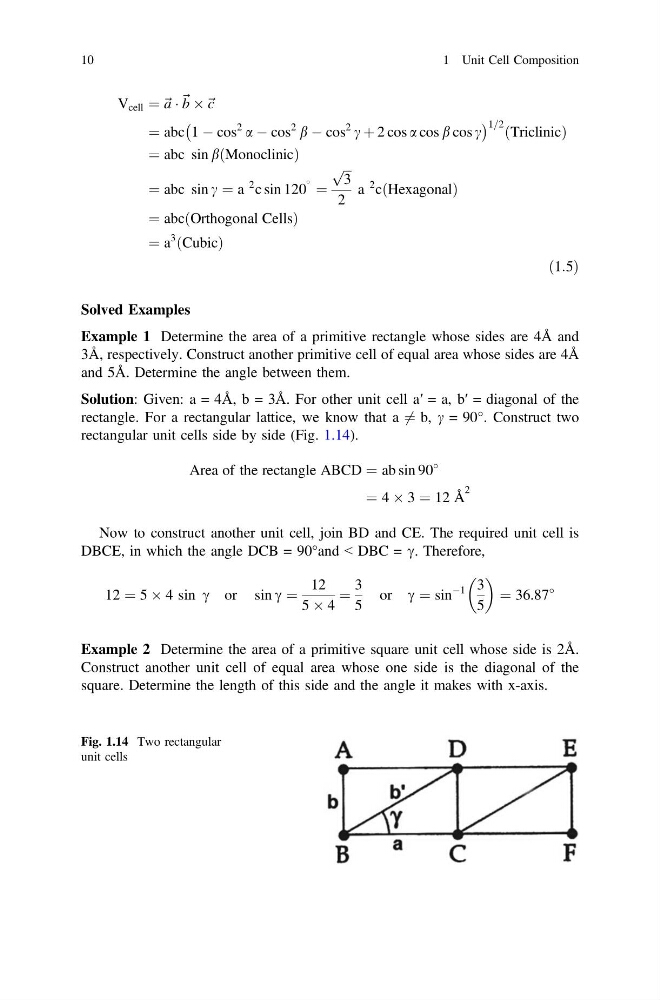
Solution: Given: a = 4Å, b = 3Å. For other unit cell a′ = a, b′ = diagonal of the
rectangle. For a rectangular lattice, we know that a 6 ¼ b, c = 90°. Construct two
rectangular unit cells side by side (Fig. 1.14).
Area of the rectangle ABCD ¼ ab sin 90
¼ 4 Â 3 ¼ 12 ˚
A
2
Now to construct another unit cell, join BD and CE. The required unit cell is
DBCE, in which the angle DCB = 90°and ˂ DBC = c. Therefore,
12 ¼ 5 Â 4 sin c or sin c ¼
12
5 Â 4
¼
3
5
or c ¼ sin
À1 3
5
¼ 36.87
Example 2 Determine the area of a primitive square unit cell whose side is 2Å.
Construct another unit cell of equal area whose one side is the diagonal of the
square. Determine the length of this side and the angle it makes with x-axis.
Fig. 1.14 Two rectangular
unit cells
10
1 Unit Cell Composition
¼ abc 1 À cos
2
a À cos
2
b À cos
2
c þ 2 cos a cos b cos c
À
Á 1=2 Triclinic
ð
Þ
¼ abc sin b Monoclinic
ð
Þ
¼ abc sin c ¼ a
2 c sin 120
¼
ffiffi ffi
3
p
2
a
2 c Hexagonal
ð
Þ
¼ abc Orthogonal Cells
ð
Þ
¼ a
3
ðCubicÞ
ð1:5Þ
Solved Examples
Example 1 Determine the area of a primitive rectangle whose sides are 4Å and
3Å, respectively. Construct another primitive cell of equal area whose sides are 4Å
and 5Å. Determine the angle between them.
Solution: Given: a = 4Å, b = 3Å. For other unit cell a′ = a, b′ = diagonal of the
rectangle. For a rectangular lattice, we know that a 6 ¼ b, c = 90°. Construct two
rectangular unit cells side by side (Fig. 1.14).
Area of the rectangle ABCD ¼ ab sin 90
¼ 4 Â 3 ¼ 12 ˚
A
2
Now to construct another unit cell, join BD and CE. The required unit cell is
DBCE, in which the angle DCB = 90°and ˂ DBC = c. Therefore,
12 ¼ 5 Â 4 sin c or sin c ¼
12
5 Â 4
¼
3
5
or c ¼ sin
À1 3
5
¼ 36.87
Example 2 Determine the area of a primitive square unit cell whose side is 2Å.
Construct another unit cell of equal area whose one side is the diagonal of the
square. Determine the length of this side and the angle it makes with x-axis.
Fig. 1.14 Two rectangular
unit cells
10
1 Unit Cell Composition