

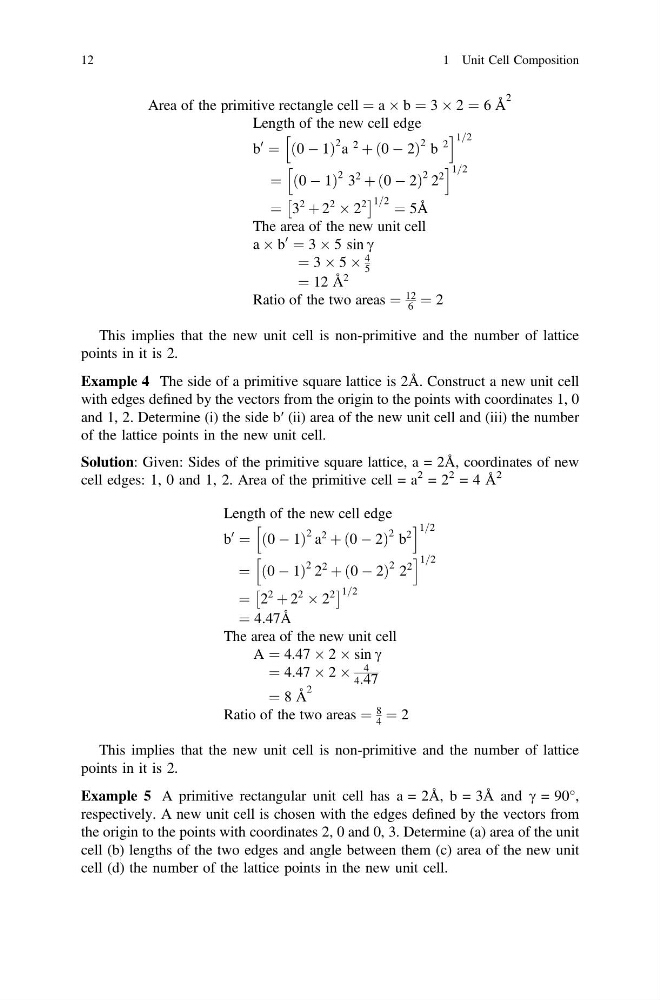
Area of the primitive rectangle cell ¼ a  b ¼ 3  2 ¼ 6 ˚
A
2
Length of the new cell edge
b
0
¼ 0 À 1
ð
Þ
2 a
2
þ 0 À 2
ð
Þ
2 b
2
h
i 1=2
¼ 0 À 1
ð
Þ
2 3
2
þ 0 À 2
ð
Þ
2 2
2
h
i 1=2
¼ 3
2
þ 2
2
 2
2
Â
à 1=2 ¼ 5 ˚
A
The area of the new unit cell
a  b
0
¼ 3 Â 5 sin c
¼ 3 Â 5 Â
4
5
¼ 12 ˚
A
2
Ratio of the two areas ¼
12
6 ¼ 2
This implies that the new unit cell is non-primitive and the number of lattice
points in it is 2.
Example 4 The side of a primitive square lattice is 2Å. Construct a new unit cell
with edges defined by the vectors from the origin to the points with coordinates 1, 0
and 1, 2. Determine (i) the side b′ (ii) area of the new unit cell and (iii) the number
of the lattice points in the new unit cell.
Solution: Given: Sides of the primitive square lattice, a = 2Å, coordinates of new
cell edges: 1, 0 and 1, 2. Area of the primitive cell = a
2 = 2
2 = 4 Å
2
Length of the new cell edge
b
0
¼ 0 À 1
ð
Þ
2 a
2
þ 0 À 2
ð
Þ
2 b
2
h
i 1=2
¼ 0 À 1
ð
Þ
2 2
2
þ 0 À 2
ð
Þ
2 2
2
h
i 1=2
¼ 2
2
þ 2
2
 2
2
Â
à 1=2
¼ 4.47 ˚
A
The area of the new unit cell
A ¼ 4.47 Â 2 Â sin c
¼ 4.47 Â 2 Â
4
4.47
¼ 8 ˚
A
2
Ratio of the two areas ¼
8
4 ¼ 2
This implies that the new unit cell is non-primitive and the number of lattice
points in it is 2.
Example 5 A primitive rectangular unit cell has a = 2Å, b = 3Å and c = 90°,
respectively. A new unit cell is chosen with the edges defined by the vectors from
the origin to the points with coordinates 2, 0 and 0, 3. Determine (a) area of the unit
cell (b) lengths of the two edges and angle between them (c) area of the new unit
cell (d) the number of the lattice points in the new unit cell.
12
1 Unit Cell Composition
A
2
Length of the new cell edge
b
0
¼ 0 À 1
ð
Þ
2 a
2
þ 0 À 2
ð
Þ
2 b
2
h
i 1=2
¼ 0 À 1
ð
Þ
2 3
2
þ 0 À 2
ð
Þ
2 2
2
h
i 1=2
¼ 3
2
þ 2
2
 2
2
Â
à 1=2 ¼ 5 ˚
A
The area of the new unit cell
a  b
0
¼ 3 Â 5 sin c
¼ 3 Â 5 Â
4
5
¼ 12 ˚
A
2
Ratio of the two areas ¼
12
6 ¼ 2
This implies that the new unit cell is non-primitive and the number of lattice
points in it is 2.
Example 4 The side of a primitive square lattice is 2Å. Construct a new unit cell
with edges defined by the vectors from the origin to the points with coordinates 1, 0
and 1, 2. Determine (i) the side b′ (ii) area of the new unit cell and (iii) the number
of the lattice points in the new unit cell.
Solution: Given: Sides of the primitive square lattice, a = 2Å, coordinates of new
cell edges: 1, 0 and 1, 2. Area of the primitive cell = a
2 = 2
2 = 4 Å
2
Length of the new cell edge
b
0
¼ 0 À 1
ð
Þ
2 a
2
þ 0 À 2
ð
Þ
2 b
2
h
i 1=2
¼ 0 À 1
ð
Þ
2 2
2
þ 0 À 2
ð
Þ
2 2
2
h
i 1=2
¼ 2
2
þ 2
2
 2
2
Â
à 1=2
¼ 4.47 ˚
A
The area of the new unit cell
A ¼ 4.47 Â 2 Â sin c
¼ 4.47 Â 2 Â
4
4.47
¼ 8 ˚
A
2
Ratio of the two areas ¼
8
4 ¼ 2
This implies that the new unit cell is non-primitive and the number of lattice
points in it is 2.
Example 5 A primitive rectangular unit cell has a = 2Å, b = 3Å and c = 90°,
respectively. A new unit cell is chosen with the edges defined by the vectors from
the origin to the points with coordinates 2, 0 and 0, 3. Determine (a) area of the unit
cell (b) lengths of the two edges and angle between them (c) area of the new unit
cell (d) the number of the lattice points in the new unit cell.
12
1 Unit Cell Composition