

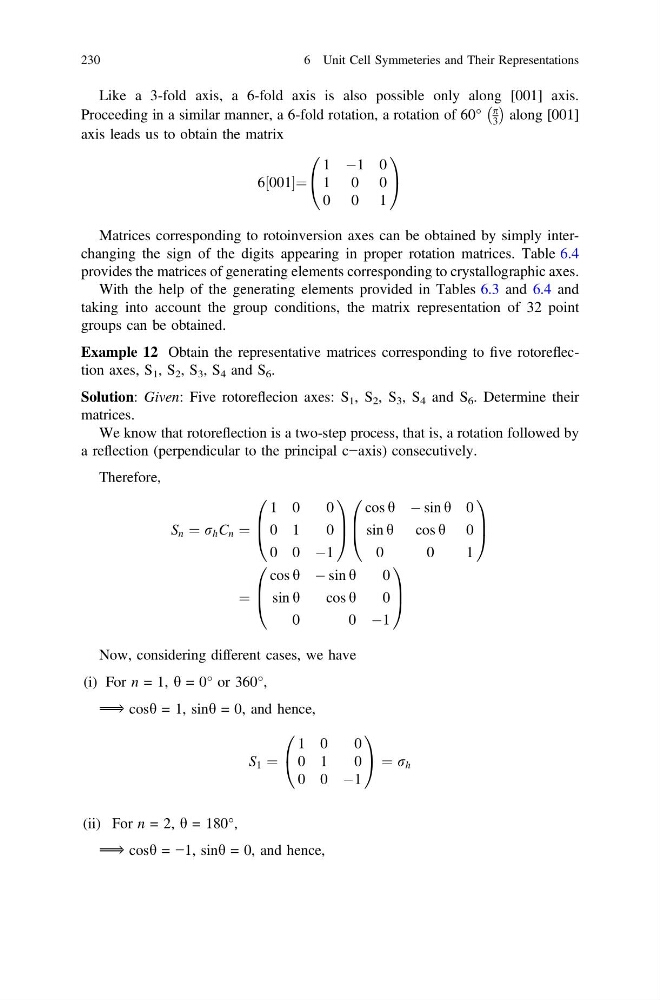
Like a 3-fold axis, a 6-fold axis is also possible only along [001] axis.
Proceeding in a similar manner, a 6-fold rotation, a rotation of 60°
p
3
À Á
along [001]
axis leads us to obtain the matrix
6 001
½
¼
1 À1 0
1 0 0
0 0 1
0
@
1
A
Matrices corresponding to rotoinversion axes can be obtained by simply interchanging the sign of the digits appearing in proper rotation matrices. Table 6.4
provides the matrices of generating elements corresponding to crystallographic axes.
With the help of the generating elements provided in Tables 6.3 and 6.4 and
taking into account the group conditions, the matrix representation of 32 point
groups can be obtained.
Example 12 Obtain the representative matrices corresponding to five rotoreflection axes, S 1 , S 2 , S 3 , S 4 and S 6 .
Solution: Given: Five rotoreflecion axes: S 1 , S 2 , S 3 , S 4 and S 6 . Determine their
matrices.
We know that rotoreflection is a two-step process, that is, a rotation followed by
a reflection (perpendicular to the principal c−axis) consecutively.
Therefore,
S n ¼ r h C n ¼
1 0
0
0 1
0
0 0 À1
0
B
@
1
C
A
cos h À sin h 0
sin h cos h 0
0
0
1
0
B
@
1
C
A
¼
cos h À sin h
0
sin h
cos h
0
0
0 À1
0
B
@
1
C
A
Now, considering different cases, we have
(i) For n = 1, h = 0° or 360°,
⟹ cosh = 1, sinh = 0, and hence,
S 1 ¼
1 0
0
0 1
0
0 0 À1
0
@
1
A ¼ r h
(ii) For n = 2, h = 180°,
⟹ cosh = −1, sinh = 0, and hence,
230
6 Unit Cell Symmeteries and Their Representations
Proceeding in a similar manner, a 6-fold rotation, a rotation of 60°
p
3
À Á
along [001]
axis leads us to obtain the matrix
6 001
½
¼
1 À1 0
1 0 0
0 0 1
0
@
1
A
Matrices corresponding to rotoinversion axes can be obtained by simply interchanging the sign of the digits appearing in proper rotation matrices. Table 6.4
provides the matrices of generating elements corresponding to crystallographic axes.
With the help of the generating elements provided in Tables 6.3 and 6.4 and
taking into account the group conditions, the matrix representation of 32 point
groups can be obtained.
Example 12 Obtain the representative matrices corresponding to five rotoreflection axes, S 1 , S 2 , S 3 , S 4 and S 6 .
Solution: Given: Five rotoreflecion axes: S 1 , S 2 , S 3 , S 4 and S 6 . Determine their
matrices.
We know that rotoreflection is a two-step process, that is, a rotation followed by
a reflection (perpendicular to the principal c−axis) consecutively.
Therefore,
S n ¼ r h C n ¼
1 0
0
0 1
0
0 0 À1
0
B
@
1
C
A
cos h À sin h 0
sin h cos h 0
0
0
1
0
B
@
1
C
A
¼
cos h À sin h
0
sin h
cos h
0
0
0 À1
0
B
@
1
C
A
Now, considering different cases, we have
(i) For n = 1, h = 0° or 360°,
⟹ cosh = 1, sinh = 0, and hence,
S 1 ¼
1 0
0
0 1
0
0 0 À1
0
@
1
A ¼ r h
(ii) For n = 2, h = 180°,
⟹ cosh = −1, sinh = 0, and hence,
230
6 Unit Cell Symmeteries and Their Representations