

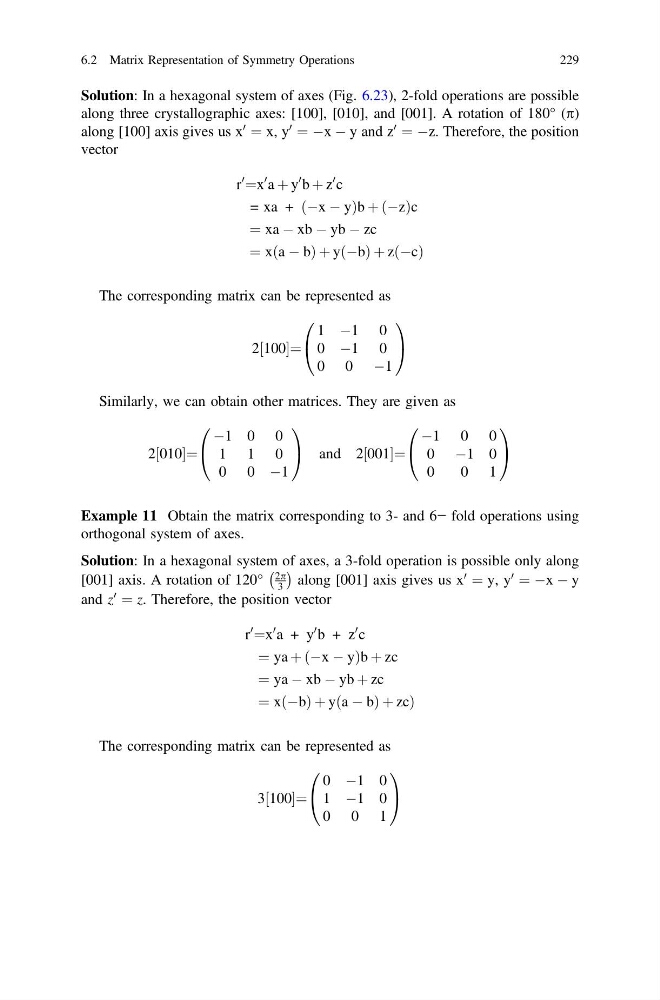
Solution: In a hexagonal system of axes (Fig. 6.23), 2-fold operations are possible
along three crystallographic axes: [100], [010], and [001]. A rotation of 180° (p)
along [100] axis gives us x
0
¼ x, y
0
¼ Àx À y and z
0
¼ Àz. Therefore, the position
vector
r
0
¼x
0 a þ y
0 b þ z
0 c
= xa + Àx À y
ð
Þb þ ðÀzÞc
¼ xa À xb À yb À zc
¼ x a À b
ð
ÞþyðÀbÞ þ zðÀcÞ
The corresponding matrix can be represented as
2 100
½ ¼
1 À1 0
0 À1 0
0 0 À1
0
@
1
A
Similarly, we can obtain other matrices. They are given as
2 010
½
¼
À1 0 0
1 1 0
0 0 À1
0
@
1
A and 2 001
½
¼
À1 0 0
0 À1 0
0
0 1
0
@
1
A
Example 11 Obtain the matrix corresponding to 3- and 6− fold operations using
orthogonal system of axes.
Solution: In a hexagonal system of axes, a 3-fold operation is possible only along
[001] axis. A rotation of 120°
2p
3
À Á
along [001] axis gives us x
0
¼ y, y
0
¼ Àx À y
and z
0
¼ z. Therefore, the position vector
r
0
¼x
0 a + y
0 b + z
0 c
¼ ya þ Àx À y
ð
Þb þ zc
¼ ya À xb À yb þ zc
¼ xðÀbÞ þ yða À bÞ þ zcÞ
The corresponding matrix can be represented as
3 100
½
¼
0 À1 0
1 À1 0
0 0 1
0
@
1
A
6.2 Matrix Representation of Symmetry Operations
229
along three crystallographic axes: [100], [010], and [001]. A rotation of 180° (p)
along [100] axis gives us x
0
¼ x, y
0
¼ Àx À y and z
0
¼ Àz. Therefore, the position
vector
r
0
¼x
0 a þ y
0 b þ z
0 c
= xa + Àx À y
ð
Þb þ ðÀzÞc
¼ xa À xb À yb À zc
¼ x a À b
ð
ÞþyðÀbÞ þ zðÀcÞ
The corresponding matrix can be represented as
2 100
½ ¼
1 À1 0
0 À1 0
0 0 À1
0
@
1
A
Similarly, we can obtain other matrices. They are given as
2 010
½
¼
À1 0 0
1 1 0
0 0 À1
0
@
1
A and 2 001
½
¼
À1 0 0
0 À1 0
0
0 1
0
@
1
A
Example 11 Obtain the matrix corresponding to 3- and 6− fold operations using
orthogonal system of axes.
Solution: In a hexagonal system of axes, a 3-fold operation is possible only along
[001] axis. A rotation of 120°
2p
3
À Á
along [001] axis gives us x
0
¼ y, y
0
¼ Àx À y
and z
0
¼ z. Therefore, the position vector
r
0
¼x
0 a + y
0 b + z
0 c
¼ ya þ Àx À y
ð
Þb þ zc
¼ ya À xb À yb þ zc
¼ xðÀbÞ þ yða À bÞ þ zcÞ
The corresponding matrix can be represented as
3 100
½
¼
0 À1 0
1 À1 0
0 0 1
0
@
1
A
6.2 Matrix Representation of Symmetry Operations
229