

Example 9 In an orthorhombic crystal system, show that three mutually perpendicular mirror planes produce an inversion.
Solution: Given: Crystal system is orthorhombic, three mutually perpendicular
mirror planes. Let us suppose that that the three mutually perpendicular mirror
planes are: m[100], m[010] and m[001]. Now, writing them in the matrix form and
taking their product, we obtain
m 100
½ Âm 010
½
Âm ½001¼
À1 0 0
0 1 0
0 0 1
0
B
@
1
C
A
1 0 0
0 À1 0
0 0 1
0
B
@
1
C
A
1 0 0
0 1 0
0 0 À1
0
B
@
1
C
A
¼
À1 0 0
0 1 0
0 0 1
0
B
@
1
C
A
1 0
0
0 À1 0
0 0 À1
0
B
@
1
C
A
¼
À1 0
0
0 À1 0
0
0 À1
0
B
@
1
C
A = i (inversion)
Here, any first two mirror planes could be taken as parallel to 2-fold axis and the
third mirror perpendicular to it, which produces an inversion.
(ii) Matrix Using Crystallographic Axes
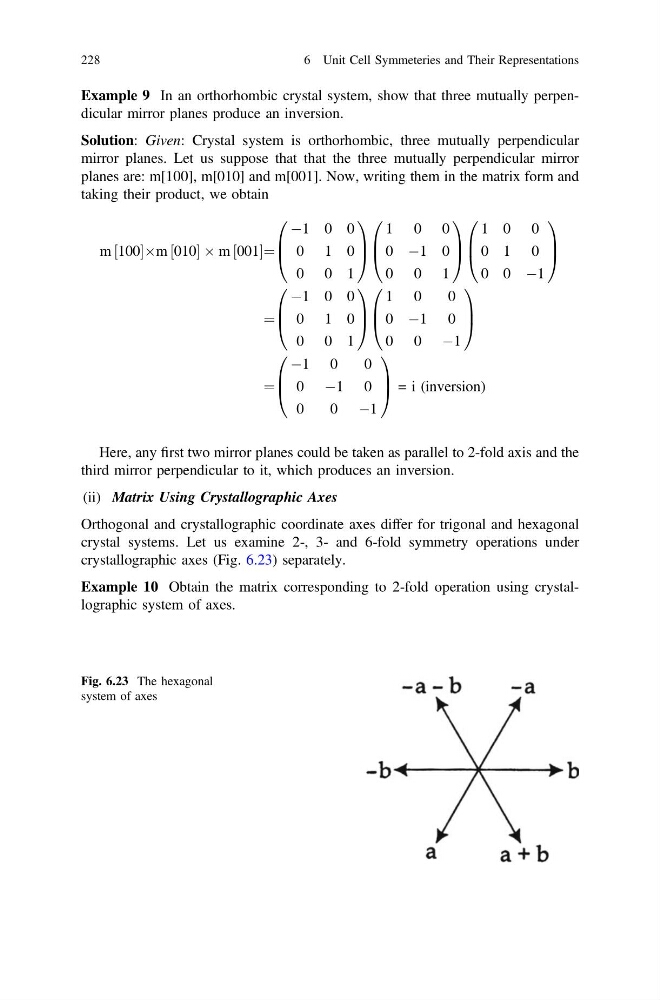
Orthogonal and crystallographic coordinate axes differ for trigonal and hexagonal
crystal systems. Let us examine 2-, 3- and 6-fold symmetry operations under
crystallographic axes (Fig. 6.23) separately.
Example 10 Obtain the matrix corresponding to 2-fold operation using crystallographic system of axes.
Fig. 6.23 The hexagonal
system of axes
228
6 Unit Cell Symmeteries and Their Representations
Solution: Given: Crystal system is orthorhombic, three mutually perpendicular
mirror planes. Let us suppose that that the three mutually perpendicular mirror
planes are: m[100], m[010] and m[001]. Now, writing them in the matrix form and
taking their product, we obtain
m 100
½ Âm 010
½
Âm ½001¼
À1 0 0
0 1 0
0 0 1
0
B
@
1
C
A
1 0 0
0 À1 0
0 0 1
0
B
@
1
C
A
1 0 0
0 1 0
0 0 À1
0
B
@
1
C
A
¼
À1 0 0
0 1 0
0 0 1
0
B
@
1
C
A
1 0
0
0 À1 0
0 0 À1
0
B
@
1
C
A
¼
À1 0
0
0 À1 0
0
0 À1
0
B
@
1
C
A = i (inversion)
Here, any first two mirror planes could be taken as parallel to 2-fold axis and the
third mirror perpendicular to it, which produces an inversion.
(ii) Matrix Using Crystallographic Axes
Orthogonal and crystallographic coordinate axes differ for trigonal and hexagonal
crystal systems. Let us examine 2-, 3- and 6-fold symmetry operations under
crystallographic axes (Fig. 6.23) separately.
Example 10 Obtain the matrix corresponding to 2-fold operation using crystallographic system of axes.
Fig. 6.23 The hexagonal
system of axes
228
6 Unit Cell Symmeteries and Their Representations