

3 111
½ ¼
cos 90
cos 90
cos 0
cos 0
cos 90
cos 90
cos 90
cos 0
cos 90
0
@
1
A ¼
0 0 1
1 0 0
0 1 0
0
@
1
A
Example 4 Obtain the matrix corresponding to 4ð 4Þ − fold operation using
orthogonal system of axes.
Solution: A 4ð 4Þ−fold operation is possible along the three crystallographic
directions [100], [010] and [001]. These directions are equivalent to orthogonal
axes. A 4−fold rotation along [001] transforms the axis x 1 into x
0
1 and x 2 into x
0
2 ,
each of which is thrown 90° away from its initial position. This gives us x
0
1 ¼ x 2 ,
x
0
2 ¼ Àx 1 . The corresponding matrix can be represented as
4 001
½ ¼
0 À1 0
1
0 0
0
0 1
0
@
1
A
ð6:5Þ
This matrix can also be obtained from Eq. 6.3 by substituting a = 90°. On the
other hand, the matrix corresponding to 4 001
½ symmetry operation can be obtained
from Eq. 6.5 by changing the sign of the digit 1, that is,
4 001
½
¼
0 1
0
À1 0
0
0 0 À1
0
@
1
A
The matrices of generating elements corresponding to orthogonal axes are
provided in Table 6.3.
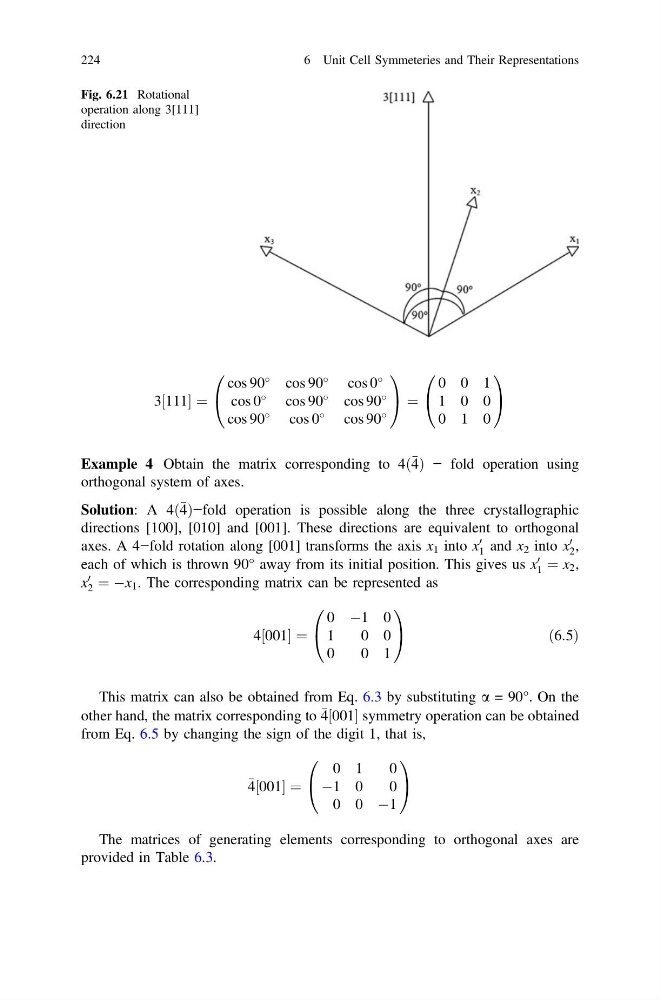
Fig. 6.21 Rotational
operation along 3[111]
direction
224
6 Unit Cell Symmeteries and Their Representations
½ ¼
cos 90
cos 90
cos 0
cos 0
cos 90
cos 90
cos 90
cos 0
cos 90
0
@
1
A ¼
0 0 1
1 0 0
0 1 0
0
@
1
A
Example 4 Obtain the matrix corresponding to 4ð 4Þ − fold operation using
orthogonal system of axes.
Solution: A 4ð 4Þ−fold operation is possible along the three crystallographic
directions [100], [010] and [001]. These directions are equivalent to orthogonal
axes. A 4−fold rotation along [001] transforms the axis x 1 into x
0
1 and x 2 into x
0
2 ,
each of which is thrown 90° away from its initial position. This gives us x
0
1 ¼ x 2 ,
x
0
2 ¼ Àx 1 . The corresponding matrix can be represented as
4 001
½ ¼
0 À1 0
1
0 0
0
0 1
0
@
1
A
ð6:5Þ
This matrix can also be obtained from Eq. 6.3 by substituting a = 90°. On the
other hand, the matrix corresponding to 4 001
½ symmetry operation can be obtained
from Eq. 6.5 by changing the sign of the digit 1, that is,
4 001
½
¼
0 1
0
À1 0
0
0 0 À1
0
@
1
A
The matrices of generating elements corresponding to orthogonal axes are
provided in Table 6.3.
Fig. 6.21 Rotational
operation along 3[111]
direction
224
6 Unit Cell Symmeteries and Their Representations