

Similarly, the operations 2[010] and m [010] gives us x
0
1 ¼ Àx 1 , x
0
2 ¼ x 2 , x
0
3 ¼
Àx 3 and x
0
1 ¼ x 1 , x
0
2 ¼ Àx 2 , x
0
3 ¼ x 3 , respectively. The corresponding matrices are:
2 010
½
À1 0
0
0 1
0
0 0 À1
0
@
1
A and m 010
½
1
0 0
0 À1 0
0
0 1
0
@
1
A
Example 3 Obtain the matrix corresponding to 3 and 6-fold operation using
orthogonal system of axes.
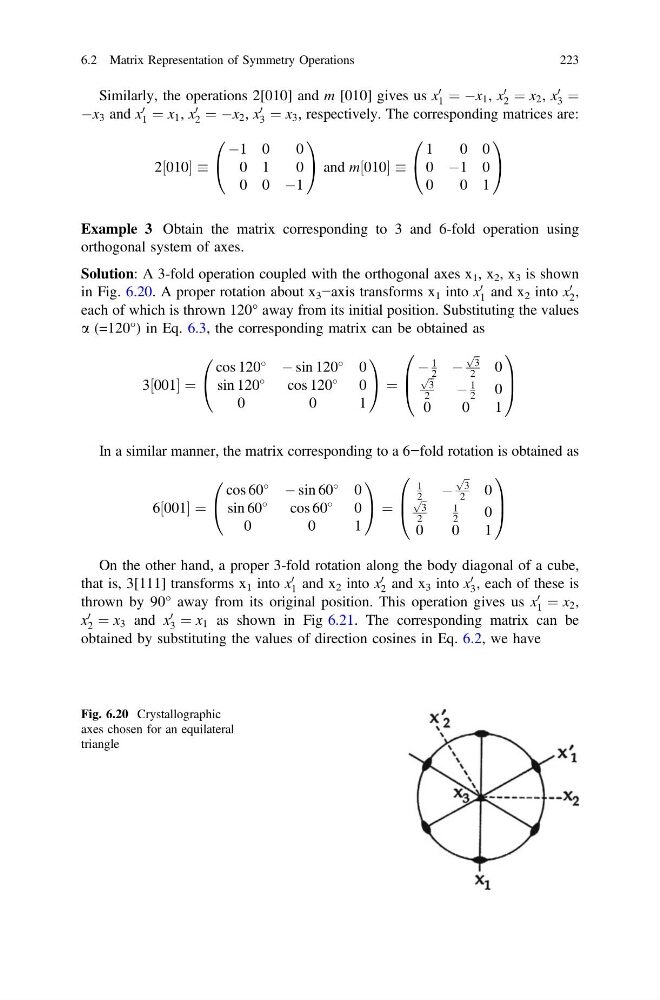
Solution: A 3-fold operation coupled with the orthogonal axes x 1 , x 2 , x 3 is shown
in Fig. 6.20. A proper rotation about x 3 −axis transforms x 1 into x
0
1 and x 2 into x
0
2 ,
each of which is thrown 120° away from its initial position. Substituting the values
a (=120°) in Eq. 6.3, the corresponding matrix can be obtained as
3 001
½
¼
cos 120
À sin 120
0
sin 120
cos 120
0
0
0
1
0
@
1
A ¼
À
1
2 À
ffiffi
3
p
2
0
ffiffi
3
p
2
À
1
2
0
0
0
1
0
B
@
1
C
A
In a similar manner, the matrix corresponding to a 6−fold rotation is obtained as
6 001
½ ¼
cos 60
À sin 60
0
sin 60
cos 60
0
0
0
1
0
@
1
A ¼
1
2
À
ffiffi
3
p
2
0
ffiffi
3
p
2
1
2
0
0
0
1
0
B
@
1
C
A
On the other hand, a proper 3-fold rotation along the body diagonal of a cube,
that is, 3[111] transforms x 1 into x
0
1 and x 2 into x
0
2 and x 3 into x
0
3 , each of these is
thrown by 90° away from its original position. This operation gives us x
0
1 ¼ x 2 ,
x
0
2 ¼ x 3 and x
0
3 ¼ x 1 as shown in Fig 6.21. The corresponding matrix can be
obtained by substituting the values of direction cosines in Eq. 6.2, we have
Fig. 6.20 Crystallographic
axes chosen for an equilateral
triangle
6.2 Matrix Representation of Symmetry Operations
223
0
1 ¼ Àx 1 , x
0
2 ¼ x 2 , x
0
3 ¼
Àx 3 and x
0
1 ¼ x 1 , x
0
2 ¼ Àx 2 , x
0
3 ¼ x 3 , respectively. The corresponding matrices are:
2 010
½
À1 0
0
0 1
0
0 0 À1
0
@
1
A and m 010
½
1
0 0
0 À1 0
0
0 1
0
@
1
A
Example 3 Obtain the matrix corresponding to 3 and 6-fold operation using
orthogonal system of axes.
Solution: A 3-fold operation coupled with the orthogonal axes x 1 , x 2 , x 3 is shown
in Fig. 6.20. A proper rotation about x 3 −axis transforms x 1 into x
0
1 and x 2 into x
0
2 ,
each of which is thrown 120° away from its initial position. Substituting the values
a (=120°) in Eq. 6.3, the corresponding matrix can be obtained as
3 001
½
¼
cos 120
À sin 120
0
sin 120
cos 120
0
0
0
1
0
@
1
A ¼
À
1
2 À
ffiffi
3
p
2
0
ffiffi
3
p
2
À
1
2
0
0
0
1
0
B
@
1
C
A
In a similar manner, the matrix corresponding to a 6−fold rotation is obtained as
6 001
½ ¼
cos 60
À sin 60
0
sin 60
cos 60
0
0
0
1
0
@
1
A ¼
1
2
À
ffiffi
3
p
2
0
ffiffi
3
p
2
1
2
0
0
0
1
0
B
@
1
C
A
On the other hand, a proper 3-fold rotation along the body diagonal of a cube,
that is, 3[111] transforms x 1 into x
0
1 and x 2 into x
0
2 and x 3 into x
0
3 , each of these is
thrown by 90° away from its original position. This operation gives us x
0
1 ¼ x 2 ,
x
0
2 ¼ x 3 and x
0
3 ¼ x 1 as shown in Fig 6.21. The corresponding matrix can be
obtained by substituting the values of direction cosines in Eq. 6.2, we have
Fig. 6.20 Crystallographic
axes chosen for an equilateral
triangle
6.2 Matrix Representation of Symmetry Operations
223