

1
1 0 0
0 1 0
0 0 1
0
@
1
A
ð6:4Þ
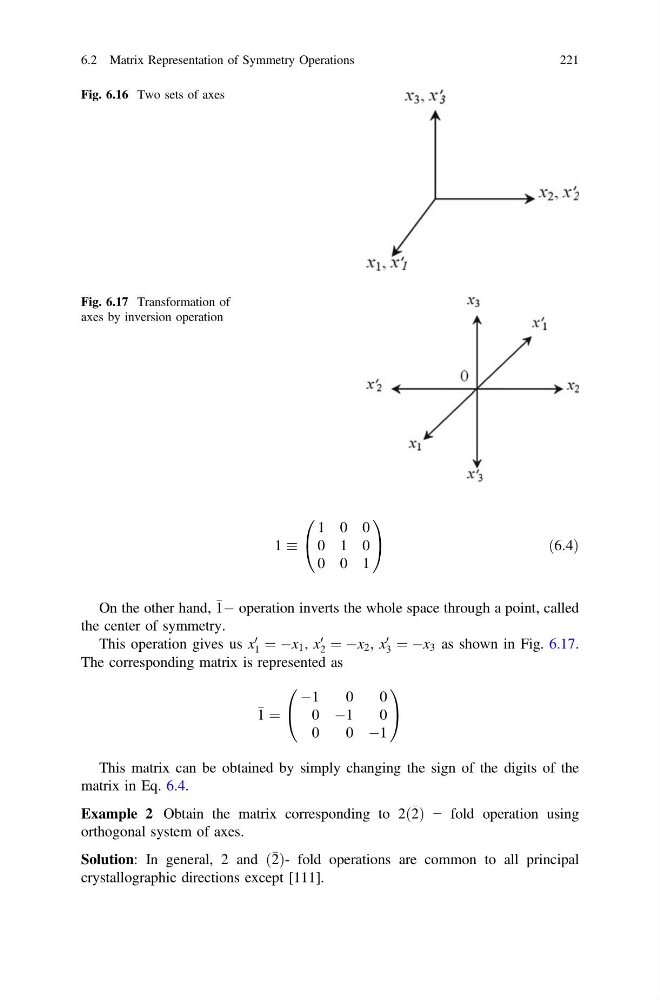
On the other hand, 1À operation inverts the whole space through a point, called
the center of symmetry.
This operation gives us x
0
1 ¼ Àx 1 , x
0
2 ¼ Àx 2 , x
0
3 ¼ Àx 3 as shown in Fig. 6.17.
The corresponding matrix is represented as
1 ¼
À1
0
0
0 À1
0
0
0 À1
0
@
1
A
This matrix can be obtained by simply changing the sign of the digits of the
matrix in Eq. 6.4.
Example 2 Obtain the matrix corresponding to 2ð 2Þ − fold operation using
orthogonal system of axes.
Solution: In general, 2 and ð 2Þ- fold operations are common to all principal
crystallographic directions except [111].
Fig. 6.16 Two sets of axes
Fig. 6.17 Transformation of
axes by inversion operation
6.2 Matrix Representation of Symmetry Operations
221
1 0 0
0 1 0
0 0 1
0
@
1
A
ð6:4Þ
On the other hand, 1À operation inverts the whole space through a point, called
the center of symmetry.
This operation gives us x
0
1 ¼ Àx 1 , x
0
2 ¼ Àx 2 , x
0
3 ¼ Àx 3 as shown in Fig. 6.17.
The corresponding matrix is represented as
1 ¼
À1
0
0
0 À1
0
0
0 À1
0
@
1
A
This matrix can be obtained by simply changing the sign of the digits of the
matrix in Eq. 6.4.
Example 2 Obtain the matrix corresponding to 2ð 2Þ − fold operation using
orthogonal system of axes.
Solution: In general, 2 and ð 2Þ- fold operations are common to all principal
crystallographic directions except [111].
Fig. 6.16 Two sets of axes
Fig. 6.17 Transformation of
axes by inversion operation
6.2 Matrix Representation of Symmetry Operations
221