

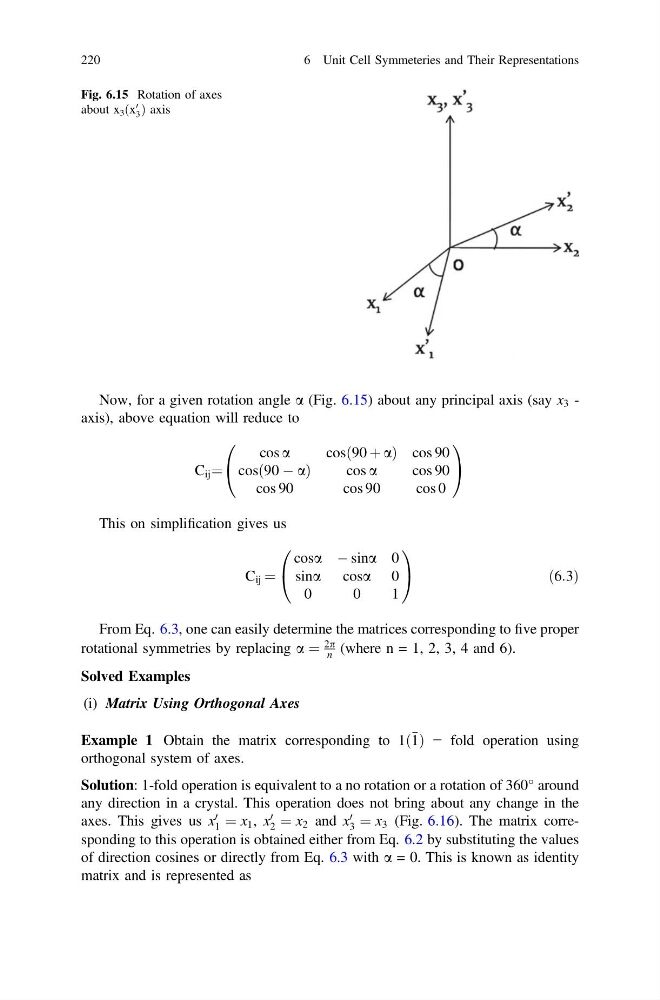
Now, for a given rotation angle a (Fig. 6.15) about any principal axis (say x 3 -
axis), above equation will reduce to
C ij ¼
cos a
cosð90 þ aÞ cos 90
cosð90 À aÞ
cos a
cos 90
cos 90
cos 90
cos 0
0
@
1
A
This on simplification gives us
C ij ¼
cosa À sina 0
sina cosa 0
0
0
1
0
@
1
A
ð6:3Þ
From Eq. 6.3, one can easily determine the matrices corresponding to five proper
rotational symmetries by replacing a ¼
2p
n (where n = 1, 2, 3, 4 and 6).
Solved Examples
(i) Matrix Using Orthogonal Axes
Example 1 Obtain the matrix corresponding to 1 1
ð Þ − fold operation using
orthogonal system of axes.
Solution: 1-fold operation is equivalent to a no rotation or a rotation of 360° around
any direction in a crystal. This operation does not bring about any change in the
axes. This gives us x
0
1 ¼ x 1 , x
0
2 ¼ x 2 and x
0
3 ¼ x 3 (Fig. 6.16). The matrix corresponding to this operation is obtained either from Eq. 6.2 by substituting the values
of direction cosines or directly from Eq. 6.3 with a = 0. This is known as identity
matrix and is represented as
Fig. 6.15 Rotation of axes
about x 3 ðx
0
3 Þ axis
220
6 Unit Cell Symmeteries and Their Representations
axis), above equation will reduce to
C ij ¼
cos a
cosð90 þ aÞ cos 90
cosð90 À aÞ
cos a
cos 90
cos 90
cos 90
cos 0
0
@
1
A
This on simplification gives us
C ij ¼
cosa À sina 0
sina cosa 0
0
0
1
0
@
1
A
ð6:3Þ
From Eq. 6.3, one can easily determine the matrices corresponding to five proper
rotational symmetries by replacing a ¼
2p
n (where n = 1, 2, 3, 4 and 6).
Solved Examples
(i) Matrix Using Orthogonal Axes
Example 1 Obtain the matrix corresponding to 1 1
ð Þ − fold operation using
orthogonal system of axes.
Solution: 1-fold operation is equivalent to a no rotation or a rotation of 360° around
any direction in a crystal. This operation does not bring about any change in the
axes. This gives us x
0
1 ¼ x 1 , x
0
2 ¼ x 2 and x
0
3 ¼ x 3 (Fig. 6.16). The matrix corresponding to this operation is obtained either from Eq. 6.2 by substituting the values
of direction cosines or directly from Eq. 6.3 with a = 0. This is known as identity
matrix and is represented as
Fig. 6.15 Rotation of axes
about x 3 ðx
0
3 Þ axis
220
6 Unit Cell Symmeteries and Their Representations