

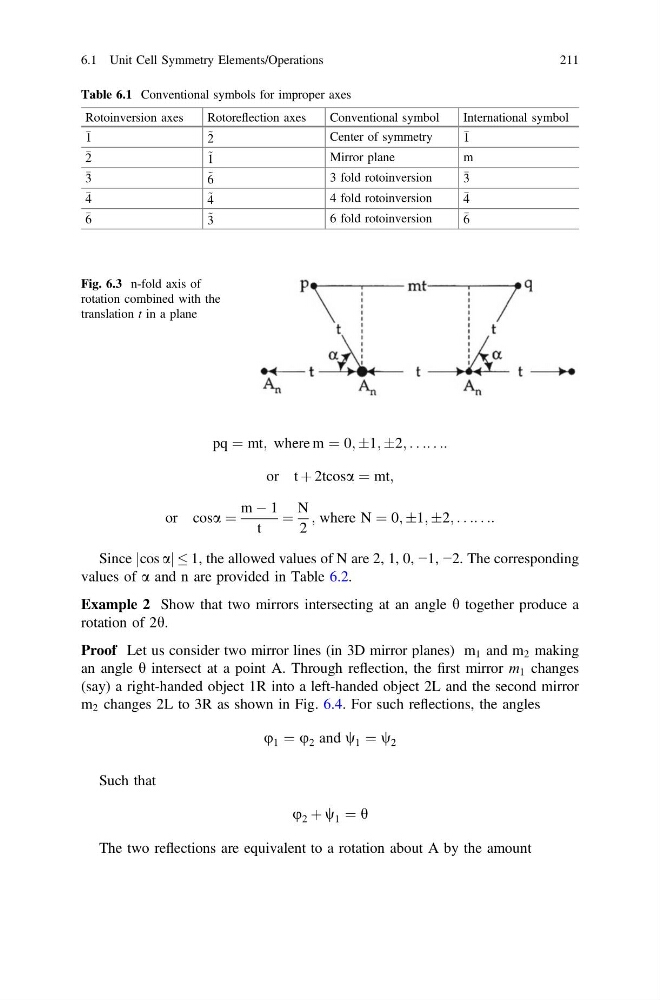
pq ¼ mt; where m ¼ 0; Æ1; Æ2; . . .. . .:
or t þ 2tcosa ¼ mt;
or cosa ¼
m À 1
t
¼
N
2
; where N ¼ 0; Æ1; Æ2; . . .. . .:
Since cos a
j
j 1, the allowed values of N are 2, 1, 0, −1, −2. The corresponding
values of a and n are provided in Table 6.2.
Example 2 Show that two mirrors intersecting at an angle h together produce a
rotation of 2h.
Proof Let us consider two mirror lines (in 3D mirror planes) m 1 and m 2 making
an angle h intersect at a point A. Through reflection, the first mirror m 1 changes
(say) a right-handed object 1R into a left-handed object 2L and the second mirror
m 2 changes 2L to 3R as shown in Fig. 6.4. For such reflections, the angles
u 1 ¼ u 2 and w 1 ¼ w 2
Such that
u 2 þ w 1 ¼ h
The two reflections are equivalent to a rotation about A by the amount
Table 6.1 Conventional symbols for improper axes
Rotoinversion axes
Rotoreflection axes
Conventional symbol
International symbol
1
~ 2
Center of symmetry
1
2
~ 1
Mirror plane
m
3
~ 6
3 fold rotoinversion
3
4
~ 4
4 fold rotoinversion
4
6
~ 3
6 fold rotoinversion
6
Fig. 6.3 n-fold axis of
rotation combined with the
translation t in a plane
6.1 Unit Cell Symmetry Elements/Operations
211
or t þ 2tcosa ¼ mt;
or cosa ¼
m À 1
t
¼
N
2
; where N ¼ 0; Æ1; Æ2; . . .. . .:
Since cos a
j
j 1, the allowed values of N are 2, 1, 0, −1, −2. The corresponding
values of a and n are provided in Table 6.2.
Example 2 Show that two mirrors intersecting at an angle h together produce a
rotation of 2h.
Proof Let us consider two mirror lines (in 3D mirror planes) m 1 and m 2 making
an angle h intersect at a point A. Through reflection, the first mirror m 1 changes
(say) a right-handed object 1R into a left-handed object 2L and the second mirror
m 2 changes 2L to 3R as shown in Fig. 6.4. For such reflections, the angles
u 1 ¼ u 2 and w 1 ¼ w 2
Such that
u 2 þ w 1 ¼ h
The two reflections are equivalent to a rotation about A by the amount
Table 6.1 Conventional symbols for improper axes
Rotoinversion axes
Rotoreflection axes
Conventional symbol
International symbol
1
~ 2
Center of symmetry
1
2
~ 1
Mirror plane
m
3
~ 6
3 fold rotoinversion
3
4
~ 4
4 fold rotoinversion
4
6
~ 3
6 fold rotoinversion
6
Fig. 6.3 n-fold axis of
rotation combined with the
translation t in a plane
6.1 Unit Cell Symmetry Elements/Operations
211