

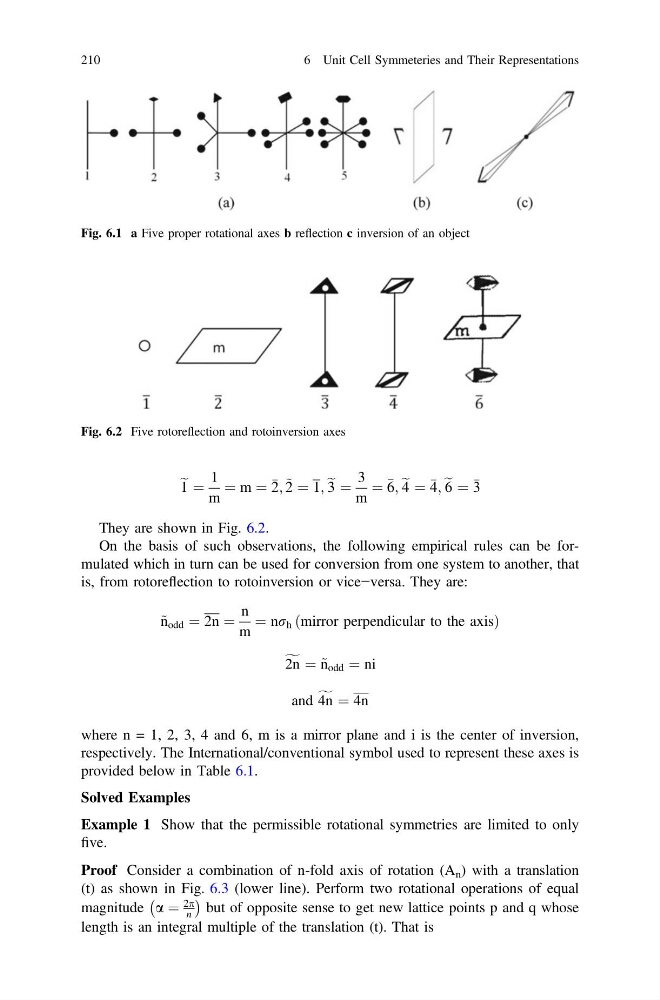
Fig. 6.1 a Five proper rotational axes b reflection c inversion of an object
Fig. 6.2 Five rotoreflection and rotoinversion axes
e 1 ¼
1
m
¼ m ¼ 2; ~ 2 ¼ 1; e 3 ¼
3
m
¼ 6; e 4 ¼ 4; e 6 ¼ 3
They are shown in Fig. 6.2.
On the basis of such observations, the following empirical rules can be formulated which in turn can be used for conversion from one system to another, that
is, from rotoreflection to rotoinversion or vice−versa. They are:
~ n odd ¼ 2n ¼
n
m
¼ nr h mirror perpendicular to the axis
ð
Þ
f 2n ¼ ~ n odd ¼ ni
and f 4n ¼ 4n
where n = 1, 2, 3, 4 and 6, m is a mirror plane and i is the center of inversion,
respectively. The International/conventional symbol used to represent these axes is
provided below in Table 6.1.
Solved Examples
Example 1 Show that the permissible rotational symmetries are limited to only
five.
Proof Consider a combination of n-fold axis of rotation (A n ) with a translation
(t) as shown in Fig. 6.3 (lower line). Perform two rotational operations of equal
magnitude a ¼
2p
n
À
Á
but of opposite sense to get new lattice points p and q whose
length is an integral multiple of the translation (t). That is
210
6 Unit Cell Symmeteries and Their Representations
Fig. 6.2 Five rotoreflection and rotoinversion axes
e 1 ¼
1
m
¼ m ¼ 2; ~ 2 ¼ 1; e 3 ¼
3
m
¼ 6; e 4 ¼ 4; e 6 ¼ 3
They are shown in Fig. 6.2.
On the basis of such observations, the following empirical rules can be formulated which in turn can be used for conversion from one system to another, that
is, from rotoreflection to rotoinversion or vice−versa. They are:
~ n odd ¼ 2n ¼
n
m
¼ nr h mirror perpendicular to the axis
ð
Þ
f 2n ¼ ~ n odd ¼ ni
and f 4n ¼ 4n
where n = 1, 2, 3, 4 and 6, m is a mirror plane and i is the center of inversion,
respectively. The International/conventional symbol used to represent these axes is
provided below in Table 6.1.
Solved Examples
Example 1 Show that the permissible rotational symmetries are limited to only
five.
Proof Consider a combination of n-fold axis of rotation (A n ) with a translation
(t) as shown in Fig. 6.3 (lower line). Perform two rotational operations of equal
magnitude a ¼
2p
n
À
Á
but of opposite sense to get new lattice points p and q whose
length is an integral multiple of the translation (t). That is
210
6 Unit Cell Symmeteries and Their Representations