

Example 7 Determine the magnitude and direction of translation vector in a
hexagonal crystal system with a = b = 3Å and c = 4Å. Further, the integers n 1 = 4
units, n 2 = 3 units and n 3 = 1, respectively.
Solution: Given: a = b = 3Å and c = 4Å, n 1 = 4, n 2 = 3 and n 3 = 1. We know that
in a hexagonal crystal system, a ¼ b ¼ 90
and c ¼ 120
, therefore the magnitude
of the resultant translation vector ~ T is given by
T ¼ n 1 a
ð Þ
2 þ n 2 b
ð Þ
2 þ 2 n 1 a
ð Þ n 2 b
ð Þcos c
h
i 1=2
¼ ð4 Â 3Þ
2 þ ð3 Â 3Þ
2 þ ð4 Â 1Þ
2 þ 2ð4 Â 3Þð3 Â 3Þ À
1
2
! 1=2
¼ ½ð144 þ 81 þ 16 À 108Þ
1=2 ¼ 11:53 ˚
A
Direction of the translation vector is [431].
1.2 Choice of Axes and Unit Cells
(a) In general, for a plane lattice, the choice of axes is infinite and so the basis
vectors. Consequently, the choice of the unit cell is also infinite. However, the
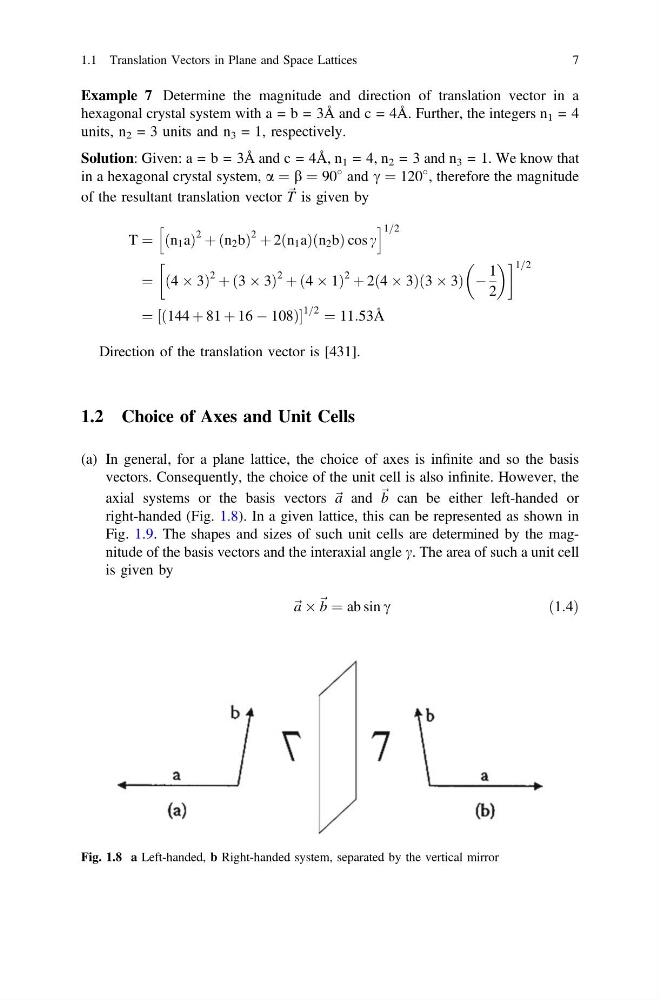
axial systems or the basis vectors ~ a and ~ b can be either left-handed or
right-handed (Fig. 1.8). In a given lattice, this can be represented as shown in
Fig. 1.9. The shapes and sizes of such unit cells are determined by the magnitude of the basis vectors and the interaxial angle c. The area of such a unit cell
is given by
~ a  ~ b ¼ ab sin c
ð1:4Þ
Fig. 1.8 a Left-handed, b Right-handed system, separated by the vertical mirror
1.1 Translation Vectors in Plane and Space Lattices
7
hexagonal crystal system with a = b = 3Å and c = 4Å. Further, the integers n 1 = 4
units, n 2 = 3 units and n 3 = 1, respectively.
Solution: Given: a = b = 3Å and c = 4Å, n 1 = 4, n 2 = 3 and n 3 = 1. We know that
in a hexagonal crystal system, a ¼ b ¼ 90
and c ¼ 120
, therefore the magnitude
of the resultant translation vector ~ T is given by
T ¼ n 1 a
ð Þ
2 þ n 2 b
ð Þ
2 þ 2 n 1 a
ð Þ n 2 b
ð Þcos c
h
i 1=2
¼ ð4 Â 3Þ
2 þ ð3 Â 3Þ
2 þ ð4 Â 1Þ
2 þ 2ð4 Â 3Þð3 Â 3Þ À
1
2
! 1=2
¼ ½ð144 þ 81 þ 16 À 108Þ
1=2 ¼ 11:53 ˚
A
Direction of the translation vector is [431].
1.2 Choice of Axes and Unit Cells
(a) In general, for a plane lattice, the choice of axes is infinite and so the basis
vectors. Consequently, the choice of the unit cell is also infinite. However, the
axial systems or the basis vectors ~ a and ~ b can be either left-handed or
right-handed (Fig. 1.8). In a given lattice, this can be represented as shown in
Fig. 1.9. The shapes and sizes of such unit cells are determined by the magnitude of the basis vectors and the interaxial angle c. The area of such a unit cell
is given by
~ a  ~ b ¼ ab sin c
ð1:4Þ
Fig. 1.8 a Left-handed, b Right-handed system, separated by the vertical mirror
1.1 Translation Vectors in Plane and Space Lattices
7