

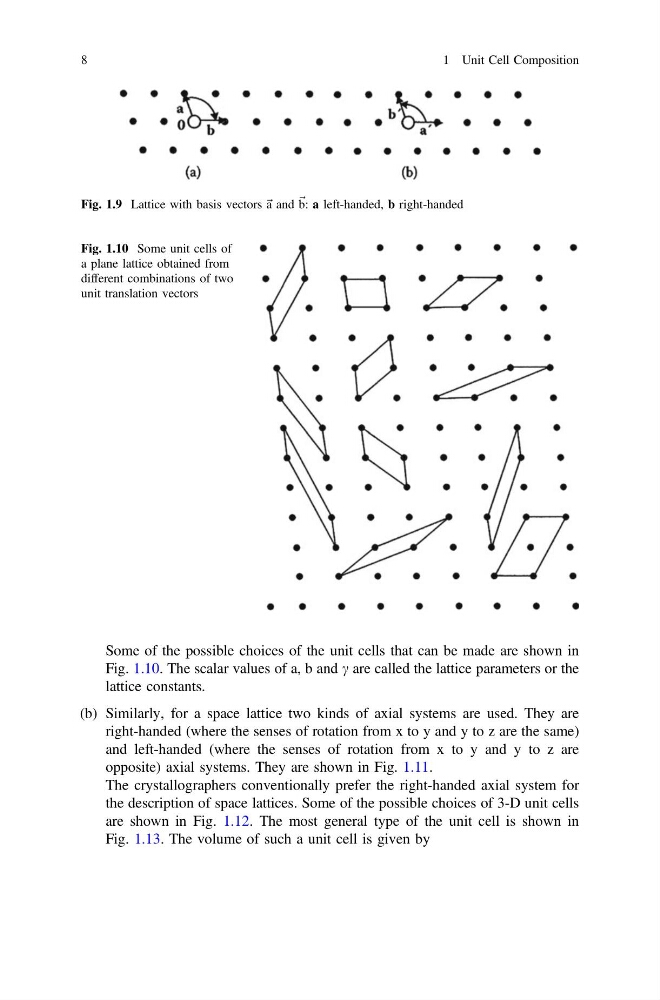
Some of the possible choices of the unit cells that can be made are shown in
Fig. 1.10. The scalar values of a, b and c are called the lattice parameters or the
lattice constants.
(b) Similarly, for a space lattice two kinds of axial systems are used. They are
right-handed (where the senses of rotation from x to y and y to z are the same)
and left-handed (where the senses of rotation from x to y and y to z are
opposite) axial systems. They are shown in Fig. 1.11.
The crystallographers conventionally prefer the right-handed axial system for
the description of space lattices. Some of the possible choices of 3-D unit cells
are shown in Fig. 1.12. The most general type of the unit cell is shown in
Fig. 1.13. The volume of such a unit cell is given by
Fig. 1.9 Lattice with basis vectors ~ a and ~ b: a left-handed, b right-handed
Fig. 1.10 Some unit cells of
a plane lattice obtained from
different combinations of two
unit translation vectors
8
1 Unit Cell Composition
Fig. 1.10. The scalar values of a, b and c are called the lattice parameters or the
lattice constants.
(b) Similarly, for a space lattice two kinds of axial systems are used. They are
right-handed (where the senses of rotation from x to y and y to z are the same)
and left-handed (where the senses of rotation from x to y and y to z are
opposite) axial systems. They are shown in Fig. 1.11.
The crystallographers conventionally prefer the right-handed axial system for
the description of space lattices. Some of the possible choices of 3-D unit cells
are shown in Fig. 1.12. The most general type of the unit cell is shown in
Fig. 1.13. The volume of such a unit cell is given by
Fig. 1.9 Lattice with basis vectors ~ a and ~ b: a left-handed, b right-handed
Fig. 1.10 Some unit cells of
a plane lattice obtained from
different combinations of two
unit translation vectors
8
1 Unit Cell Composition