

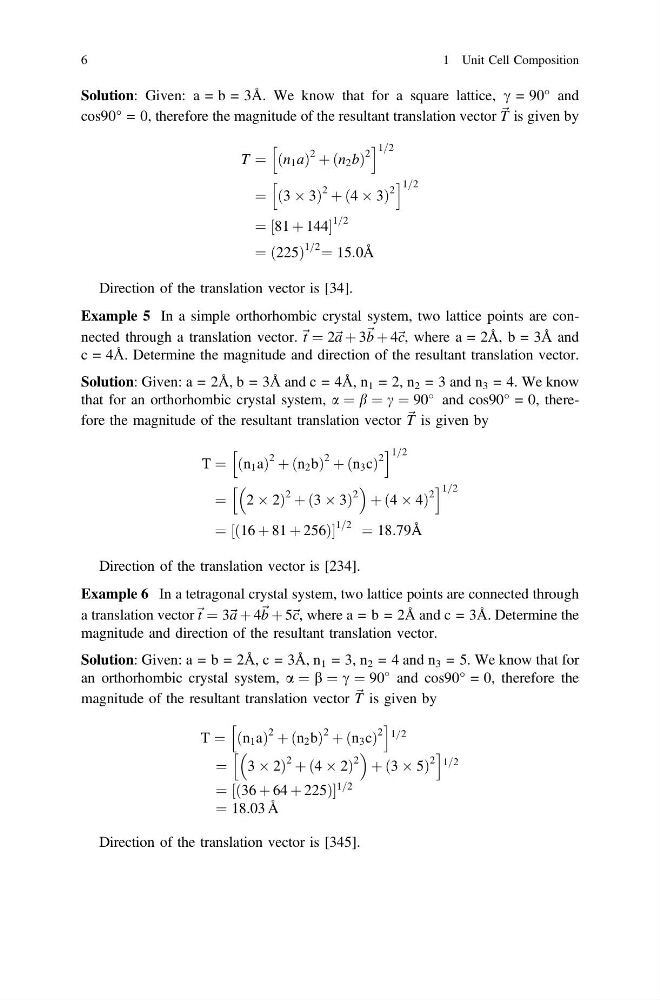
Solution: Given: a = b = 3Å. We know that for a square lattice, c = 90° and
cos90° = 0, therefore the magnitude of the resultant translation vector ~ T is given by
T ¼ n 1 a
ð Þ
2 þ n 2 b
ð Þ
2
h
i 1=2
¼ 3 Â 3
ð
Þ
2 þ 4 Â 3
ð
Þ
2
h
i 1=2
¼ 81 þ 144
½
1=2
¼ 225
ð
Þ
1=2 ¼ 15:0 ˚
A
Direction of the translation vector is [34].
Example 5 In a simple orthorhombic crystal system, two lattice points are connected through a translation vector. ~ t ¼ 2~ a þ 3 ~ b þ 4~ c, where a = 2Å, b = 3Å and
c = 4Å. Determine the magnitude and direction of the resultant translation vector.
Solution: Given: a = 2Å, b = 3Å and c = 4Å, n 1 = 2, n 2 = 3 and n 3 = 4. We know
that for an orthorhombic crystal system, a ¼ b ¼ c ¼ 90
and cos90° = 0, therefore the magnitude of the resultant translation vector ~ T is given by
T ¼ n 1 a
ð Þ
2 þ n 2 b
ð Þ
2 þ n 3 c
ð Þ
2
h
i 1=2
¼ 2 Â 2Þ
2 þ ð3 Â 3Þ
2
þ ð4 Â 4Þ
2
h
i 1=2
¼ 16 þ 81 þ 256
ð
Þ
½
1=2 ¼ 18:79 ˚
A
Direction of the translation vector is [234].
Example 6 In a tetragonal crystal system, two lattice points are connected through
a translation vector ~ t ¼ 3~ a þ 4 ~ b þ 5~ c, where a = b = 2Å and c = 3Å. Determine the
magnitude and direction of the resultant translation vector.
Solution: Given: a = b = 2Å, c = 3Å, n 1 = 3, n 2 = 4 and n 3 = 5. We know that for
an orthorhombic crystal system, a ¼ b ¼ c ¼ 90
and cos90° = 0, therefore the
magnitude of the resultant translation vector ~ T is given by
T ¼ n 1 a
ð Þ
2 þ n 2 b
ð Þ
2 þ n 3 c
ð Þ
2
h
i
1=2
¼ 3 Â 2Þ
2 þ ð4 Â 2Þ
2
þ ð3 Â 5Þ
2
h
i
1=2
¼ 36 þ 64 þ 225
ð
Þ
½
1=2
¼ 18.03 ˚
A
Direction of the translation vector is [345].
6
1 Unit Cell Composition
cos90° = 0, therefore the magnitude of the resultant translation vector ~ T is given by
T ¼ n 1 a
ð Þ
2 þ n 2 b
ð Þ
2
h
i 1=2
¼ 3 Â 3
ð
Þ
2 þ 4 Â 3
ð
Þ
2
h
i 1=2
¼ 81 þ 144
½
1=2
¼ 225
ð
Þ
1=2 ¼ 15:0 ˚
A
Direction of the translation vector is [34].
Example 5 In a simple orthorhombic crystal system, two lattice points are connected through a translation vector. ~ t ¼ 2~ a þ 3 ~ b þ 4~ c, where a = 2Å, b = 3Å and
c = 4Å. Determine the magnitude and direction of the resultant translation vector.
Solution: Given: a = 2Å, b = 3Å and c = 4Å, n 1 = 2, n 2 = 3 and n 3 = 4. We know
that for an orthorhombic crystal system, a ¼ b ¼ c ¼ 90
and cos90° = 0, therefore the magnitude of the resultant translation vector ~ T is given by
T ¼ n 1 a
ð Þ
2 þ n 2 b
ð Þ
2 þ n 3 c
ð Þ
2
h
i 1=2
¼ 2 Â 2Þ
2 þ ð3 Â 3Þ
2
þ ð4 Â 4Þ
2
h
i 1=2
¼ 16 þ 81 þ 256
ð
Þ
½
1=2 ¼ 18:79 ˚
A
Direction of the translation vector is [234].
Example 6 In a tetragonal crystal system, two lattice points are connected through
a translation vector ~ t ¼ 3~ a þ 4 ~ b þ 5~ c, where a = b = 2Å and c = 3Å. Determine the
magnitude and direction of the resultant translation vector.
Solution: Given: a = b = 2Å, c = 3Å, n 1 = 3, n 2 = 4 and n 3 = 5. We know that for
an orthorhombic crystal system, a ¼ b ¼ c ¼ 90
and cos90° = 0, therefore the
magnitude of the resultant translation vector ~ T is given by
T ¼ n 1 a
ð Þ
2 þ n 2 b
ð Þ
2 þ n 3 c
ð Þ
2
h
i
1=2
¼ 3 Â 2Þ
2 þ ð4 Â 2Þ
2
þ ð3 Â 5Þ
2
h
i
1=2
¼ 36 þ 64 þ 225
ð
Þ
½
1=2
¼ 18.03 ˚
A
Direction of the translation vector is [345].
6
1 Unit Cell Composition