

(i) The indices of the two sets are interchanged.
(ii) The matrix elements (rows and columns) are interchanged.
The Eq. 5.32 can also be used to transform:
(i) the reciprocal lattice vectors
(ii) the coordinate positions in the unit cell from one set to another and vice-versa.
Solved Examples
1. FCC and Rhombohedral
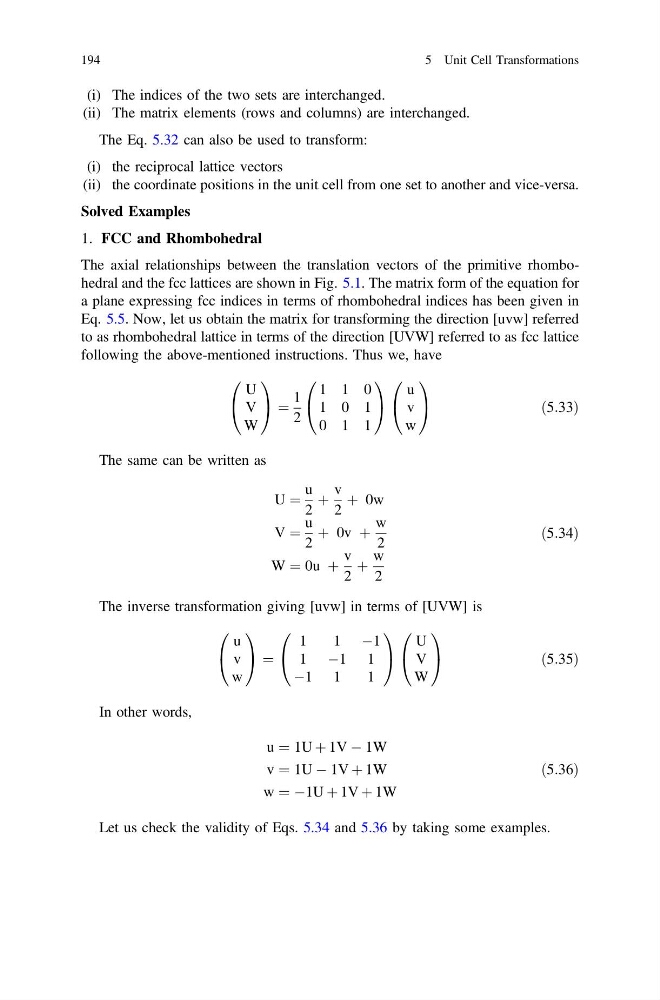
The axial relationships between the translation vectors of the primitive rhombohedral and the fcc lattices are shown in Fig. 5.1. The matrix form of the equation for
a plane expressing fcc indices in terms of rhombohedral indices has been given in
Eq. 5.5. Now, let us obtain the matrix for transforming the direction [uvw] referred
to as rhombohedral lattice in terms of the direction [UVW] referred to as fcc lattice
following the above-mentioned instructions. Thus we, have
U
V
W
0
@
1
A ¼
1
2
1 1 0
1 0 1
0 1 1
0
@
1
A
u
v
w
0
@
1
A
ð5:33Þ
The same can be written as
U ¼
u
2
þ
v
2
þ 0w
V ¼
u
2
þ 0v þ
w
2
W ¼ 0u þ
v
2
þ
w
2
ð5:34Þ
The inverse transformation giving [uvw] in terms of [UVW] is
u
v
w
0
@
1
A ¼
1
1 À1
1 À1 1
À1 1
1
0
@
1
A
U
V
W
0
@
1
A
ð5:35Þ
In other words,
u ¼ 1U þ 1V À 1W
v ¼ 1U À 1V þ 1W
w ¼ À1U þ 1V þ 1W
ð5:36Þ
Let us check the validity of Eqs. 5.34 and 5.36 by taking some examples.
194
5 Unit Cell Transformations
(ii) The matrix elements (rows and columns) are interchanged.
The Eq. 5.32 can also be used to transform:
(i) the reciprocal lattice vectors
(ii) the coordinate positions in the unit cell from one set to another and vice-versa.
Solved Examples
1. FCC and Rhombohedral
The axial relationships between the translation vectors of the primitive rhombohedral and the fcc lattices are shown in Fig. 5.1. The matrix form of the equation for
a plane expressing fcc indices in terms of rhombohedral indices has been given in
Eq. 5.5. Now, let us obtain the matrix for transforming the direction [uvw] referred
to as rhombohedral lattice in terms of the direction [UVW] referred to as fcc lattice
following the above-mentioned instructions. Thus we, have
U
V
W
0
@
1
A ¼
1
2
1 1 0
1 0 1
0 1 1
0
@
1
A
u
v
w
0
@
1
A
ð5:33Þ
The same can be written as
U ¼
u
2
þ
v
2
þ 0w
V ¼
u
2
þ 0v þ
w
2
W ¼ 0u þ
v
2
þ
w
2
ð5:34Þ
The inverse transformation giving [uvw] in terms of [UVW] is
u
v
w
0
@
1
A ¼
1
1 À1
1 À1 1
À1 1
1
0
@
1
A
U
V
W
0
@
1
A
ð5:35Þ
In other words,
u ¼ 1U þ 1V À 1W
v ¼ 1U À 1V þ 1W
w ¼ À1U þ 1V þ 1W
ð5:36Þ
Let us check the validity of Eqs. 5.34 and 5.36 by taking some examples.
194
5 Unit Cell Transformations