

Example 1 Find the equivalent fcc directions for the following rhombohedral
directions: [111], ½11 1 and [200].
Solution: Given: Rhombohedral directions: [111], ½11 1 and [200].
Let us take them one by one.
Case I: Rhombohedral direction: [uvw] [111].
Substituting the values of u, v and w in Eq. 5.34, we obtain [UVW] [111] for fcc.
Again, substituting the values of U, V and W in Eq. 5.36, we obtain [uvw] [111]
for rhombohedron, this is the same indices with which we started. This also shows
that for [111] direction, both fcc and rhombohedron have identical indices.
Case II: Rhombohedral direction: [uvw] ½11 1.
A similar operation using Eq. 5.34 with the given u, v and w values will provide us
[UVW] [100] for fcc. Again, substituting the values of U, V and W in Eq. 5.36,
we obtain [uvw] ½11 1 for rhombohedron. This confirms the validity of Eqs. 5.34
and 5.36.
Case III: Rhombohedral direction: [uvw] [200].
A similar operation using Eq. 5.34 with the given u, v and w values will provide us
[UVW] [110] for fcc. Again, substituting the values of U, V and W in Eq. 5.36,
we obtain [uvw] [200] for rhombohedron. This confirms the validity of Eqs. 5.34
and 5.36. Using these equations, a one to one correspondence of other directions
can be obtained.
2. Simple Hexagonal and Orthorhombic
The axial relationships between the translation vectors of simple hexagonal and
orthorhombic lattices are shown in Fig. 5.2. The matrix form of the equation for a
plane expressing orthorhombic indices in terms of hexagonal indices has been given
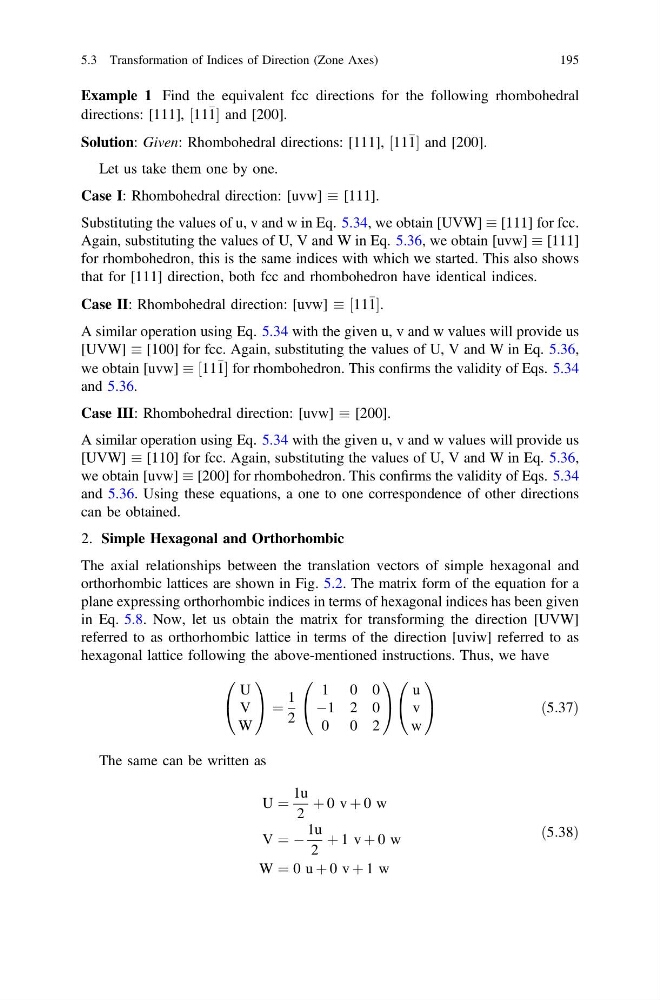
in Eq. 5.8. Now, let us obtain the matrix for transforming the direction [UVW]
referred to as orthorhombic lattice in terms of the direction [uviw] referred to as
hexagonal lattice following the above-mentioned instructions. Thus, we have
U
V
W
0
@
1
A ¼
1
2
1 0 0
À1 2 0
0 0 2
0
@
1
A
u
v
w
0
@
1
A
ð5:37Þ
The same can be written as
U ¼
1u
2
þ 0 v þ 0 w
V ¼ À
1u
2
þ 1 v þ 0 w
W ¼ 0 u þ 0 v þ 1 w
ð5:38Þ
5.3 Transformation of Indices of Direction (Zone Axes)
195
directions: [111], ½11 1 and [200].
Solution: Given: Rhombohedral directions: [111], ½11 1 and [200].
Let us take them one by one.
Case I: Rhombohedral direction: [uvw] [111].
Substituting the values of u, v and w in Eq. 5.34, we obtain [UVW] [111] for fcc.
Again, substituting the values of U, V and W in Eq. 5.36, we obtain [uvw] [111]
for rhombohedron, this is the same indices with which we started. This also shows
that for [111] direction, both fcc and rhombohedron have identical indices.
Case II: Rhombohedral direction: [uvw] ½11 1.
A similar operation using Eq. 5.34 with the given u, v and w values will provide us
[UVW] [100] for fcc. Again, substituting the values of U, V and W in Eq. 5.36,
we obtain [uvw] ½11 1 for rhombohedron. This confirms the validity of Eqs. 5.34
and 5.36.
Case III: Rhombohedral direction: [uvw] [200].
A similar operation using Eq. 5.34 with the given u, v and w values will provide us
[UVW] [110] for fcc. Again, substituting the values of U, V and W in Eq. 5.36,
we obtain [uvw] [200] for rhombohedron. This confirms the validity of Eqs. 5.34
and 5.36. Using these equations, a one to one correspondence of other directions
can be obtained.
2. Simple Hexagonal and Orthorhombic
The axial relationships between the translation vectors of simple hexagonal and
orthorhombic lattices are shown in Fig. 5.2. The matrix form of the equation for a
plane expressing orthorhombic indices in terms of hexagonal indices has been given
in Eq. 5.8. Now, let us obtain the matrix for transforming the direction [UVW]
referred to as orthorhombic lattice in terms of the direction [uviw] referred to as
hexagonal lattice following the above-mentioned instructions. Thus, we have
U
V
W
0
@
1
A ¼
1
2
1 0 0
À1 2 0
0 0 2
0
@
1
A
u
v
w
0
@
1
A
ð5:37Þ
The same can be written as
U ¼
1u
2
þ 0 v þ 0 w
V ¼ À
1u
2
þ 1 v þ 0 w
W ¼ 0 u þ 0 v þ 1 w
ð5:38Þ
5.3 Transformation of Indices of Direction (Zone Axes)
195