

Case III: Plane of fcc primitive: (hkl) (111).
A similar operation with the given h, k and l values will provide us (HKL)
(111) for fcc plane. Again, substituting the values of H, K and L in Eq. 5.28, we
obtain (hkl) (111) for primitive fcc plane. This confirms the validity of Eqs. 5.25
and 5.28. This also shows that for (111) plane, both crystal systems have identical
indices. Using these equations, a one to one correspondence of other Miller indices
can be obtained.
5.3 Transformation of Indices of Direction (Zone Axes)
Unlike the transformation of indices of planes, the transformation of indices of
direction is not identical to the transformation axes. In order to find the general
equation for transformation of indices of direction, let us assume ½u 1 v 1 w 1 and
½u 2 v 2 w 2 are the indices of direction (for a vector ~ r) in the two sets of axes,
respectively. Therefore, the vector ~ r in terms of components of two sets of unit cell
vectors can be written as
~ r ¼ u 1 a 1 + v 1 b 1 þ w 1 c 1 ¼ u 2 a 2 + v 2 b 2 þ w 2 c 2
ð5:29Þ
Substituting the values of a 2 , b 2 and c 2 from Eq. 5.1 into Eq. 5.29, we obtain
~ r ¼ u 1 a 1 þ v 1 b 1 þ w 1 c 1
¼ u 2 m 11 a 1 þ m 12 b 1 þ m 13 c 1
ð
Þ
þ v 2 m 21 a 1 þ m 22 b 1 þ m 23 c 1
ð
Þ
þ w 2 m 31 a 1 + m 32 b 1 þ m 33 c 1
ð
Þ
ð5:30Þ
Now, comparing the coefficients of a 1 , b 1 and c 1 in Eq. 5.30, we have
u 1 ¼ m 11 u 2 þ m 21 v 2 þ m 31 w 2
v 1 ¼ m 12 u 2 þ m 22 v 2 þ m 32 w 2
w 1 ¼ m 13 u 2 þ m 23 v 2 þ m 33 w 2
ð5:31Þ
Matrix form of Eq. 5.31 is
u 1
v 1
w 1
0
@
1
A ¼
m 11 m 21 m 31
m 12 m 22 m 32
m 13 m 23 m 33
0
@
1
A
u 2
v 2
w 2
0
@
1
A
ð5:32Þ
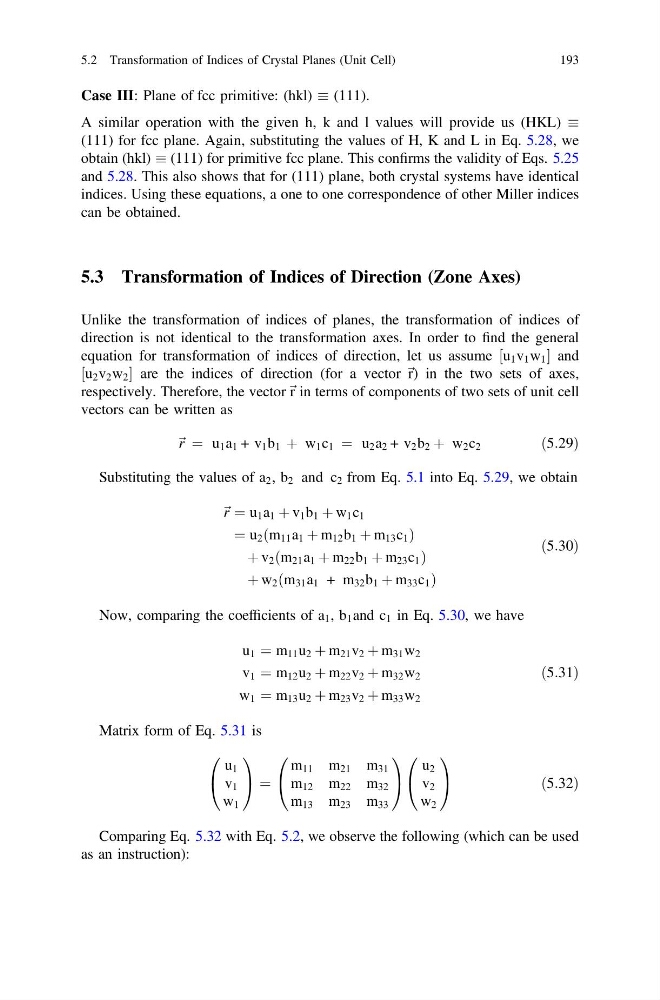
Comparing Eq. 5.32 with Eq. 5.2, we observe the following (which can be used
as an instruction):
5.2 Transformation of Indices of Crystal Planes (Unit Cell)
193
A similar operation with the given h, k and l values will provide us (HKL)
(111) for fcc plane. Again, substituting the values of H, K and L in Eq. 5.28, we
obtain (hkl) (111) for primitive fcc plane. This confirms the validity of Eqs. 5.25
and 5.28. This also shows that for (111) plane, both crystal systems have identical
indices. Using these equations, a one to one correspondence of other Miller indices
can be obtained.
5.3 Transformation of Indices of Direction (Zone Axes)
Unlike the transformation of indices of planes, the transformation of indices of
direction is not identical to the transformation axes. In order to find the general
equation for transformation of indices of direction, let us assume ½u 1 v 1 w 1 and
½u 2 v 2 w 2 are the indices of direction (for a vector ~ r) in the two sets of axes,
respectively. Therefore, the vector ~ r in terms of components of two sets of unit cell
vectors can be written as
~ r ¼ u 1 a 1 + v 1 b 1 þ w 1 c 1 ¼ u 2 a 2 + v 2 b 2 þ w 2 c 2
ð5:29Þ
Substituting the values of a 2 , b 2 and c 2 from Eq. 5.1 into Eq. 5.29, we obtain
~ r ¼ u 1 a 1 þ v 1 b 1 þ w 1 c 1
¼ u 2 m 11 a 1 þ m 12 b 1 þ m 13 c 1
ð
Þ
þ v 2 m 21 a 1 þ m 22 b 1 þ m 23 c 1
ð
Þ
þ w 2 m 31 a 1 + m 32 b 1 þ m 33 c 1
ð
Þ
ð5:30Þ
Now, comparing the coefficients of a 1 , b 1 and c 1 in Eq. 5.30, we have
u 1 ¼ m 11 u 2 þ m 21 v 2 þ m 31 w 2
v 1 ¼ m 12 u 2 þ m 22 v 2 þ m 32 w 2
w 1 ¼ m 13 u 2 þ m 23 v 2 þ m 33 w 2
ð5:31Þ
Matrix form of Eq. 5.31 is
u 1
v 1
w 1
0
@
1
A ¼
m 11 m 21 m 31
m 12 m 22 m 32
m 13 m 23 m 33
0
@
1
A
u 2
v 2
w 2
0
@
1
A
ð5:32Þ
Comparing Eq. 5.32 with Eq. 5.2, we observe the following (which can be used
as an instruction):
5.2 Transformation of Indices of Crystal Planes (Unit Cell)
193