

Example 2 Find the equivalent hexagonal planes for the following orthorhombic
planes: (110) and (200).
Solution: Given: Simple orthorhombic planes: (110) and (200).
Let us take them one by one.
Case I: Orthorhombic plane: (HKL) (110).
Substituting the values of H, K and L in Eq. 5.10, we obtain (hkl) (010), so that
(hkil) ð01 10Þ for hexagonal system. Again, substituting the values of h, k and l in
Eq. 5.7, we obtain (HKL) (110) for orthorhombic system, this is the same indices
with which we started.
Case II: Orthorhombic plane: (HKL) (200).
A similar operation with the given H, K and L values will provide us (hkl) (100),
so that (hkil) ð10 10Þ for hexagonal system. Again, substituting the values of h, k
and l in Eq. 5.7, we obtain (HKL) (200) for orthorhombic system, this is the
same indices with which we started. This confirms the validity of Eqs. 5.7 and 5.10.
3. HCP and RCP
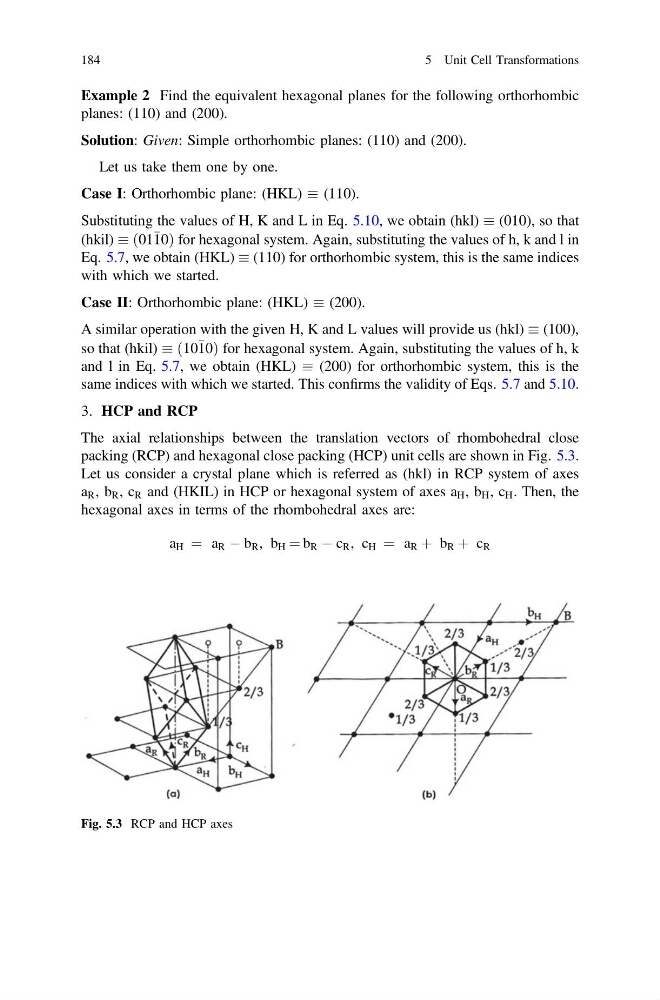
The axial relationships between the translation vectors of rhombohedral close
packing (RCP) and hexagonal close packing (HCP) unit cells are shown in Fig. 5.3.
Let us consider a crystal plane which is referred as (hkl) in RCP system of axes
a R , b R , c R and (HKIL) in HCP or hexagonal system of axes a H , b H , c H . Then, the
hexagonal axes in terms of the rhombohedral axes are:
a H ¼ a R À b R , b H ¼ b R À c R , c H ¼ a R þ b R þ c R
Fig. 5.3 RCP and HCP axes
184
5 Unit Cell Transformations
planes: (110) and (200).
Solution: Given: Simple orthorhombic planes: (110) and (200).
Let us take them one by one.
Case I: Orthorhombic plane: (HKL) (110).
Substituting the values of H, K and L in Eq. 5.10, we obtain (hkl) (010), so that
(hkil) ð01 10Þ for hexagonal system. Again, substituting the values of h, k and l in
Eq. 5.7, we obtain (HKL) (110) for orthorhombic system, this is the same indices
with which we started.
Case II: Orthorhombic plane: (HKL) (200).
A similar operation with the given H, K and L values will provide us (hkl) (100),
so that (hkil) ð10 10Þ for hexagonal system. Again, substituting the values of h, k
and l in Eq. 5.7, we obtain (HKL) (200) for orthorhombic system, this is the
same indices with which we started. This confirms the validity of Eqs. 5.7 and 5.10.
3. HCP and RCP
The axial relationships between the translation vectors of rhombohedral close
packing (RCP) and hexagonal close packing (HCP) unit cells are shown in Fig. 5.3.
Let us consider a crystal plane which is referred as (hkl) in RCP system of axes
a R , b R , c R and (HKIL) in HCP or hexagonal system of axes a H , b H , c H . Then, the
hexagonal axes in terms of the rhombohedral axes are:
a H ¼ a R À b R , b H ¼ b R À c R , c H ¼ a R þ b R þ c R
Fig. 5.3 RCP and HCP axes
184
5 Unit Cell Transformations