

V ORTH ¼ 2V SH
The reverse relationships can be found by determining the inverse of the matrix
in Eq. 5.8, that is,
2 1 0
0 1 0
0 0 1
0
@
1
A
À1
¼
1
2
1 À1 0
0 2 0
0 0 2
0
@
1
A
Hence the inverse relationship (i.e., transformation from orthorhombic to simple
hexagon) is
h
k
l
0
@
1
A ¼
1
2
1 À1 0
0 2 0
0 0 2
0
@
1
A
H
K
L
0
@
1
A
ð5:9Þ
The same can be written as
h ¼
H
2
À
K
2
þ 0 L
k ¼ 0 H þ 1K þ 0 L
l ¼ 0 H þ 0 K þ 1 L
ð5:10Þ
where i ¼ À (h + k)
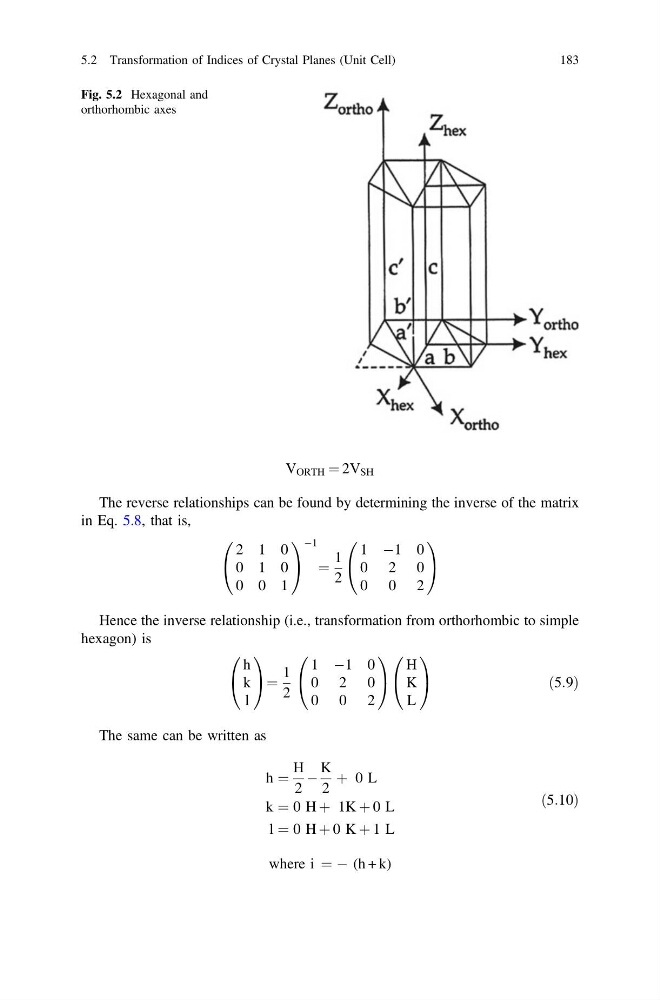
Fig. 5.2 Hexagonal and
orthorhombic axes
5.2 Transformation of Indices of Crystal Planes (Unit Cell)
183
The reverse relationships can be found by determining the inverse of the matrix
in Eq. 5.8, that is,
2 1 0
0 1 0
0 0 1
0
@
1
A
À1
¼
1
2
1 À1 0
0 2 0
0 0 2
0
@
1
A
Hence the inverse relationship (i.e., transformation from orthorhombic to simple
hexagon) is
h
k
l
0
@
1
A ¼
1
2
1 À1 0
0 2 0
0 0 2
0
@
1
A
H
K
L
0
@
1
A
ð5:9Þ
The same can be written as
h ¼
H
2
À
K
2
þ 0 L
k ¼ 0 H þ 1K þ 0 L
l ¼ 0 H þ 0 K þ 1 L
ð5:10Þ
where i ¼ À (h + k)
Fig. 5.2 Hexagonal and
orthorhombic axes
5.2 Transformation of Indices of Crystal Planes (Unit Cell)
183