

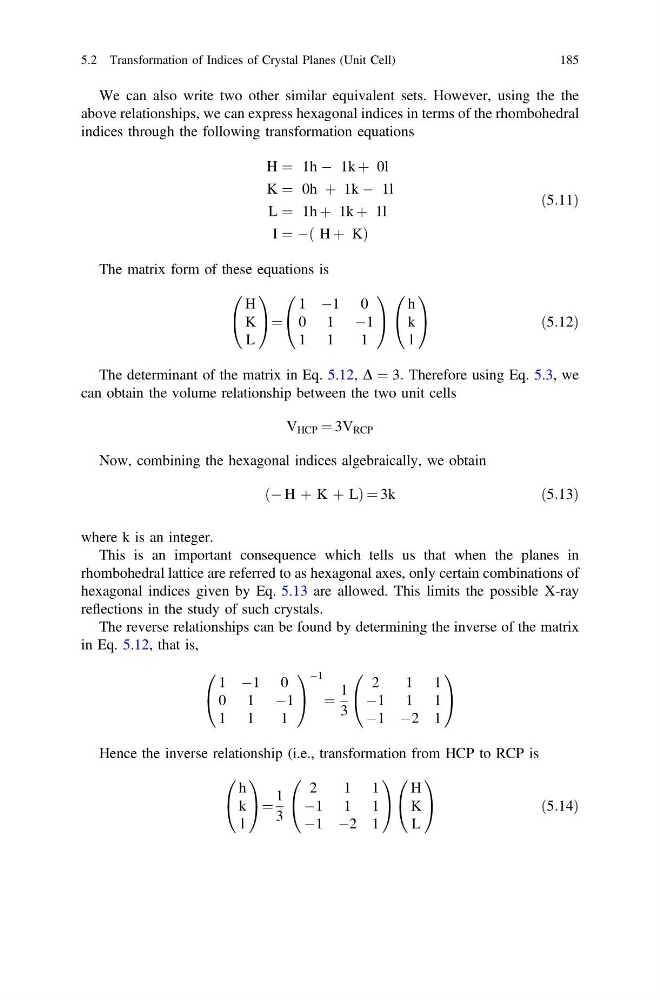
We can also write two other similar equivalent sets. However, using the the
above relationships, we can express hexagonal indices in terms of the rhombohedral
indices through the following transformation equations
H ¼ 1h À 1k þ 0l
K ¼ 0h þ 1k À 1l
L ¼ 1h þ 1k þ 1l
I ¼ Àð H þ KÞ
ð5:11Þ
The matrix form of these equations is
H
K
L
0
@
1
A ¼
1 À1 0
0 1 À1
1 1
1
0
@
1
A
h
k
l
0
@
1
A
ð5:12Þ
The determinant of the matrix in Eq. 5.12, D ¼ 3: Therefore using Eq. 5.3, we
can obtain the volume relationship between the two unit cells
V HCP ¼ 3V RCP
Now, combining the hexagonal indices algebraically, we obtain
À H þ K þ L
ð
Þ ¼ 3k
ð5:13Þ
where k is an integer.
This is an important consequence which tells us that when the planes in
rhombohedral lattice are referred to as hexagonal axes, only certain combinations of
hexagonal indices given by Eq. 5.13 are allowed. This limits the possible X-ray
reflections in the study of such crystals.
The reverse relationships can be found by determining the inverse of the matrix
in Eq. 5.12, that is,
1 À1 0
0 1 À1
1 1
1
0
@
1
A
À1
¼
1
3
2
1 1
À1 1 1
À1 À2 1
0
@
1
A
Hence the inverse relationship (i.e., transformation from HCP to RCP is
h
k
l
0
@
1
A ¼
1
3
2
1 1
À1 1 1
À1 À2 1
0
@
1
A
H
K
L
0
@
1
A
ð5:14Þ
5.2 Transformation of Indices of Crystal Planes (Unit Cell)
185
above relationships, we can express hexagonal indices in terms of the rhombohedral
indices through the following transformation equations
H ¼ 1h À 1k þ 0l
K ¼ 0h þ 1k À 1l
L ¼ 1h þ 1k þ 1l
I ¼ Àð H þ KÞ
ð5:11Þ
The matrix form of these equations is
H
K
L
0
@
1
A ¼
1 À1 0
0 1 À1
1 1
1
0
@
1
A
h
k
l
0
@
1
A
ð5:12Þ
The determinant of the matrix in Eq. 5.12, D ¼ 3: Therefore using Eq. 5.3, we
can obtain the volume relationship between the two unit cells
V HCP ¼ 3V RCP
Now, combining the hexagonal indices algebraically, we obtain
À H þ K þ L
ð
Þ ¼ 3k
ð5:13Þ
where k is an integer.
This is an important consequence which tells us that when the planes in
rhombohedral lattice are referred to as hexagonal axes, only certain combinations of
hexagonal indices given by Eq. 5.13 are allowed. This limits the possible X-ray
reflections in the study of such crystals.
The reverse relationships can be found by determining the inverse of the matrix
in Eq. 5.12, that is,
1 À1 0
0 1 À1
1 1
1
0
@
1
A
À1
¼
1
3
2
1 1
À1 1 1
À1 À2 1
0
@
1
A
Hence the inverse relationship (i.e., transformation from HCP to RCP is
h
k
l
0
@
1
A ¼
1
3
2
1 1
À1 1 1
À1 À2 1
0
@
1
A
H
K
L
0
@
1
A
ð5:14Þ
5.2 Transformation of Indices of Crystal Planes (Unit Cell)
185