

Draw a line DC parallel to OB, so that the Δ OCD is an equilateral triangle and
the length of its sides, OD = DC = r (Fig. 4.16). Further, the Δ AOB and Δ ADC
are similar, so that
DC
AD
¼
OB
OA
or
r
p À r
¼
q
p
or rp ¼ q p À r
ð
Þ¼qp À qr
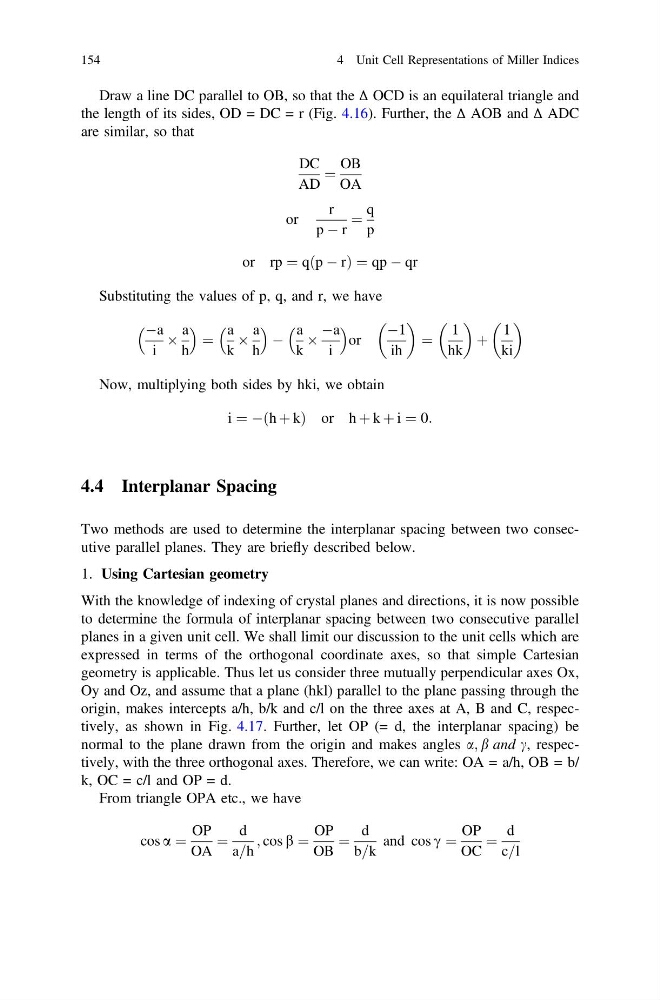
Substituting the values of p, q, and r, we have
Àa
i
Â
a
h
¼
a
k
Â
a
h
À
a
k
Â
Àa
i
or
À1
ih
¼
1
hk
þ
1
ki
Now, multiplying both sides by hki, we obtain
i ¼ À h þ k
ð
Þ or h þ k þ i ¼ 0:
4.4 Interplanar Spacing
Two methods are used to determine the interplanar spacing between two consecutive parallel planes. They are briefly described below.
1. Using Cartesian geometry
With the knowledge of indexing of crystal planes and directions, it is now possible
to determine the formula of interplanar spacing between two consecutive parallel
planes in a given unit cell. We shall limit our discussion to the unit cells which are
expressed in terms of the orthogonal coordinate axes, so that simple Cartesian
geometry is applicable. Thus let us consider three mutually perpendicular axes Ox,
Oy and Oz, and assume that a plane (hkl) parallel to the plane passing through the
origin, makes intercepts a/h, b/k and c/l on the three axes at A, B and C, respectively, as shown in Fig. 4.17. Further, let OP (= d, the interplanar spacing) be
normal to the plane drawn from the origin and makes angles a; b and c, respectively, with the three orthogonal axes. Therefore, we can write: OA = a/h, OB = b/
k, OC = c/l and OP = d.
From triangle OPA etc., we have
cos a ¼
OP
OA
¼
d
a=h
; cos b ¼
OP
OB
¼
d
b=k
and cos c ¼
OP
OC
¼
d
c=l
154
4 Unit Cell Representations of Miller Indices
the length of its sides, OD = DC = r (Fig. 4.16). Further, the Δ AOB and Δ ADC
are similar, so that
DC
AD
¼
OB
OA
or
r
p À r
¼
q
p
or rp ¼ q p À r
ð
Þ¼qp À qr
Substituting the values of p, q, and r, we have
Àa
i
Â
a
h
¼
a
k
Â
a
h
À
a
k
Â
Àa
i
or
À1
ih
¼
1
hk
þ
1
ki
Now, multiplying both sides by hki, we obtain
i ¼ À h þ k
ð
Þ or h þ k þ i ¼ 0:
4.4 Interplanar Spacing
Two methods are used to determine the interplanar spacing between two consecutive parallel planes. They are briefly described below.
1. Using Cartesian geometry
With the knowledge of indexing of crystal planes and directions, it is now possible
to determine the formula of interplanar spacing between two consecutive parallel
planes in a given unit cell. We shall limit our discussion to the unit cells which are
expressed in terms of the orthogonal coordinate axes, so that simple Cartesian
geometry is applicable. Thus let us consider three mutually perpendicular axes Ox,
Oy and Oz, and assume that a plane (hkl) parallel to the plane passing through the
origin, makes intercepts a/h, b/k and c/l on the three axes at A, B and C, respectively, as shown in Fig. 4.17. Further, let OP (= d, the interplanar spacing) be
normal to the plane drawn from the origin and makes angles a; b and c, respectively, with the three orthogonal axes. Therefore, we can write: OA = a/h, OB = b/
k, OC = c/l and OP = d.
From triangle OPA etc., we have
cos a ¼
OP
OA
¼
d
a=h
; cos b ¼
OP
OB
¼
d
b=k
and cos c ¼
OP
OC
¼
d
c=l
154
4 Unit Cell Representations of Miller Indices