

Case III: Given: [HKL] [110]. Using the conversion formula, we can write.
Miller–Bravais indices
h
k
i
l
1
3
1
3
À
2
3
0
Removing fractions
1
1
−2
0
⟹ The required Miller–Bravais indices are: 11 20
½
.
The above calculations show that: 2 1 10
½
, 12 10
½
and 11 20
½
belong to the same
family.
Example 4 Show that in a hexagonal crystal system, the Miller–Bravais indices
are related as
i ¼ À h þ k
ð
Þ or h þ k þ i ¼ 0:
Proof We know that in a hexagonal unit cell a = b 6 ¼ c and a = b = 90° 6 ¼ c =
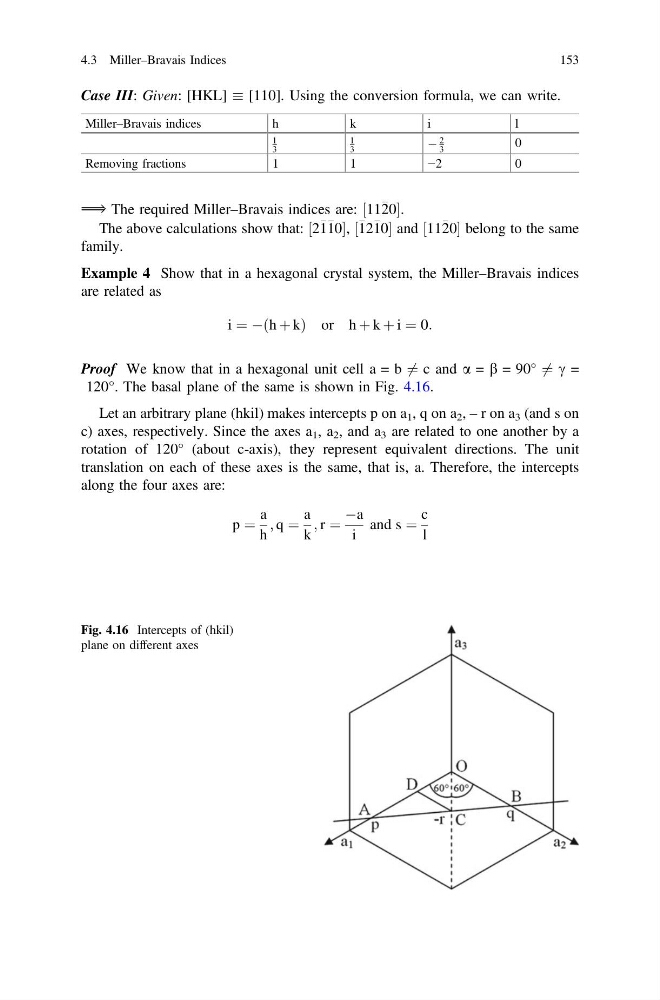
120°. The basal plane of the same is shown in Fig. 4.16.
Let an arbitrary plane (hkil) makes intercepts p on a 1 , q on a 2 , – r on a 3 (and s on
c) axes, respectively. Since the axes a 1 , a 2 , and a 3 are related to one another by a
rotation of 120° (about c-axis), they represent equivalent directions. The unit
translation on each of these axes is the same, that is, a. Therefore, the intercepts
along the four axes are:
p ¼
a
h
; q ¼
a
k
; r ¼
Àa
i
and s ¼
c
l
Fig. 4.16 Intercepts of (hkil)
plane on different axes
4.3 Miller–Bravais Indices
153
Miller–Bravais indices
h
k
i
l
1
3
1
3
À
2
3
0
Removing fractions
1
1
−2
0
⟹ The required Miller–Bravais indices are: 11 20
½
.
The above calculations show that: 2 1 10
½
, 12 10
½
and 11 20
½
belong to the same
family.
Example 4 Show that in a hexagonal crystal system, the Miller–Bravais indices
are related as
i ¼ À h þ k
ð
Þ or h þ k þ i ¼ 0:
Proof We know that in a hexagonal unit cell a = b 6 ¼ c and a = b = 90° 6 ¼ c =
120°. The basal plane of the same is shown in Fig. 4.16.
Let an arbitrary plane (hkil) makes intercepts p on a 1 , q on a 2 , – r on a 3 (and s on
c) axes, respectively. Since the axes a 1 , a 2 , and a 3 are related to one another by a
rotation of 120° (about c-axis), they represent equivalent directions. The unit
translation on each of these axes is the same, that is, a. Therefore, the intercepts
along the four axes are:
p ¼
a
h
; q ¼
a
k
; r ¼
Àa
i
and s ¼
c
l
Fig. 4.16 Intercepts of (hkil)
plane on different axes
4.3 Miller–Bravais Indices
153