

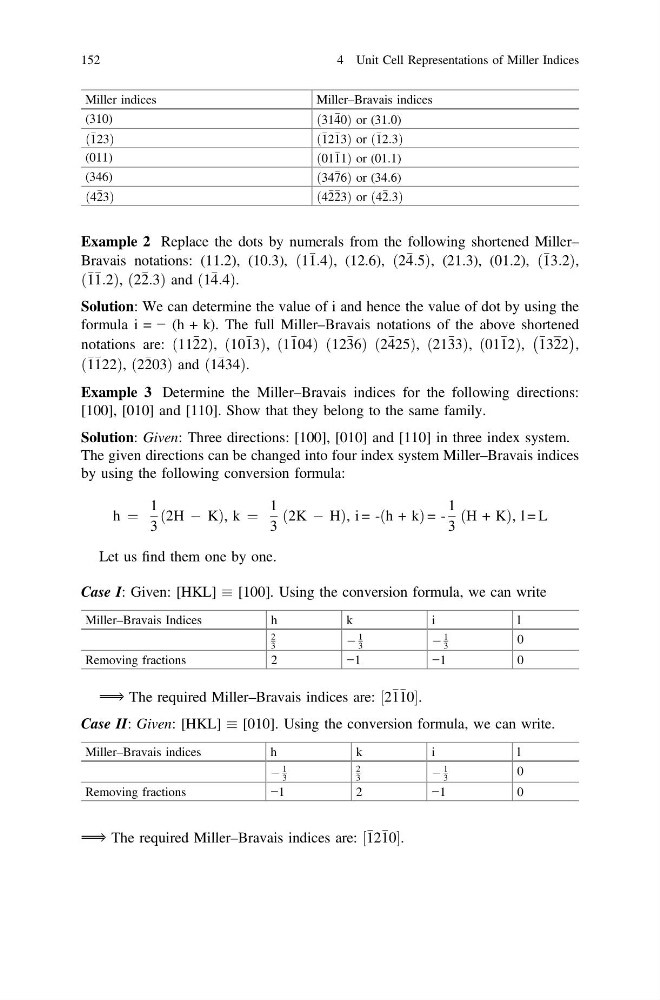
Miller indices
Miller–Bravais indices
(310)
31 40
ð
Þ or (31.0)
123
ð
Þ
12 13
ð
Þ or 12:3
ð
Þ
(011)
01 11
ð
Þ or (01.1)
(346)
34 76
ð
Þ or (34.6)
4 23
ð
Þ
4 2 23
ð
Þ or 4 2:3
ð
Þ
Example 2 Replace the dots by numerals from the following shortened Miller–
Bravais notations: (11.2), (10.3), 1 1:4
ð
Þ, (12.6), 2 4:5
ð
Þ, (21.3), (01.2), 13:2
ð
Þ,
1 1:2
ð
Þ, 2 2:3
ð
Þ and 1 4:4
ð
Þ.
Solution: We can determine the value of i and hence the value of dot by using the
formula i = − (h + k). The full Miller–Bravais notations of the above shortened
notations are: 11 22
ð
Þ, 10 13
ð
Þ, 1 104
ð
Þ 12 36
ð
Þ 2 425
ð
Þ, 21 33
ð
Þ, 01 12
ð
Þ, 1322
À
Á
,
1 122
ð
Þ, 2 203
ð
Þ and 1 434
ð
Þ.
Example 3 Determine the Miller–Bravais indices for the following directions:
[100], [010] and [110]. Show that they belong to the same family.
Solution: Given: Three directions: [100], [010] and [110] in three index system.
The given directions can be changed into four index system Miller–Bravais indices
by using the following conversion formula:
h ¼
1
3
2H À K
ð
Þ , k ¼
1
3
2K À H
ð
Þ , i = - h + k
ð
Þ= -
1
3
H + K
ð
Þ, l = L
Let us find them one by one.
Case I: Given: [HKL] [100]. Using the conversion formula, we can write
Miller–Bravais Indices
h
k
i
l
2
3
À
1
3
À
1
3
0
Removing fractions
2
−1
−1
0
⟹ The required Miller–Bravais indices are: 2 1 10
½
.
Case II: Given: [HKL] [010]. Using the conversion formula, we can write.
Miller–Bravais indices
h
k
i
l
À
1
3
2
3
À
1
3
0
Removing fractions
−1
2
−1
0
⟹ The required Miller–Bravais indices are: 12 10
½
.
152
4 Unit Cell Representations of Miller Indices
Miller–Bravais indices
(310)
31 40
ð
Þ or (31.0)
123
ð
Þ
12 13
ð
Þ or 12:3
ð
Þ
(011)
01 11
ð
Þ or (01.1)
(346)
34 76
ð
Þ or (34.6)
4 23
ð
Þ
4 2 23
ð
Þ or 4 2:3
ð
Þ
Example 2 Replace the dots by numerals from the following shortened Miller–
Bravais notations: (11.2), (10.3), 1 1:4
ð
Þ, (12.6), 2 4:5
ð
Þ, (21.3), (01.2), 13:2
ð
Þ,
1 1:2
ð
Þ, 2 2:3
ð
Þ and 1 4:4
ð
Þ.
Solution: We can determine the value of i and hence the value of dot by using the
formula i = − (h + k). The full Miller–Bravais notations of the above shortened
notations are: 11 22
ð
Þ, 10 13
ð
Þ, 1 104
ð
Þ 12 36
ð
Þ 2 425
ð
Þ, 21 33
ð
Þ, 01 12
ð
Þ, 1322
À
Á
,
1 122
ð
Þ, 2 203
ð
Þ and 1 434
ð
Þ.
Example 3 Determine the Miller–Bravais indices for the following directions:
[100], [010] and [110]. Show that they belong to the same family.
Solution: Given: Three directions: [100], [010] and [110] in three index system.
The given directions can be changed into four index system Miller–Bravais indices
by using the following conversion formula:
h ¼
1
3
2H À K
ð
Þ , k ¼
1
3
2K À H
ð
Þ , i = - h + k
ð
Þ= -
1
3
H + K
ð
Þ, l = L
Let us find them one by one.
Case I: Given: [HKL] [100]. Using the conversion formula, we can write
Miller–Bravais Indices
h
k
i
l
2
3
À
1
3
À
1
3
0
Removing fractions
2
−1
−1
0
⟹ The required Miller–Bravais indices are: 2 1 10
½
.
Case II: Given: [HKL] [010]. Using the conversion formula, we can write.
Miller–Bravais indices
h
k
i
l
À
1
3
2
3
À
1
3
0
Removing fractions
−1
2
−1
0
⟹ The required Miller–Bravais indices are: 12 10
½
.
152
4 Unit Cell Representations of Miller Indices