

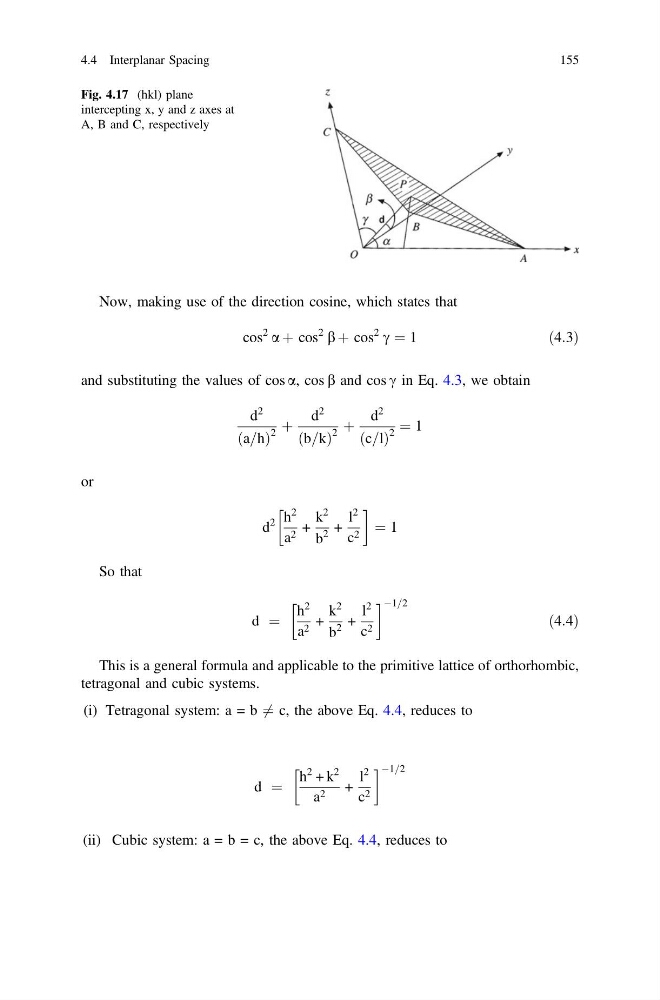
Now, making use of the direction cosine, which states that
cos
2
a þ cos
2
b þ cos
2
c ¼ 1
ð4:3Þ
and substituting the values of cos a, cos b and cos c in Eq. 4.3, we obtain
d
2
a=h
ð Þ
2
þ
d
2
b=k
ð
Þ
2
þ
d
2
c=l
ð Þ
2
¼ 1
or
d
2 h
2
a 2 +
k
2
b
2
+
l
2
c 2
!
¼ 1
So that
d ¼
h
2
a 2 +
k
2
b
2
+
l
2
c 2
! À1=2
ð4:4Þ
This is a general formula and applicable to the primitive lattice of orthorhombic,
tetragonal and cubic systems.
(i) Tetragonal system: a = b 6 ¼ c, the above Eq. 4.4, reduces to
d ¼
h
2 + k
2
a 2 +
l
2
c 2
! À1=2
(ii) Cubic system: a = b = c, the above Eq. 4.4, reduces to
Fig. 4.17 (hkl) plane
intercepting x, y and z axes at
A, B and C, respectively
4.4 Interplanar Spacing
155
cos
2
a þ cos
2
b þ cos
2
c ¼ 1
ð4:3Þ
and substituting the values of cos a, cos b and cos c in Eq. 4.3, we obtain
d
2
a=h
ð Þ
2
þ
d
2
b=k
ð
Þ
2
þ
d
2
c=l
ð Þ
2
¼ 1
or
d
2 h
2
a 2 +
k
2
b
2
+
l
2
c 2
!
¼ 1
So that
d ¼
h
2
a 2 +
k
2
b
2
+
l
2
c 2
! À1=2
ð4:4Þ
This is a general formula and applicable to the primitive lattice of orthorhombic,
tetragonal and cubic systems.
(i) Tetragonal system: a = b 6 ¼ c, the above Eq. 4.4, reduces to
d ¼
h
2 + k
2
a 2 +
l
2
c 2
! À1=2
(ii) Cubic system: a = b = c, the above Eq. 4.4, reduces to
Fig. 4.17 (hkl) plane
intercepting x, y and z axes at
A, B and C, respectively
4.4 Interplanar Spacing
155