

ðPQÞ
2 ¼ PT
ð Þ
2 þ QT
ð Þ
2 þ 2 PT:QT cos c
¼ x 2 À x 1
ð
Þ
2 a
2
þ y 2 À y 1
ð
Þ
2 b
2
þ 2 x 2 À x 1
ð
Þy 2 À y 1
ð
Þab cos c
or PQ ¼ x 2 À x 1
ð
Þ
2 a
2
þ y 2 À y 1
ð
Þ
2 b
2
þ 2 x 2 À x 1
ð
Þy 2 À y 1
ð
Þab cos c
h
i 1=2
ð3:3Þ
This is a general equation expressing the distance between two lattice points in
an oblique system. Equations for other lattices can be obtained by substituting
the respective axial parameters (i.e., axes and the angle between them) in
Eq. 3.3.
(b) In Three Dimensions
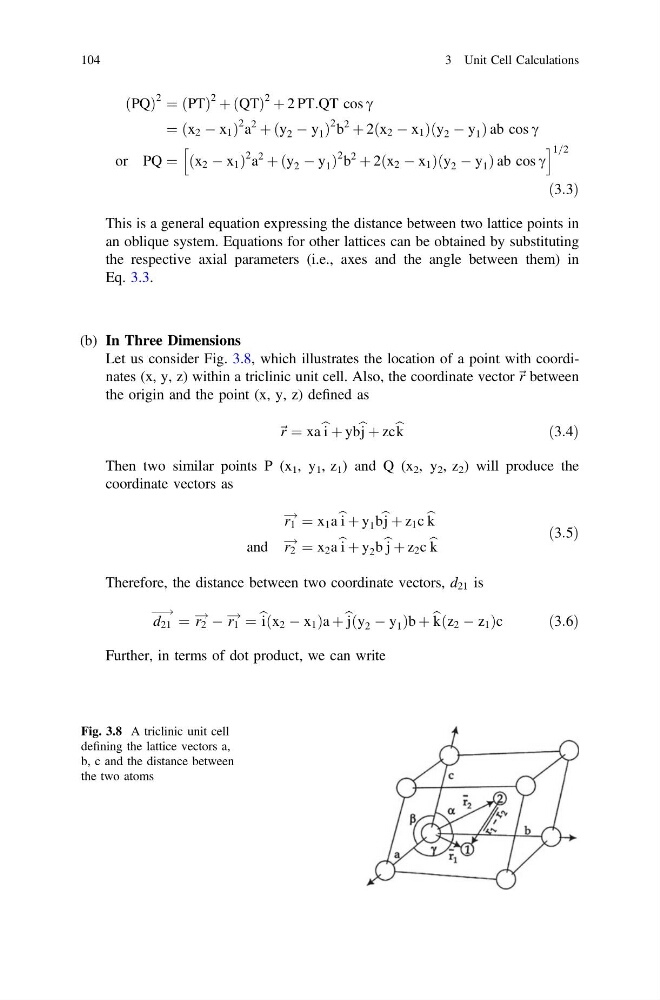
Let us consider Fig. 3.8, which illustrates the location of a point with coordinates (x, y, z) within a triclinic unit cell. Also, the coordinate vector ~ r between
the origin and the point (x, y, z) defined as
~ r ¼ xa b i þ yb b j þ zc b k
ð3:4Þ
Then two similar points P (x 1 , y 1 , z 1 ) and Q (x 2 , y 2 , z 2 ) will produce the
coordinate vectors as
r 1
! ¼ x 1 a b i þ y 1 b b j þ z 1 c b k
and r 2
! ¼ x 2 a b i þ y 2 b b j þ z 2 c b k
ð3:5Þ
Therefore, the distance between two coordinate vectors, d 21 is
d 21
! ¼ r 2
! À r 1
! ¼ b i x 2 À x 1
ð
Þ a þ b j y 2 À y 1
ð
Þ b þ b k z 2 À z 1
ð
Þc
ð3:6Þ
Further, in terms of dot product, we can write
Fig. 3.8 A triclinic unit cell
defining the lattice vectors a,
b, c and the distance between
the two atoms
104
3 Unit Cell Calculations
2 ¼ PT
ð Þ
2 þ QT
ð Þ
2 þ 2 PT:QT cos c
¼ x 2 À x 1
ð
Þ
2 a
2
þ y 2 À y 1
ð
Þ
2 b
2
þ 2 x 2 À x 1
ð
Þy 2 À y 1
ð
Þab cos c
or PQ ¼ x 2 À x 1
ð
Þ
2 a
2
þ y 2 À y 1
ð
Þ
2 b
2
þ 2 x 2 À x 1
ð
Þy 2 À y 1
ð
Þab cos c
h
i 1=2
ð3:3Þ
This is a general equation expressing the distance between two lattice points in
an oblique system. Equations for other lattices can be obtained by substituting
the respective axial parameters (i.e., axes and the angle between them) in
Eq. 3.3.
(b) In Three Dimensions
Let us consider Fig. 3.8, which illustrates the location of a point with coordinates (x, y, z) within a triclinic unit cell. Also, the coordinate vector ~ r between
the origin and the point (x, y, z) defined as
~ r ¼ xa b i þ yb b j þ zc b k
ð3:4Þ
Then two similar points P (x 1 , y 1 , z 1 ) and Q (x 2 , y 2 , z 2 ) will produce the
coordinate vectors as
r 1
! ¼ x 1 a b i þ y 1 b b j þ z 1 c b k
and r 2
! ¼ x 2 a b i þ y 2 b b j þ z 2 c b k
ð3:5Þ
Therefore, the distance between two coordinate vectors, d 21 is
d 21
! ¼ r 2
! À r 1
! ¼ b i x 2 À x 1
ð
Þ a þ b j y 2 À y 1
ð
Þ b þ b k z 2 À z 1
ð
Þc
ð3:6Þ
Further, in terms of dot product, we can write
Fig. 3.8 A triclinic unit cell
defining the lattice vectors a,
b, c and the distance between
the two atoms
104
3 Unit Cell Calculations