

1 À1
1 0
1 À1
1 0
¼
0 À1
1 À1
Hence, the fractional coordinates of the third point are: (y; x–y). Thus, the
fractional coordinates of three equivalent positions in 2-D are: (x, y), (x–y, x),
(y; x–y). Similarly, considering the product of proper matrices other three fractional
coordinates can also be obtained (actually they are simply inverses of the earlier
three). Therefore all the six fractional coordinates in 2-D are:
ðx; yÞ; ðx À y; xÞ; ðy; x À yÞ; ðx; yÞ; ðy À x; xÞ; ðy; y À xÞ:
Similarly in 3-D, they are:
ðx; y; zÞ; ðx À y; x; zÞ; ðy; x À y; zÞ; ðx; y; zÞ; ðy À x; x; zÞ; ðy; y À x; zÞ:
3.2 Distance Between Two Lattice Points (Oblique
System)
(a) In Two Dimensions
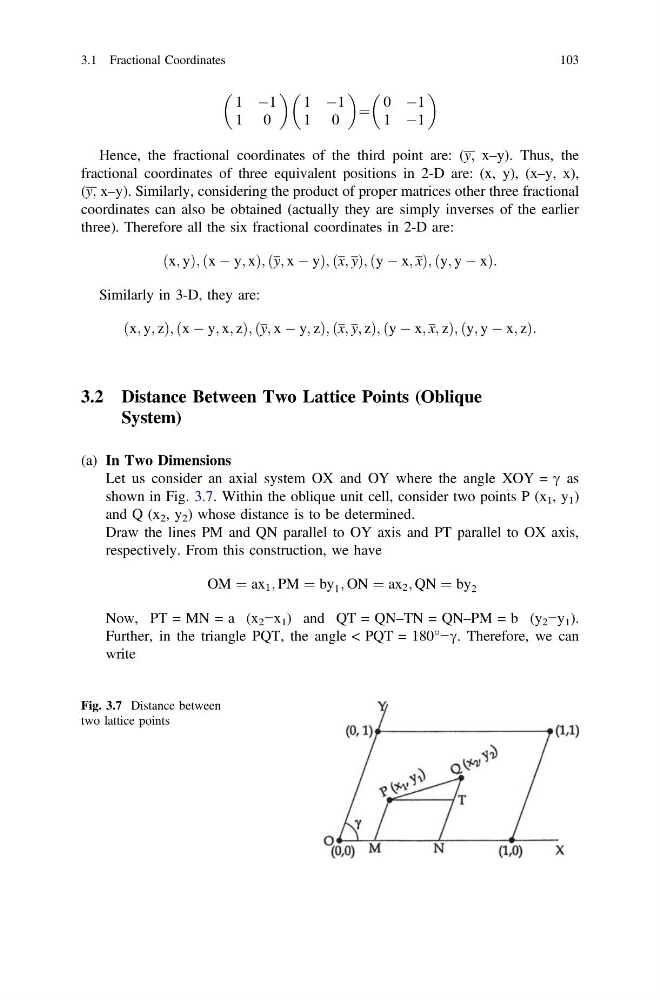
Let us consider an axial system OX and OY where the angle XOY = c as
shown in Fig. 3.7. Within the oblique unit cell, consider two points P (x 1 , y 1 )
and Q (x 2 , y 2 ) whose distance is to be determined.
Draw the lines PM and QN parallel to OY axis and PT parallel to OX axis,
respectively. From this construction, we have
OM ¼ ax 1 ; PM ¼ by 1 ; ON ¼ ax 2 ; QN ¼ by 2
Now, PT = MN = a (x 2 −x 1 ) and QT = QN–TN = QN–PM = b (y 2 −y 1 ).
Further, in the triangle PQT, the angle < PQT = 180°−c. Therefore, we can
write
Fig. 3.7 Distance between
two lattice points
3.1 Fractional Coordinates
103
1 0
1 À1
1 0
¼
0 À1
1 À1
Hence, the fractional coordinates of the third point are: (y; x–y). Thus, the
fractional coordinates of three equivalent positions in 2-D are: (x, y), (x–y, x),
(y; x–y). Similarly, considering the product of proper matrices other three fractional
coordinates can also be obtained (actually they are simply inverses of the earlier
three). Therefore all the six fractional coordinates in 2-D are:
ðx; yÞ; ðx À y; xÞ; ðy; x À yÞ; ðx; yÞ; ðy À x; xÞ; ðy; y À xÞ:
Similarly in 3-D, they are:
ðx; y; zÞ; ðx À y; x; zÞ; ðy; x À y; zÞ; ðx; y; zÞ; ðy À x; x; zÞ; ðy; y À x; zÞ:
3.2 Distance Between Two Lattice Points (Oblique
System)
(a) In Two Dimensions
Let us consider an axial system OX and OY where the angle XOY = c as
shown in Fig. 3.7. Within the oblique unit cell, consider two points P (x 1 , y 1 )
and Q (x 2 , y 2 ) whose distance is to be determined.
Draw the lines PM and QN parallel to OY axis and PT parallel to OX axis,
respectively. From this construction, we have
OM ¼ ax 1 ; PM ¼ by 1 ; ON ¼ ax 2 ; QN ¼ by 2
Now, PT = MN = a (x 2 −x 1 ) and QT = QN–TN = QN–PM = b (y 2 −y 1 ).
Further, in the triangle PQT, the angle < PQT = 180°−c. Therefore, we can
write
Fig. 3.7 Distance between
two lattice points
3.1 Fractional Coordinates
103