

Solution: Given: A 6-fold rotational symmetry (means 60° rotations).
Select crystallographic axes and consider a point with fractional coordinates
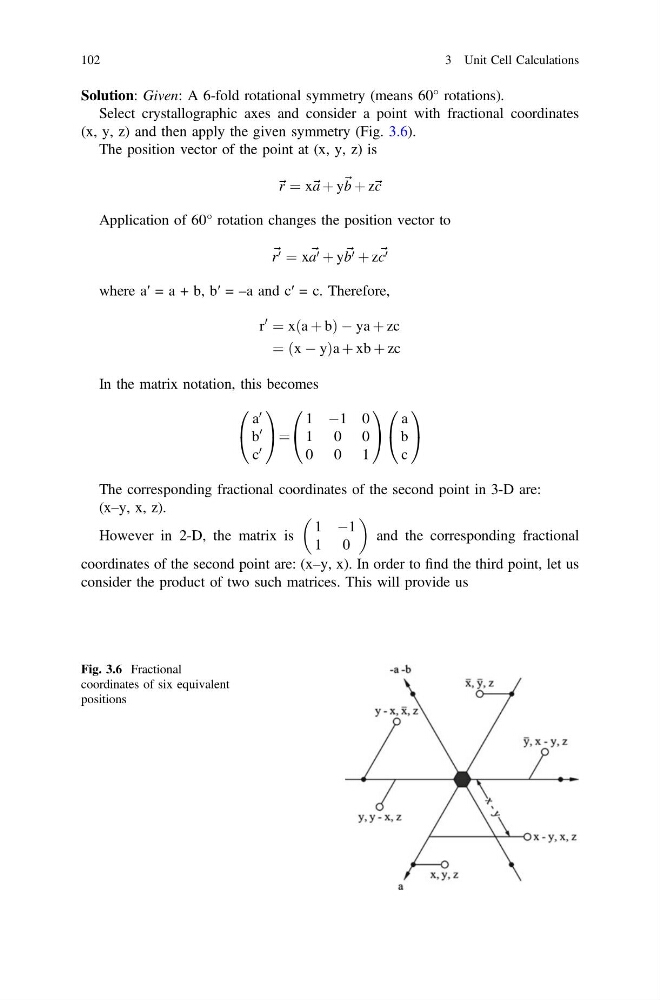
(x, y, z) and then apply the given symmetry (Fig. 3.6).
The position vector of the point at (x, y, z) is
~ r ¼ x~ a þ y ~ b þ z~ c
Application of 60° rotation changes the position vector to
~ r 0 ¼ x ~
a 0 þ y ~
b 0 þ z ~ c 0
where a′ = a + b, b′ = –a and c′ = c. Therefore,
r
0
¼ xða þ bÞ À ya þ zc
¼ ðx À yÞa þ xb þ zc
In the matrix notation, this becomes
a
0
b
0
c
0
0
@
1
A ¼
1 À1 0
1 0 0
0 0 1
0
@
1
A
a
b
c
0
@
1
A
The corresponding fractional coordinates of the second point in 3-D are:
(x–y, x, z).
However in 2-D, the matrix is
1 À1
1 0
and the corresponding fractional
coordinates of the second point are: (x–y, x). In order to find the third point, let us
consider the product of two such matrices. This will provide us
Fig. 3.6 Fractional
coordinates of six equivalent
positions
102
3 Unit Cell Calculations
Select crystallographic axes and consider a point with fractional coordinates
(x, y, z) and then apply the given symmetry (Fig. 3.6).
The position vector of the point at (x, y, z) is
~ r ¼ x~ a þ y ~ b þ z~ c
Application of 60° rotation changes the position vector to
~ r 0 ¼ x ~
a 0 þ y ~
b 0 þ z ~ c 0
where a′ = a + b, b′ = –a and c′ = c. Therefore,
r
0
¼ xða þ bÞ À ya þ zc
¼ ðx À yÞa þ xb þ zc
In the matrix notation, this becomes
a
0
b
0
c
0
0
@
1
A ¼
1 À1 0
1 0 0
0 0 1
0
@
1
A
a
b
c
0
@
1
A
The corresponding fractional coordinates of the second point in 3-D are:
(x–y, x, z).
However in 2-D, the matrix is
1 À1
1 0
and the corresponding fractional
coordinates of the second point are: (x–y, x). In order to find the third point, let us
consider the product of two such matrices. This will provide us
Fig. 3.6 Fractional
coordinates of six equivalent
positions
102
3 Unit Cell Calculations