

r 2 À r 1
ð
Þ: r 2 À r 1
ð
Þ¼ b i x 2 À x 1
ð
Þ a þ b j y 2 À y 1
ð
Þ b þ b k z 2 À z 1
ð
Þc
h
i
:
b i x 2 À x 1
ð
Þ a þ b j y 2 À y 1
ð
Þ b þ b k z 2 - z 1
ð
Þc
h
i
or r 2 À r 1
j
j
2 ¼ x 2 À x 1
ð
Þ
2 a
2
þ y 2 À y 1
ð
Þ
2 b
2
þ z 2 À z 1
ð
Þ
2 c
2
þ 2ab b i: b j x 2 À x 1
ð
Þy 2 À y 1
ð
Þ
þ 2bc b j: b k y 2 À y 1
ð
Þz 2 À z 1
ð
Þ
þ 2ca b k: b i z 2 À z 1
ð
Þx 2 À x 1
ð
Þ
ð3:7Þ
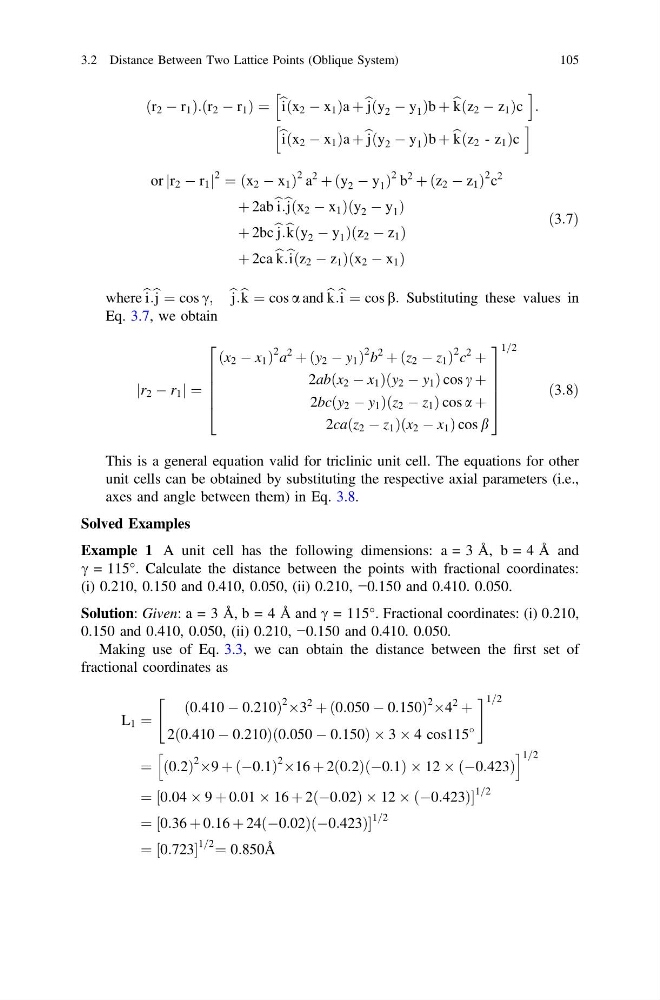
where b i: b j ¼ cos c; b j: b k ¼ cos a and b k: b i ¼ cos b: Substituting these values in
Eq. 3.7, we obtain
r 2 À r 1
j
j¼
x 2 À x 1
ð
Þ
2 a
2
þ y 2 À y 1
ð
Þ
2 b
2
þ z 2 À z 1
ð
Þ
2 c
2
þ
2ab x 2 À x 1
ð
Þy 2 À y 1
ð
Þcos c þ
2bc y 2 À y 1
ð
Þz 2 À z 1
ð
Þcos a þ
2ca z 2 À z 1
ð
Þ x 2 À x 1
ð
Þcos b
2
6
6
6
6
4
3
7
7
7
7
5
1=2
ð3:8Þ
This is a general equation valid for triclinic unit cell. The equations for other
unit cells can be obtained by substituting the respective axial parameters (i.e.,
axes and angle between them) in Eq. 3.8.
Solved Examples
Example 1 A unit cell has the following dimensions: a = 3 Å, b = 4 Å and
c = 115°. Calculate the distance between the points with fractional coordinates:
(i) 0.210, 0.150 and 0.410, 0.050, (ii) 0.210, −0.150 and 0.410. 0.050.
Solution: Given: a = 3 Å, b = 4 Å and c = 115°. Fractional coordinates: (i) 0.210,
0.150 and 0.410, 0.050, (ii) 0.210, −0.150 and 0.410. 0.050.
Making use of Eq. 3.3, we can obtain the distance between the first set of
fractional coordinates as
L 1 ¼
0:410 À 0:210
ð
Þ
2 Â3
2
þ 0:050 À 0:150
ð
Þ
2 Â4
2
þ
2 0:410 À 0:210
ð
Þ0:050 À 0:150
ð
Þ Â 3 Â 4 cos115
"
# 1=2
¼ 0:2
ð Þ
2 Â9 þ À0:1
ð
Þ
2 Â16 þ 2 0:2
ð Þ À0:1
ð
ÞÂ12 Â À0:423
ð
Þ
h
i 1=2
¼ 0:04 Â 9 þ 0:01 Â 16 þ 2 À0:02
ð
ÞÂ12 Â À0:423
ð
Þ
½
1=2
¼ 0:36 þ 0:16 þ 24 À0:02
ð
Þ À0:423
ð
Þ
½
1=2
¼ 0:723
½
1=2 ¼ 0:850 ˚
A
3.2 Distance Between Two Lattice Points (Oblique System)
105
ð
Þ: r 2 À r 1
ð
Þ¼ b i x 2 À x 1
ð
Þ a þ b j y 2 À y 1
ð
Þ b þ b k z 2 À z 1
ð
Þc
h
i
:
b i x 2 À x 1
ð
Þ a þ b j y 2 À y 1
ð
Þ b þ b k z 2 - z 1
ð
Þc
h
i
or r 2 À r 1
j
j
2 ¼ x 2 À x 1
ð
Þ
2 a
2
þ y 2 À y 1
ð
Þ
2 b
2
þ z 2 À z 1
ð
Þ
2 c
2
þ 2ab b i: b j x 2 À x 1
ð
Þy 2 À y 1
ð
Þ
þ 2bc b j: b k y 2 À y 1
ð
Þz 2 À z 1
ð
Þ
þ 2ca b k: b i z 2 À z 1
ð
Þx 2 À x 1
ð
Þ
ð3:7Þ
where b i: b j ¼ cos c; b j: b k ¼ cos a and b k: b i ¼ cos b: Substituting these values in
Eq. 3.7, we obtain
r 2 À r 1
j
j¼
x 2 À x 1
ð
Þ
2 a
2
þ y 2 À y 1
ð
Þ
2 b
2
þ z 2 À z 1
ð
Þ
2 c
2
þ
2ab x 2 À x 1
ð
Þy 2 À y 1
ð
Þcos c þ
2bc y 2 À y 1
ð
Þz 2 À z 1
ð
Þcos a þ
2ca z 2 À z 1
ð
Þ x 2 À x 1
ð
Þcos b
2
6
6
6
6
4
3
7
7
7
7
5
1=2
ð3:8Þ
This is a general equation valid for triclinic unit cell. The equations for other
unit cells can be obtained by substituting the respective axial parameters (i.e.,
axes and angle between them) in Eq. 3.8.
Solved Examples
Example 1 A unit cell has the following dimensions: a = 3 Å, b = 4 Å and
c = 115°. Calculate the distance between the points with fractional coordinates:
(i) 0.210, 0.150 and 0.410, 0.050, (ii) 0.210, −0.150 and 0.410. 0.050.
Solution: Given: a = 3 Å, b = 4 Å and c = 115°. Fractional coordinates: (i) 0.210,
0.150 and 0.410, 0.050, (ii) 0.210, −0.150 and 0.410. 0.050.
Making use of Eq. 3.3, we can obtain the distance between the first set of
fractional coordinates as
L 1 ¼
0:410 À 0:210
ð
Þ
2 Â3
2
þ 0:050 À 0:150
ð
Þ
2 Â4
2
þ
2 0:410 À 0:210
ð
Þ0:050 À 0:150
ð
Þ Â 3 Â 4 cos115
"
# 1=2
¼ 0:2
ð Þ
2 Â9 þ À0:1
ð
Þ
2 Â16 þ 2 0:2
ð Þ À0:1
ð
ÞÂ12 Â À0:423
ð
Þ
h
i 1=2
¼ 0:04 Â 9 þ 0:01 Â 16 þ 2 À0:02
ð
ÞÂ12 Â À0:423
ð
Þ
½
1=2
¼ 0:36 þ 0:16 þ 24 À0:02
ð
Þ À0:423
ð
Þ
½
1=2
¼ 0:723
½
1=2 ¼ 0:850 ˚
A
3.2 Distance Between Two Lattice Points (Oblique System)
105